Question types

Graphical Representation of Statistical Data question types

52 questions across 4 question groups — pick any mix to generate a MATHS paper with step-by-step answer keys.

52
Questions
4
Question groups
5
Question types
Sample Questions

Graphical Representation of Statistical Data questions

One sample from each question group in this chapter. Select any group above to see the full set with answer keys.

Q 1M.C.Q1 Mark
In a histogram the class intervals or the group are taken along:
  1. Y-axis.
  2. X-axis.
  3. Both of X-axis and Y-axis.
  4. In between X and Y axis.
View full solution
Q 2M.C.Q1 Mark
A frequency polygon is constructed by plotting frequency of the class interval and the:
  1. Upper limit of the class.
  2. Lower limit of the class.
  3. Mid value of the class.
  4. Any values of the class.
View full solution
Q 3M.C.Q1 Mark
In the 'less than' type of ogive the cumulative frequency is plotted against:
  1. The lower limit of the concerned class interval.
  2. The upper limit of the concerned class interval.
  3. The mid-value of the concerned class interval.
  4. Any value of the concerned class interval.
View full solution
Q 4M.C.Q1 Mark
A histogram is a pictorial representation of the grouped data in which class intervals and frequency are respectively taken along:
  1. Vertical axis and horizontal axis.
  2. Vertical axis only.
  3. Horizontal axis only.
  4. Horizontal axis and vertical axis.
View full solution
Q 5M.C.Q1 Mark
Which one of the following is not the graphical representation of statistical data:
  1. Bar graph.
  2. Histogram.
  3. Frequency polygon.
  4. Cumulative frequency distribution.
View full solution
The distribution of height (in cm) of 96 children is given below. Construct a histogram and a frequency polygon on the same axes.
Height (in cm): 124 to 128 128 to 132 132 to 136 136 to 140 140 tom 144 144 to 148 148 to 152 152 to 156 156 to 160 160 to 164
No. of children: 5 8 17 24 16 12 6 4 3 1
View full solution
Draw a histogram for the daily earning of 30 drug stores in the following table:
Daily earning (in ₹): 450-500 500-550 550-600 600-650 650-700
Number of stores: 16 10 7 3 1
View full solution
Construct a histogram for the following data:
Monthly School fee (in ₹): 30-60 60-90 90-120 120-150 150-180 180-210 210-240
No of schools 5 12 14 18 10 9 4
View full solution
The following is the distribution of total household expenditure (in ₹) of manual worker in a city:
Expenditure (in ₹): 100-150 150-200 200-250 250-300 300-350 350-400 400-450 450-500
No. of manual workers: 25 40 33 28 30 22 16 8
Draw a histogram and a frequency polygon representing the above data.
View full solution
Q 103 Marks Question3 Marks
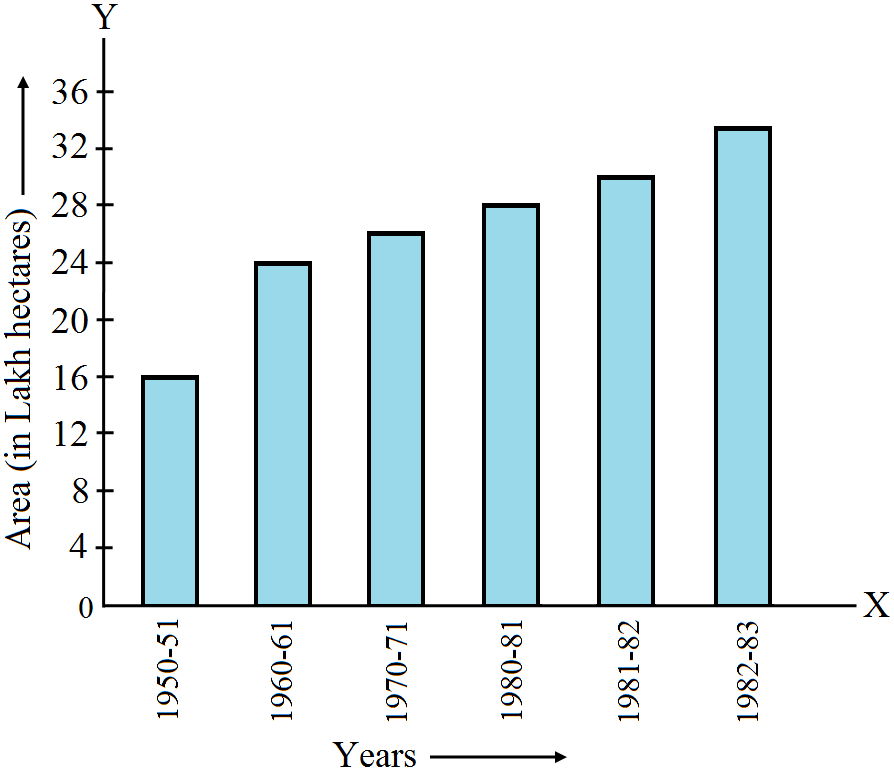
Read the following bar graph and answer the following questions:
  1. What is the information given by the bar graph?
  2. State each of the following whether true or false.
  1. The number of government companies in 1957 is that of 1982 is 1 : 9.
  2. The number of government companies has decreased over the year 1957 to 1983.
View full solution
The investments (in ten crores of rupees) of Life Insurance Corporation of India in different sectors is given below:
Sectors
Investment (in ten crores of rupess)
Central government securities
45
State government securities
11
Securities guaranteed by the government
23
Private sectors
18
Socially oriented sectors (plan)
46
Socially oriented sectors (Non–plan)
11
Represent the above data with the help of a bar graph.
View full solution
The population of Delhi State in different census years is as given below:
Census year
1961
1971
1981
1991
2001
Population in Lakhs
30
55
70
110
150
Represent the above information with the help of a bar graph.
View full solution
The expenditure (in 10 crores of rupees) on health by the Government of India during the various five-year plans is shown below: 
Plans
I
II
III
IV
V
VI
Expenditure on health(in 10 crores of rupees)
7
14
23
34
76
182
Construct a bar graph to represent the above data.
View full solution
The following data gives the value (in crores of rupees) of the Indian export of cotton textiles for different years: 
Years
1982–83
1983–84
1984–85
1985–86
1986–87
Value of exports of cotton textiles (in crores of rupees)
300
325
475
450
550
Represent the above data with the help of a bar graph. Indicate with the help of a bar graph the year in which the rate of increase in exports is maximum over the preceding year.
View full solution
The following data gives the amount of manure (in thousand tonnes) manufactured by a company during some years:
Year
1992
1993
1994
1995
1996
1997
Manure (in thousand tonnes)
15
35
45
30
40
20
  1. Represent the above data with the help of a bar graph.
  2. Indicate with the help of the bar graph the year in which the amount of manufactured by the company was maximum.
  3. Choose the correct alternative:
The consecutive years during which there was the maximum decrease in manure production are:
  1. 1994 and 1995
  2. 1992 and 1993
  3. 1996 and 1997
  4. 1995 and 1996
View full solution
The following table shows the daily production of T.V. sets in an industry for 7 days of a week:
Day
Mon
Tue
Wed
Thurs
Fri
Sat
Sun
Number of T.V. Sets
300
400
150
250
100
350
200
Represent the above information by a pictograph.
View full solution
The production of oil (in lakh tonnes) in some of the refineries in India during 1982 was given below:
Refinery
Barauni
Koyali
Mathura
Mumbai
Florida
Production of oil (in lakh tonnes)
30
70
40
45
25
Construct a bar graph to represent the above data so that the bars are drawn horizontally.
View full solution
The income and expenditure for 5 years of a family is given in the following data:
Years
1995–96
1996–97
1997–98
1998–99
1999–2000
Income (Rs. In thousands)
100
140
150
170
210
Expenditure (Rs. in thousands)
80
130
145
160
190
Represent the above data by a bar graph.
View full solution
The following table shows the interest paid by a company (in lakhs):
Year
1995–96
1996–97
1997–98
1998–99
1999–2000
Interest (in lakhs of rupees)
20
25
15
18
30
Draw the bar graph to represent the above information.
View full solution
The following table gives the route length (in thousand kilometres) of the Indian Railways in some of the years:
Year 1960-61 1970-71 1980-81 1990-91 2000-2001
Route lenght (in thousand Km) 56 60 61 74 98
Represent the above data with the help of a bar graph.
View full solution

Generate a Graphical Representation of Statistical Data paper free

Pick question groups from the list above, set marks and difficulty, and export a branded PDF with step-by-step answer keys. First 3 chapters free — no signup.

Download App