Questions

5 Marks Questions

🎯

Test yourself on this topic

7 questions · timed · auto-graded

Question 15 Marks
A transversal intersects two parallel lines. Prove that the bisectors of any pair of corresponding angles so formed are parallel.
Answer
Given Two lines AB and CD are parallel and intersected by transversal t at P and 0, respectively. Also, EP and FQ are the bisectors of angles $\angle\text{APG}$ and $\angle\text{CQP},$respectively.
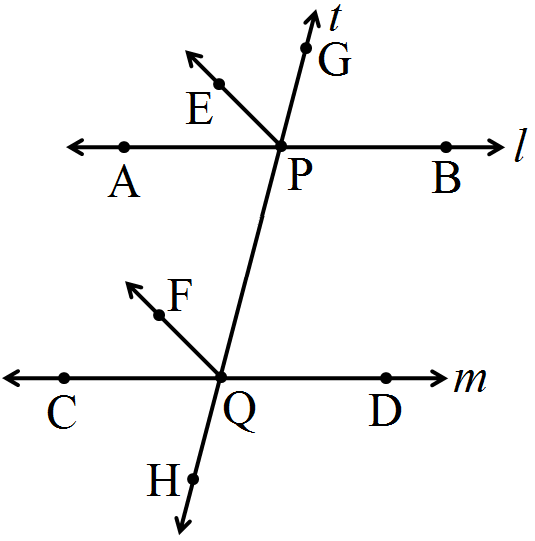
To prove $\text{EP}||\text{FQ}$ Proof Given, $\text{AB}||\text{CD}$ $\Rightarrow\angle\text{APG}=\angle\text{CQP}$ [corresponding angles] $\Rightarrow\frac{1}{2}\angle\text{APG}=\frac{1}{2}\angle\text{CQP}$ [dividing both sides by 2] $\Rightarrow\angle\text{EPG}=\angle\text{FQP}$ $\big[\because$ EP and FQ are the bisectors of $\angle\text{APG} $ and $\angle\text{CQP},$ respectively$\big]$ As these, are the corresponding angles on the transversal line t. $\text{EP}||\text{FQ}$ Hence proved.
View full question & answer
Question 25 Marks
Prove that two lines that are respectively perpendicular to two intersecting lines intersect each other.
[Hint: Use proof by contradiction].
Answer
Given: Let lines l and m are two intersecting lines. Again, let n and p be another two lines which are perpendicular to the intersecting lines meet at point D.
To prove: Two lines n and p intersecting at a point.
Proof: Let us consider lines n and p are not intersecting, then it means they are parallel to each other i.e., n || p.....(1)
Since, lines n and p are perpendicular to m and l respectively.
But from equation (1), n || p, it implies that l and m. It is a contradiction.
Thus, our assumption is wrong. Hence, lines n and p intersect at a point.
View full question & answer
Question 35 Marks
Bisectors of interior $\angle\text{B}$ and exterior $\angle\text{ACD}$ of a $\Delta\text{ABC}$ intersect at the point T. Prove that,
$\angle\text{BTC}=\frac{1}{2}\angle\text{BAC}.$
Answer
Given In AABC, produce SC to D and the bisectors of $\angle\text{ABC}$ and $\angle\text{ACD}$ meet at point T. To prove $\angle\text{BTC}=\frac{1}{2}\angle\text{BAC}$
Proof In $\Delta\text{ABC},$$\angle\text{C}$ is an exterior angle.
$\therefore\angle\text{ACD}=\angle\text{ABC}+\angle\text{CAB}$
[exterior angle of a triangle is equal to the sum of two opposite angles]
$\Rightarrow\frac{1}{2}\angle\text{ACD}=\frac{1}{2}\angle\text{CAB}+\frac{1}{2}\angle\text{ABC}$ [dividing both sides by 2]
$\Rightarrow\angle\text{TCD}=\frac{1}{2}\angle\text{CAB}+\frac{1}{2}\angle\text{ABC}..(\text{i})$
$\big[\because$ is a bisector of $\angle\text{ACD}\Rightarrow\frac{1}{2}\angle\text{ACD}=\angle\text{TCD}\big]$
In $\Delta\text{BTC},$ $\angle\text{TCD}=\angle\text{BTC}+\angle\text{CBT}$
[exterior angle of a triangle is equal to the sum of two opposite interior angles
$\Rightarrow\angle\text{TCD}=\angle\text{BTC}+\frac{1}{2}\angle\text{ABC}...(\text{ii})$ 
$\big[\because$ BT bisects of $\angle\text{ABC}\Rightarrow\angle\text{CBT}=\frac{1}{2}\angle\text{ABC}\big]$
From Eqs. (i) and (ii) ,
$\frac{1}{2}\angle\text{CAB}+\frac{1}{2}\angle\text{ABC}=\angle\text{BTC}+\frac{1}{2}\angle\text{ABC}$
$\Rightarrow\angle\text{BTC}=\frac{1}{2}\angle\text{CAB}$
or $\angle\text{BTC}=\frac{1}{2}\angle\text{BAC}$
View full question & answer
Question 45 Marks
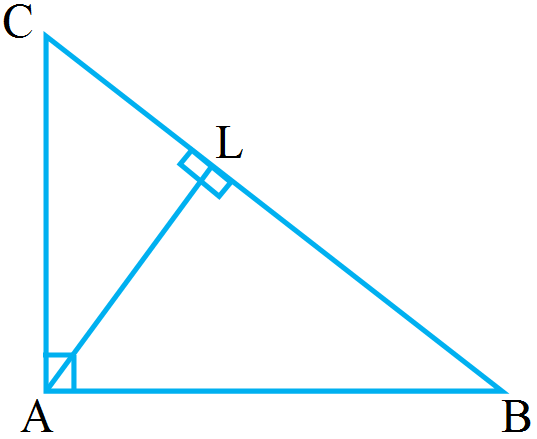
A triangle ABC is right angled at A. L is a point on BC such that AL $\perp$ BC. Prove that $\angle\text{BAL}=\angle\text{ACB}.$
Answer
Given: ABC is a triangle right angled at A. AL is drawn perpendicular to BC. To Prove: $\angle\text{BAL}=\angle\text{ACB}$
Proof: In triangle ALB, $\angle\text{ALB}+\angle\text{BAL}+\text{ABL}=180^\circ$ | Angle sum property of a triangle $\Rightarrow90^\circ+\angle\text{BAL}+\angle\text{ABC}=180^\circ$ $\Rightarrow\angle\text{BAL}+\angle\text{ABC}=90^\circ...(1)$ In triangle ABC, $\angle\text{BAC}+\angle\text{ACB}+\angle\text{ABC}=180^\circ$ | Angle sum property of a triangle $\Rightarrow90^\circ+\angle\text{ACB}+\angle\text{ABC}=180^\circ$ $\Rightarrow\angle\text{BAL}+\angle\text{ABC}=\angle\text{ACB}+\angle\text{ABC}$ $\Rightarrow\angle\text{BAL}=\angle\text{ACB}$
View full question & answer
Question 55 Marks
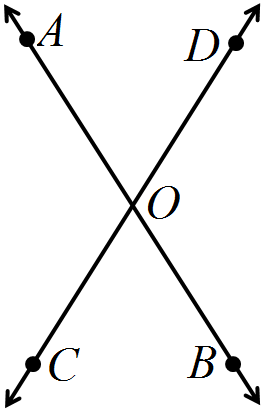
If two lines intersect, prove that the vertically opposite angles are equal.
Answer
Given Two lines AB and CD intersect at point O.To prove:
  1. $\angle\text{AOC}=\angle\text{BOD}$
  2.  $\angle\text{AOD}=\angle\text{BOC}$
Proof:
  1.  Since, ray OA stands on line CD.
$\angle\text{AOC}+\angle\text{AOD}=180^\circ$ [linear pair axiom].....(i)
Since, ray OD stands on line AB.
$\therefore\angle\text{AOD}+\angle\text{BOD}=180^\circ$ [linear pair axiom].....(ii)
From Eqs. (i) and (ii).
$\angle\text{AOC}+\angle\text{AOD}=\angle\text{AOD}+\angle\text{BOD}$
$\Rightarrow\angle\text{AOC}=\angle\text{BOD}$
  1. Since, ray OD stands on line AB.
$\therefore\angle\text{AOD}+\angle\text{BOD}=180^\circ$ [linear pair axiom]...(iii)
Since, ray OB stands on line CD.
$\therefore\angle\text{DOB}+\angle\text{BOC}=180^\circ....(\text{iv})$
From Eqs. (iii) and (iv),
$\angle\text{AOD}+\angle\text{BOD}=\angle\text{DOD}+\angle\text{BOC}$ 
$\Rightarrow\angle\text{AOD}=\angle\text{BOC}$
Hence proved.
View full question & answer
Question 65 Marks
The angles of a triangle are in the ratio 2 : 3 : 4. Find the angles of the triangle.
Answer
Given: Ratio of angles is 2 : 3 : 4.
To find: Angles of triangle.
Proof: The ratio of angles of a triangle is 2 : 3 : 4.
Let the angles of a triangle be $\angle\text{A},$ $\angle\text{B}$ and $\angle\text{C}$
Therefore, $\angle\text{A}=2\text{x},$ then $\angle\text{B}=3\text{x}$ and $\angle\text{C}=4\text{x}.$
In $\Delta\text{ABC},\angle\text{A}+\angle\text{B}+\angle\text{C}=180^\circ$ $[\because$ sum of angles of a triangle is 180°$]$
$\therefore2\text{x}+3\text{x}+4\text{x}=180^\circ$
$\Rightarrow9\text{x}=180^\circ\Rightarrow\text{x}=\frac{180^\circ}{9}=20^\circ$
$\therefore\ \angle\text{A}=2\text{x}=2\times20^\circ=40^\circ$
$\angle\text{B}=3\text{x}=3\times20^\circ=60^\circ$
And $\angle\text{C}=4\text{x}=4\times20^\circ=80^\circ$
Hense, the angles of the triangles are 40°, 60° and 80°. 
View full question & answer
Question 75 Marks
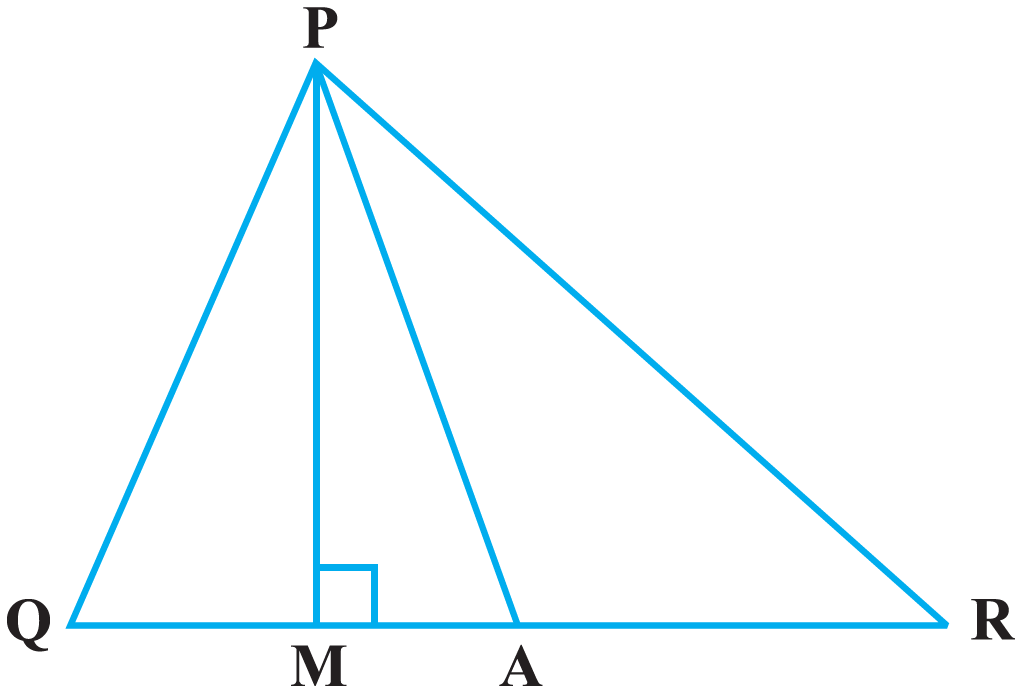
In Fig. $\angle\text{Q}>\angle\text{R},$ PA is the bisector of $\angle\text{QPR}$ and $\text{PM}\perp\text{QR}$ Prove that $\angle\text{APM}=\frac{1}{2}(\angle\text{Q}-\angle\text{R}).$
Answer
Given In $\Delta\text{PQR},\angle\text{Q}>\angle\text{R},$PA is the bisector of $\angle\text{QPR}$ and $\text{PM}\perp\text{QR}.$ 
To prove $\angle\text{APM}=\frac{1}{2}(\angle\text{Q}-\angle\text{R})$ 
Proof Since, PA is the bisector of $\angle\text{QPR}.$
$\therefore\ \angle\text{QPA}=\angle\text{APR}$
In $\Delta\text{PQM},$ $\angle\text{PQM}+\angle\text{PMQ}+\angle\text{QPM}=180^\circ...(\text{i})$
[by angle sum property of a triangle]
$\Rightarrow\angle\text{PQM}+90^\circ+\angle\text{QPM}=180^\circ$ $\big[\because\ \text{PM}\perp\text{QR}\Rightarrow\angle\text{PMQ}=90^\circ\big]$
$\Rightarrow\angle\text{PQM}=90^\circ-\angle\text{QPM}...(\text{ii})$
In $\Delta\text{PMR},$
$\angle\text{PMR}+\angle\text{PRM}+\angle\text{RPM}=180^\circ$
[by angle sum property of a triangle]
$\Rightarrow90^\circ+\angle\text{PRM}+\angle\text{RPM}=180^\circ$ $\big[\because\ \text{PM}\perp\text{QR}\Rightarrow\angle\text{PMR}=90^\circ\big]$
$\Rightarrow\angle\text{PRM}=180^\circ-90^\circ-\angle\text{RPM}$
$\Rightarrow\angle\text{PRM}=90^\circ-\angle\text{RPM}..(\text{iii})$
On subtracting Eq. (iii) from Eq. (ii), we get 
$\angle\text{Q}-\angle\text{R}=(90^\circ-\angle\text{QPM})-(90^\circ-\angle\text{RPM})$
$\big[$ where $\angle\text{PQM}=\angle\text{Q}$ and $\angle\text{PRM}=\angle\text{R}\big]$
$\Rightarrow\angle\text{Q}-\angle\text{R}=\angle\text{RPM}-\angle\text{QPM}$
$\Rightarrow\angle\text{Q}-\angle\text{R}=\big[\angle\text{RPA}+\angle\text{APM}\big]-\big[\angle\text{QPA}-\angle\text{APM}\big]..(\text{iv})$
$\Rightarrow\angle\text{Q}-\angle\text{R}=\angle\text{QPAS}+\angle\text{APM}-\angle\text{QPA}+\angle\text{APM}$
[by using Eq. (i)]
$\Rightarrow\angle\text{Q}-\angle\text{R}=2\angle\text{APM}$
$\therefore\angle\text{APM}=\frac{1}{2}(\angle\text{Q}-\angle\text{R})$
View full question & answer
5 Marks Questions - MATHS STD 9 Questions - Vidyadip