Question 11 Mark
Represent the following rational numbers on the number line:
$\frac{8}{3}$
Answer$\frac{8}{3}=2\frac{2}{3}$
View full question & answer→Question 21 Mark
Simplify:
$(3^4)^{\frac{1}{4}}$
Answer$(3^4)^{\frac{1}{4}}=3^{\big(4\times\frac{1}{4}\big)}=(3)^1=3$
View full question & answer→Question 31 Mark
Classify the following number as rational or irrational. give reasons to support your answer.
$\sqrt{\frac{3}{81}}$
Answer$\sqrt{\frac{3}{81}}$
$\sqrt{\frac{3}{81}}=\sqrt{\frac{1}{27}}=\frac{1}{3}\sqrt{\frac{1}{3}}$
It is an irrational number.
View full question & answer→Question 41 Mark
Classify the following number as rational or irrational. give reasons to support your answer.
4.1276
Answer4.1276
It is a terminating decimal. Hence, it is rational.
View full question & answer→Question 51 Mark
Classify the following number as rational or irrational. give reasons to support your answer.
6.834837...
Answer6.834837... It is neither terminating, nor repeating hence it is irrational number.
View full question & answer→Question 61 Mark
Without actual division, find the following rational numbers are terminating decimals. $\frac{31}{375}$
Answer$\frac{31}{375}$
Denominator of $\frac{31}{375}$ is $375.$
$375 = 5^3 \times 3$
So, the prime factor $375$ are $5$ and $3$.
Thus$, \frac{31}{375}$ is not a terminating decimal.
View full question & answer→Question 71 Mark
Evaluate:
$\big(125\big)^{\frac{1}{3}}$
Answer$\big(125\big)^{\frac{1}{3}}=(5^3)^{\frac{1}{3}}=5^{3\times\frac{1}{3}}=5^1=5$
View full question & answer→Question 81 Mark
Classify the following number as rational or irrational. give reasons to support your answer.
3.040040004...
Answer3.040040004... is an irrational number because it is a non-terminating, non-repeating decimal.
View full question & answer→Question 91 Mark
Rationalise the denominator of the following:
$\frac{1}{\sqrt{7}}$
AnswerOn multiplying the numerator and denominator of the given number by $\sqrt{7},$ we get
$\frac{1}{\sqrt{7}}=\frac{1}{\sqrt{7}}\times\frac{\sqrt{7}}{\sqrt{7}}=\frac{\sqrt{7}}{7}.$
View full question & answer→Question 101 Mark
Is zero a rational number? Justify.
AnswerYes, 0 is a rational number.
0 can be expressed in the form of the fraction $\frac{\text{p}}{\text{q}},$ where p = 0 and q can be any integer except 0.
View full question & answer→Question 111 Mark
Simplify $\big(2\sqrt{5}+3\sqrt{2}\big)^2.$
Answer$\big(2\sqrt{5}+3\sqrt{2}\big)^2$
$=\big(2\sqrt{5}\big)^2+2\times2\sqrt{5}\times3\sqrt{2}+\big(3\sqrt{2}\big)^2$
$=20+12\sqrt{10}+18$
$=38+12\sqrt{10}$
View full question & answer→Question 121 Mark
Give an example of two irrational numbers whose:
Quotient is a rational number.
Answer2 irrational numbers with quotient a rational number will be $\sqrt{63}$ and $\sqrt{7}$
View full question & answer→Question 131 Mark
Classify the following number as rational or irrational. give reasons to support your answer.
$\frac{22}{7}$
Answer$\frac{22}{7}$ is a rational number because it can be expressed in the $\frac{\text{p}}{\text{q}}$ form.
View full question & answer→Question 141 Mark
Without actual division, find the following rational numbers are terminating decimals.
$\frac{16}{125}$
Answer$\frac{16}{125}$
Denominator of $\frac{16}{125}$ is $125$.
And$, 125 = 5^3$
Therefore$, 125$ has no other factors than $2$ and $5.$
Thus$, \frac{16}{125}$ is a terminating decimal.
View full question & answer→Question 151 Mark
Give an example of two irrational numbers whose:
Product is a rational number.
Answer2 irrational numbers with product a rational number will be $5+\sqrt{7}$ and $5-\sqrt{7}$
View full question & answer→Question 161 Mark
Simplify:
$6^\frac{1}{2}\times7^\frac{1}{2}$
Answer$6^\frac{1}{2}\times7^\frac{1}{2}=(6\times7)^{\frac{1}{2}}=(42)^{\frac{1}{2}}$
View full question & answer→Question 171 Mark
Represent the following rational numbers on the number line:
$\frac{5}{7}$
Answer$\frac{5}{7}$
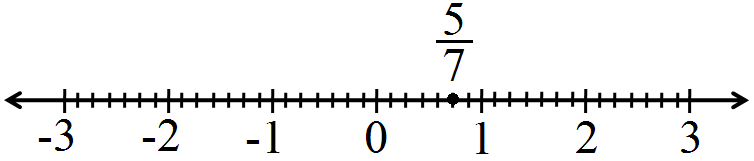
View full question & answer→Question 181 Mark
Simplify:
$3^\frac{1}{4}\times5^\frac{1}{4}$
Answer$3^\frac{1}{4}\times5^\frac{1}{4}=(3\times5)^{\frac{1}{4}}=(15)^{\frac{1}{4}}$
View full question & answer→Question 191 Mark
Give an example of two irrational numbers whose:
Difference is a rational number.
Answer2 irrational numbers with difference is a rational number will be $5+\sqrt{3}$ and $2+\sqrt{3}$
View full question & answer→Question 201 Mark
Give an example of two irrational numbers whose:
Difference is an irrational number.
Answer2 irrational numbers with difference an irrational number will be $3-\sqrt{5}$ and $3+\sqrt{5}.$
View full question & answer→Question 211 Mark
Without actual division, find the following rational numbers are terminating decimals.
$\frac{5}{12}$
Answer$\frac{5}{12}$
Denominator of $\frac{5}{12}$ is $12$.
And,
$12 = 2^2 \times 3$
So, $12$ has a prime factor $3$, which is other than $2$ and $5$.
Thus, $\frac{5}{12}$ is not a terminating decimal.
View full question & answer→Question 221 Mark
Rationalise $\frac{1}{\sqrt{3}+\sqrt{2}}.$
Answer$\frac{1}{\sqrt{3}+\sqrt{2}}=\frac{1}{\sqrt{3}+\sqrt{2}}\times\frac{\sqrt{3}-\sqrt{2}}{\sqrt{3}-\sqrt{2}}$
$=\frac{\sqrt{3}-\sqrt{2}}{\big(\sqrt{3}\big)^2-\big(\sqrt{2}\big)^2}$
$=\frac{\sqrt{3}-\sqrt{2}}{3-2}$
$=\sqrt{3}-\sqrt{2}$
View full question & answer→Question 231 Mark
Represent the following rational numbers on the number line:
$-2.4$
Answer$-2.4=\frac{-24}{10}=\frac{-12}{5}=-2\frac{2}{5}$
View full question & answer→Question 241 Mark
Find two irrational numbers between 0.16 and 0.17.
AnswerTwo irrational numbers between 0.16 and 0.17 are as follows: 0.1611161111611111611111... and 0.169669666...
View full question & answer→Question 251 Mark
Evaluate:
$\big(64\big)^{\frac{1}{6}}$
Answer$\big(64\big)^{\frac{1}{6}}=(2^6)^{\frac{1}{6}}=2^{\big(6\times\frac{1}{6}\big)}=2^1=2$
View full question & answer→Question 261 Mark
Solve: $\big(3-\sqrt{11}\big)\big(3+\sqrt{11}\big).$
Answer$\big(3-\sqrt{11}\big)\big(3+\sqrt{11}\big)$
$=3^2-\big(\sqrt{11}\big)^2$
$=9-11$
$=-2$
View full question & answer→Question 271 Mark
Without actual division, find the following rational numbers are terminating decimals.
$\frac{7}{24}$
Answer$\frac{7}{24}$
Denominator of $\frac{7}{24}$ is $24.$
And,
$24 = 2^3 \times 3$
So, $24$ has a prime factor $3,$ which is other than $2$ and $5.$
Thus, $\frac{7}{24}$ is not a terminating decimal.
View full question & answer→Question 281 Mark
Evaluate:
$\big(64\big)^{-\frac{1}{2}}$
Answer$\big(64\big)^{-\frac{1}{2}}=\frac{1}{\big(64\big)^{\frac{1}{2}}}=\frac{1}{\big(8^2\big)^{\frac{1}{2}}}=\frac{1}{\big(8\big)^{2\times\frac{1}{2}}}$
$=\frac{1}{8^1}=\frac{1}{8}$
View full question & answer→Question 291 Mark
Give an example of two irrational numbers whose:
Quotient is an irrational number.
Answer2 irrational numbers with quotient an irrational number will be $\sqrt{15}$ and $\sqrt{5}$
View full question & answer→Question 301 Mark
Find an irrational number between 5 and 6.
AnswerAn irrational number between 5 and 6 $=\sqrt{5\times6}=\sqrt{30}$
View full question & answer→Question 311 Mark
Give an example of two irrational numbers whose:
Product is an irrational number.
Answer2 irrational numbers with product an irrational number will be $6+\sqrt{3}$ and $7-\sqrt{3}$
View full question & answer→Question 321 Mark
Give an example of two irrational numbers whose:
Sum is an irrational number.
Answer2 irrational numbers with sum an irrational number $7+\sqrt{5}$ and $\sqrt{6}-8$
View full question & answer→Question 331 Mark
Rationalise the denominator of the following:
$\frac{\sqrt{5}}{2\sqrt{3}}$
AnswerOn multiplying the numerator and denominator of the given number by $\sqrt{3},$ we get
$\frac{\sqrt{5}}{2\sqrt{3}}=\frac{\sqrt{5}}{2\sqrt{3}}\times\frac{\sqrt{3}}{\sqrt{3}}=\frac{\sqrt{15}}{2\times3}=\frac{\sqrt{15}}{6}$
View full question & answer→Question 341 Mark
Simplify $\Big(\frac{3125}{243}\Big)^{\frac{4}{5}}.$
Answer$\Big(\frac{3125}{243}\Big)^{\frac{4}{5}}$
$=\Big(\frac{5^5}{3^5}\Big)^{\frac{4}{5}}$
$=\Big(\frac{5}{3}\Big)^{5\times\frac{4}{5}}$
$=\Big(\frac{5}{3}\Big)^4$
$=\frac{625}{81}$
View full question & answer→Question 351 Mark
Classify the following number as rational or irrational. give reasons to support your answer.
$\sqrt{1.44}$
Answer$\sqrt{1.44}=1.2$
So, it is rational.
View full question & answer→Question 361 Mark
Simplify:
$(14641)^{0.25}$
Answer$(14641)^{0.25}$
$=(14641)^{\frac{1}{4}}$
$=(11^4)^{\frac{1}{4}}$
$=11^{4\times\frac{1}{4}}$
$=11$
View full question & answer→Question 371 Mark
Without actual division, find the following rational numbers are terminating decimals.
$\frac{13}{80}$
Answer$\frac{13}{80}$
Denominator of $\frac{13}{80}$ is $80.$
And,
$80 = 2^4 \times 5$
Therefore, $80$ has no other factors than $2$ and $5.$
Thus, $\frac{13}{80}$ is a terminating decimal.
View full question & answer→Question 381 Mark
Simplify:
$\frac{5^{\frac{6}{7}}}{5^{\frac{2}{3}}}$
Answer$\frac{5^{\frac{6}{7}}}{5^{\frac{2}{3}}}=5^{\big(\frac{6}{7}-\frac{2}{3}\big)}$
$=5^{\big(\frac{18-14}{21}\big)}=5^{\frac{4}{21}}$
View full question & answer→Question 391 Mark
Simplify:
$2^\frac{2}{3}\times2^\frac{1}{5}$
Answer$2^\frac{2}{3}\times2^\frac{1}{5}$
$=2^{\frac{2}{3}+\frac{1}{5}}$
$=2^{\frac{10+3}{15}}$
$=2^{\frac{13}{15}}$
View full question & answer→Question 401 Mark
Simplify:
$\frac{8^{\frac{1}{2}}}{8^{\frac{2}{3}}}$
Answer$\frac{8^{\frac{1}{2}}}{8^{\frac{2}{3}}}=8^{\big(\frac{1}{2}-\frac{2}{3}\big)}$
$=8^{\big(\frac{3-4}{6}\big)}=8^{\frac{-1}{6}}$
View full question & answer→Question 411 Mark
Classify the following number as rational or irrational. give reasons to support your answer.
1.23232333...
Answer1.23232333... is an irrational number because it is a non−terminating, non−repeating decimal.
View full question & answer→Question 421 Mark
Simplify $\sqrt[4]{81\text{x}^8\text{y}^4\text{z}^{16}}.$
Answer$\sqrt[4]{81\text{x}^8\text{y}^4\text{z}^{16}}$
$=\sqrt[4]{3^4(\text{x}^2)^4\text{y}^4(\text{z}^4)^4}$
$=\sqrt[4]{(3\text{x}^2\text{y}\text{z}^4)^4}$
$=(3\text{x}^2\text{y}\text{z}^4)^{4\times\frac{1}{4}}$
$=3\text{x}^2\text{y}\text{z}^4$
View full question & answer→Question 431 Mark
Write the rationalising factor of the denominator in $\frac{1}{\sqrt{2}+\sqrt{3}}.$
AnswerThe rationalising factor of the denominator in $\frac{1}{\sqrt{2}+\sqrt{3}}$ is $\big(\sqrt{2}-\sqrt{3}\big).$
View full question & answer→Question 441 Mark
Add:
$\Big(\frac{2}{3}\sqrt{7}-\frac{1}{2}\sqrt{2}+6\sqrt{11}\Big)$ and $\Big(\frac{1}{3}\sqrt{7}+\frac{3}{2}\sqrt{2}-\sqrt{11}\Big)$
AnswerWe have:
$\Big(\frac{2}{3}\sqrt{7}-\frac{1}{2}\sqrt{2}+6\sqrt{11}\Big)+\Big(\frac{1}{3}\sqrt{7}+\frac{3}{2}\sqrt{2}-\sqrt{11}\Big)$
$=\Big(\frac{2}{3}\sqrt{7}+\frac{1}{3}\sqrt{7}\Big)+\Big(-\frac{1}{2}\sqrt{2}+\frac{3}{2}\sqrt{2}\Big)+\big(6\sqrt{11}-\sqrt{11}\big)$
$=\Big(\frac{2}{3}+\frac{1}{3}\Big)\sqrt{7}+\Big(-\frac{1}{2}+\frac{3}{2}\Big)\sqrt{2}+(6-1)\sqrt{11}$
$=\sqrt{7}+\sqrt{2}+5\sqrt{11}$
View full question & answer→Question 451 Mark
Evaluate $\Big(\frac{81}{49}\Big)^{\frac{-3}{2}}.$
Answer$\Big(\frac{81}{49}\Big)^{\frac{-3}{2}}$
$=\Big(\frac{49}{81}\Big)^{\frac{3}{2}}$
$=\Big(\frac{7^2}{9^2}\Big)^{\frac{3}{2}}$
$=\Big(\frac{7}{9}\Big)^{2\times\frac{3}{2}}$
$=\Big(\frac{7}{9}\Big)^3$
$=\frac{343}{729}$
View full question & answer→Question 461 Mark
Represent the following rational numbers on the number line:
$1.3$
Answer$1.3=\frac{13}{10}=1\frac{3}{10}$
View full question & answer→Question 471 Mark
Simplify $\sqrt[4]{\sqrt[3]{\text{x}^2}}$ and express the result in the exponential form of x.
Answer$\sqrt[4]{\sqrt[3]{\text{x}^2}}$ $=\Big(\sqrt[3]{\text{x}^2}\Big)^\frac{1}{4}$ $=\big(\text{x}^2\big)^{\frac{1}{3}\times\frac{1}{4}}$ $=\text{x}^{2\times\frac{1}{12}}$ $=\text{x}^\frac{1}{6}$
View full question & answer→Question 481 Mark
Simplify $(32)^\frac{1}{5}+(-7)^0+(64)^{\frac{1}{2}}.$
Answer$(32)^\frac{1}{5}+(-7)^0+(64)^{\frac{1}{2}}$
$=(2^5)^{\frac{1}{5}}+1+(8^2)^{\frac{1}{2}}$
$=2^{5\times\frac{1}{5}}+1+8^{2\times\frac{1}{2}}$
$=2+1+8$
$=11$
View full question & answer→Question 491 Mark
If $a = 1, b = 2$ then find the value of $(a^b + b^a)^{-1}.$
AnswerGiven, $a = 1$ and $b = 2$
$\therefore(\text{a}^{\text{b}}+\text{b}^{\text{a}})^{-1}$
$=\frac{1}{\text{a}^{\text{b}}+\text{b}^{\text{a}}}$
$=\frac{1}{1^2+2^1}$
$=\frac{1}{1+2}$
$=\frac{1}{3}$
View full question & answer→Question 501 Mark
Simplify $6\sqrt{36}+5\sqrt{12}$
Answer$6\sqrt{3}+5\sqrt{12}$
$=6\sqrt{3}+5\sqrt{4\times3}$
$=6\sqrt{3}+5\times2\sqrt{3}$
$=6\sqrt{3}+10\sqrt{3}$
$=16\sqrt{3}$
View full question & answer→