Question 15 Marks
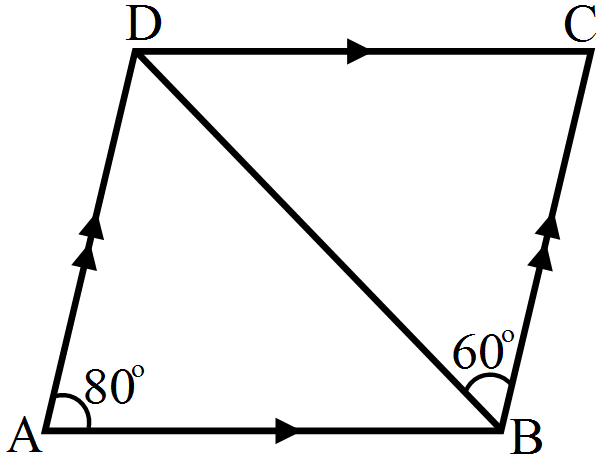
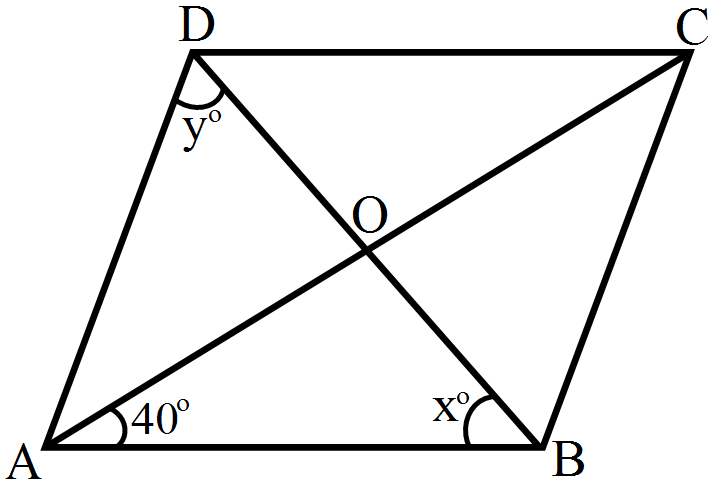
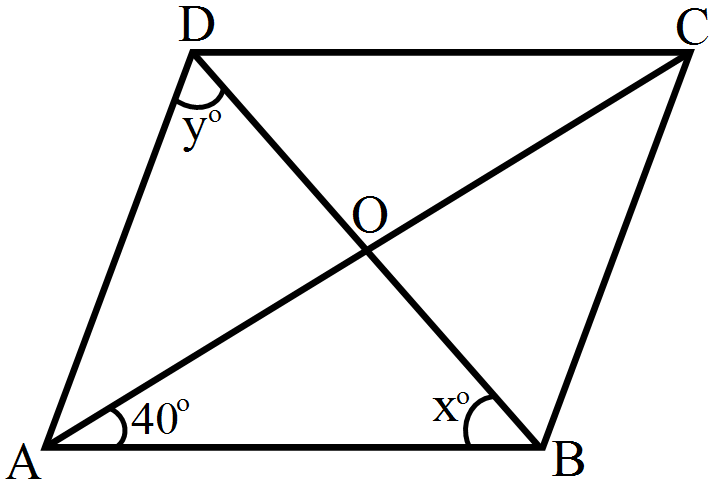
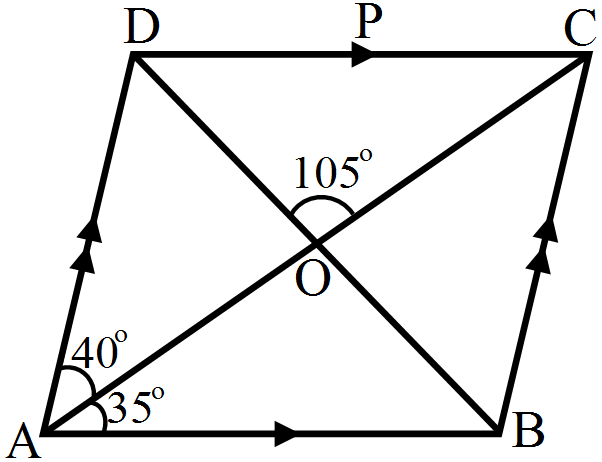
In the adjoining figure, ABCD is a parallelogram in which $\angle\text{DAB}=80^{\circ}$ and $\angle\text{DBC}=60^{\circ}.$ Calculate $\angle\text{CDB}$ and $\angle\text{ADB}.$
Answer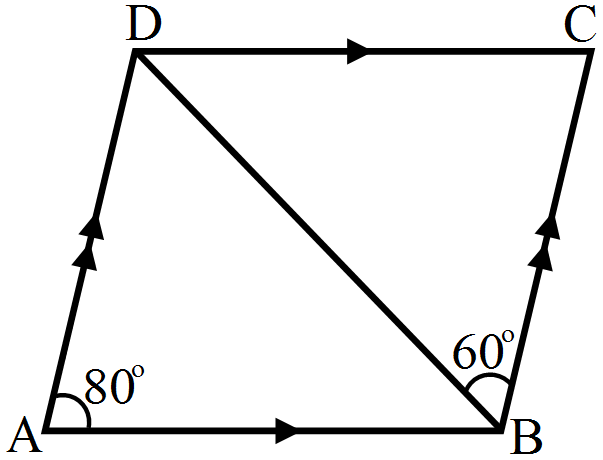
ABCD is a parallelogram,
so opposite angles are equal.
$\therefore\angle\text{C}=\angle\text{A}=80^{\circ}$
As AD || BC and BD is a transversal.
So, $\angle\text{ADB}=\angle\text{DBC}=60^{\circ}$ [Alternate angles]
In $\triangle\text{ABD}$
$\angle\text{A}+\angle\text{ADB}+\angle\text{ABD}=180^{\circ}$
$\Rightarrow80^{\circ}+60^{\circ}+\angle\text{ABD}=180^{\circ}$
$\Rightarrow140^{\circ}+\angle\text{ABD}=180^{\circ}$
$\Rightarrow\angle\text{ABD}=180^{\circ}-140^{\circ}=40^{\circ}$
$\therefore\angle\text{ABC}=\angle\text{ABD}+\angle\text{DBC}$
$=40^{\circ}+60^{\circ}=100^{\circ}$
In a parallelogarm, opposite angles are equal.
So, $\angle\text{ADC}=\angle\text{ABC}=\angle100^{\circ}$
$\therefore\angle\text{CDB}=\angle\text{ADC}-\angle\text{ADB}$
$=100^{\circ}-60^{\circ}=40^{\circ}$
and $\angle\text{ADB}=60^{\circ}.$
View full question & answer→ABCD is a parallelogram,
so opposite angles are equal.
$\therefore\angle\text{C}=\angle\text{A}=80^{\circ}$
As AD || BC and BD is a transversal.
So, $\angle\text{ADB}=\angle\text{DBC}=60^{\circ}$ [Alternate angles]
In $\triangle\text{ABD}$
$\angle\text{A}+\angle\text{ADB}+\angle\text{ABD}=180^{\circ}$
$\Rightarrow80^{\circ}+60^{\circ}+\angle\text{ABD}=180^{\circ}$
$\Rightarrow140^{\circ}+\angle\text{ABD}=180^{\circ}$
$\Rightarrow\angle\text{ABD}=180^{\circ}-140^{\circ}=40^{\circ}$
$\therefore\angle\text{ABC}=\angle\text{ABD}+\angle\text{DBC}$
$=40^{\circ}+60^{\circ}=100^{\circ}$
In a parallelogarm, opposite angles are equal.
So, $\angle\text{ADC}=\angle\text{ABC}=\angle100^{\circ}$
$\therefore\angle\text{CDB}=\angle\text{ADC}-\angle\text{ADB}$
$=100^{\circ}-60^{\circ}=40^{\circ}$
and $\angle\text{ADB}=60^{\circ}.$
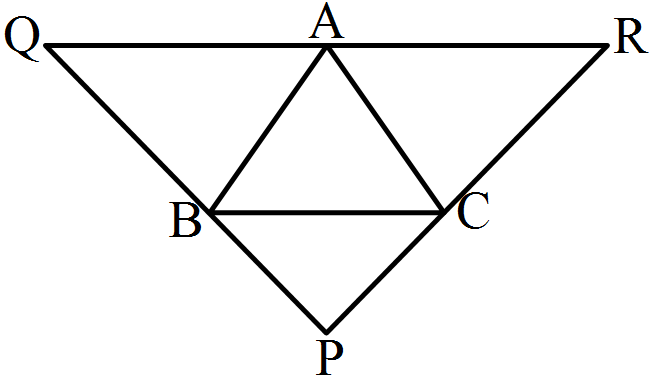
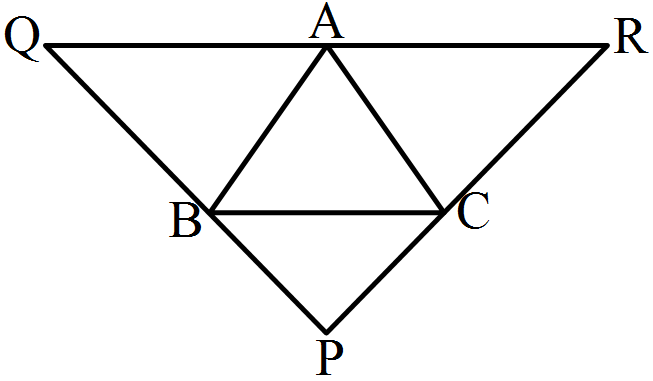
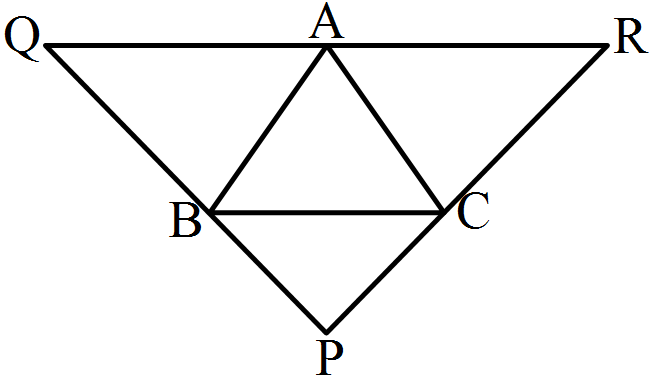
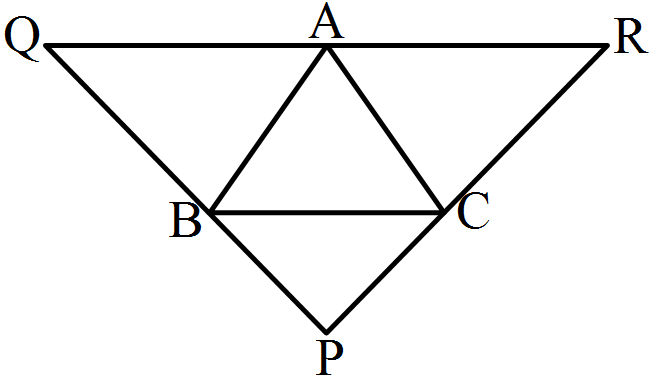 To prove: $\text{BC}=\frac{1}{2}\text{QR}$
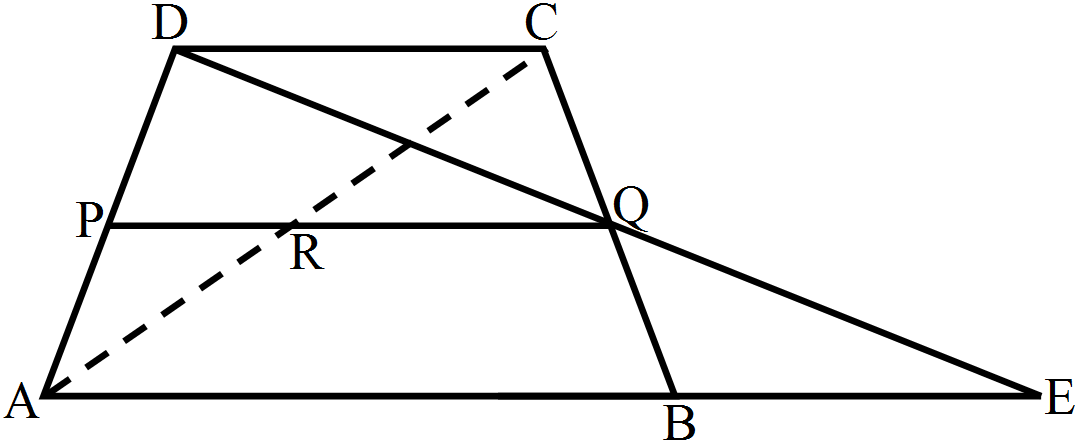
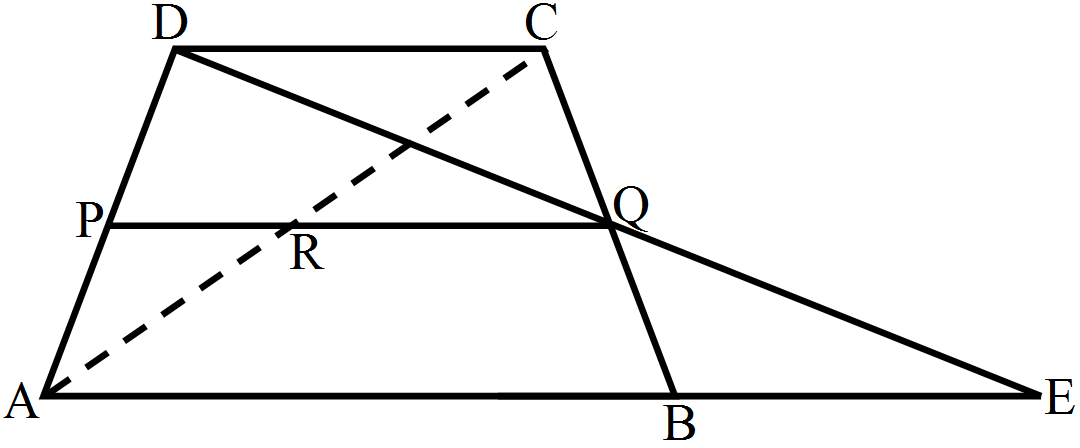 To prove: DQ = QE PR || AB AR = RC Proof:
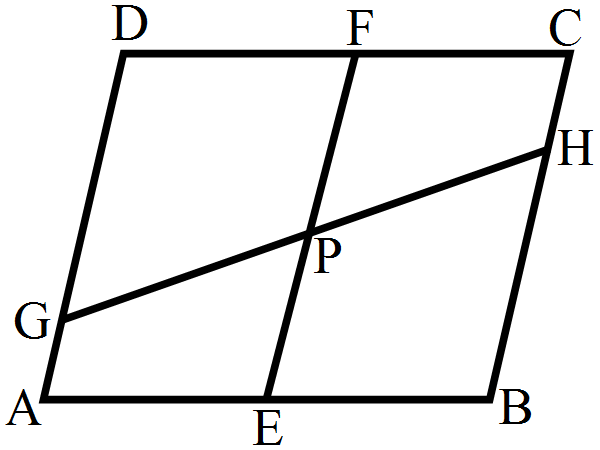
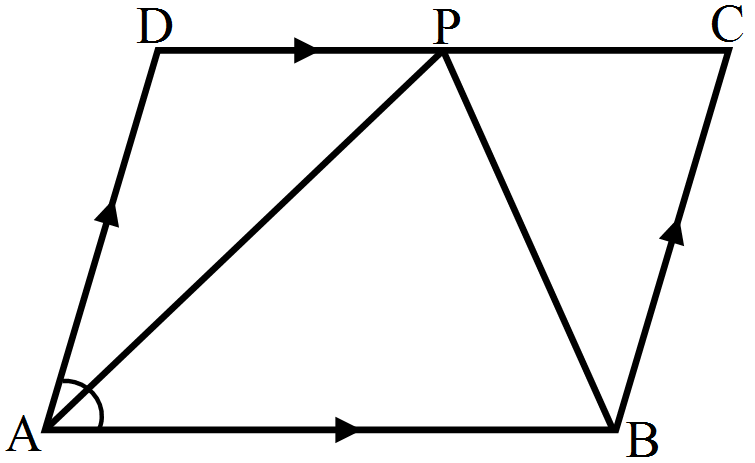
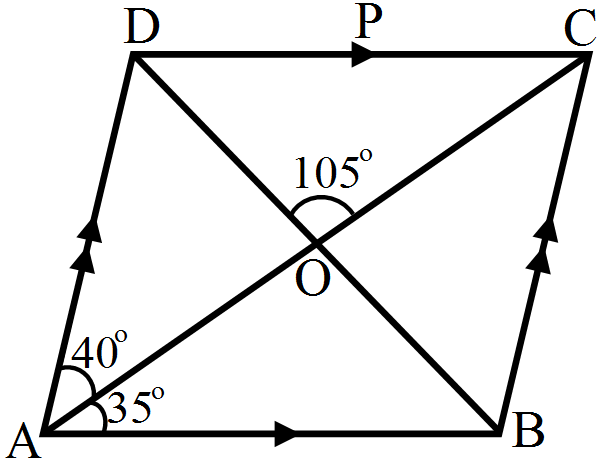
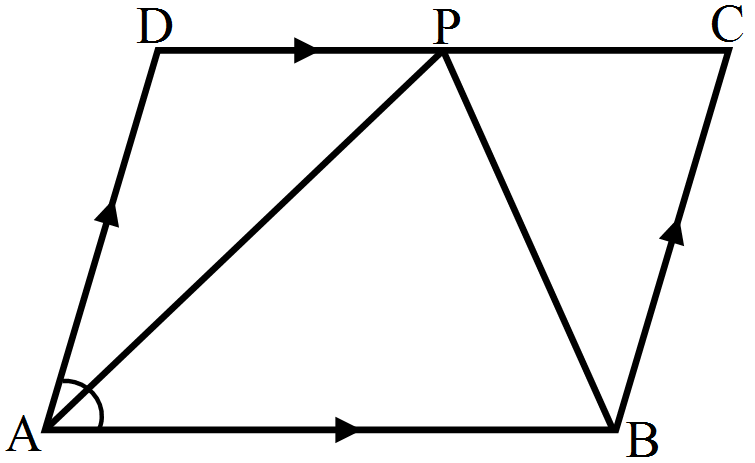 ABCD is a parallelogram in which DA = 60° and bisectore of A and B meets DC at P.
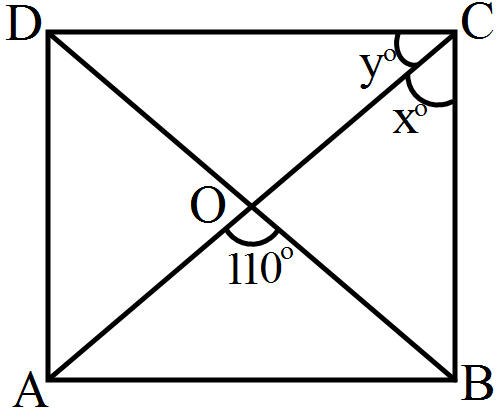
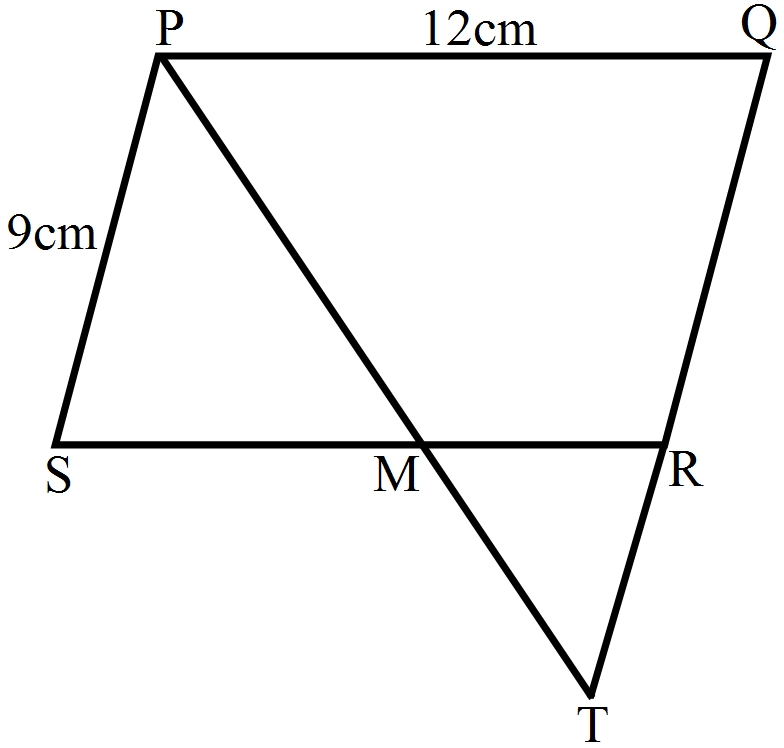 PM is the bisector of $\angle\text{P}.$
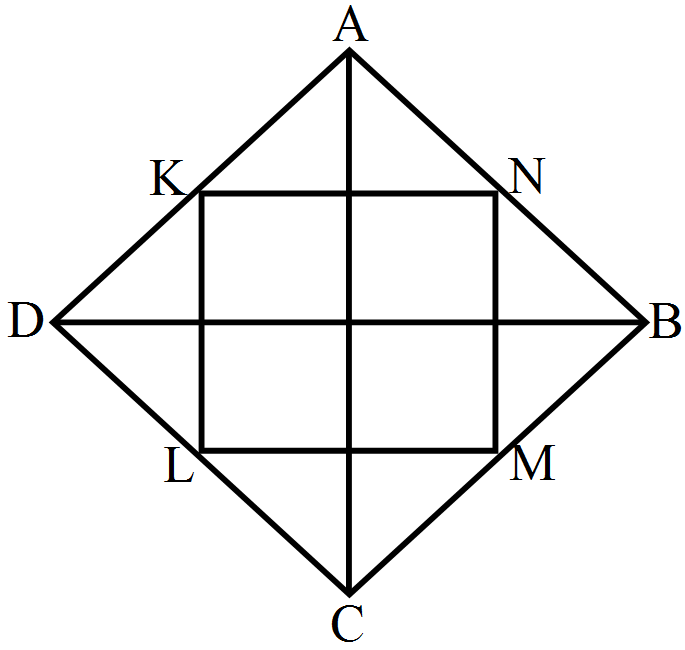
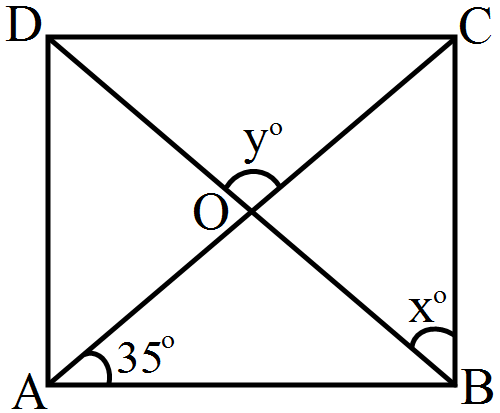 We know that diagonals of a rectangle are equal and bisect each other.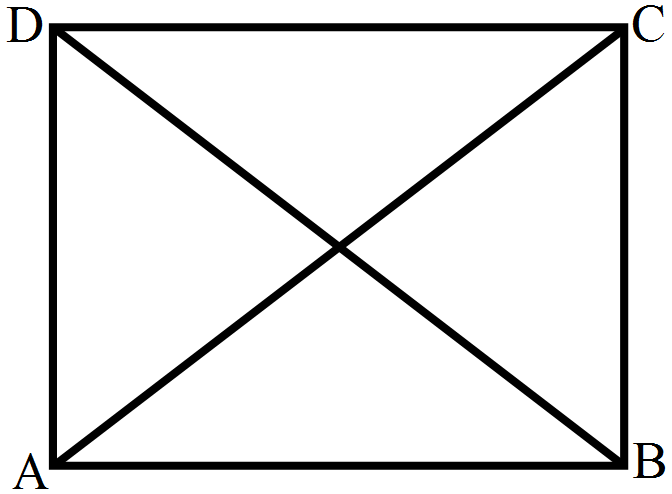
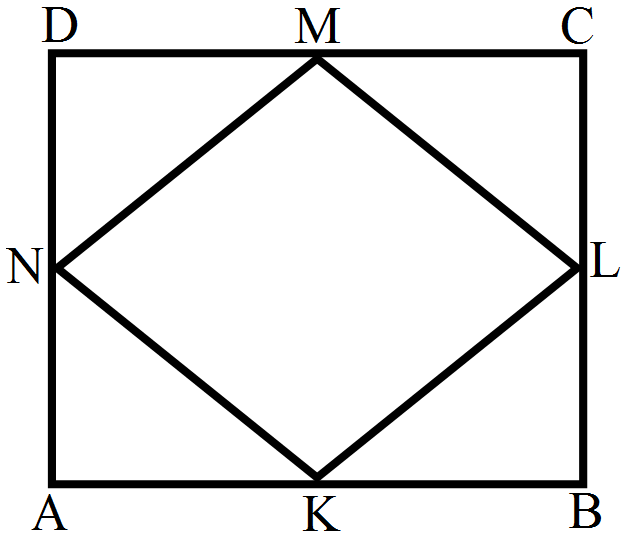 $\text{AK = BL = CM = DN}$ (given)
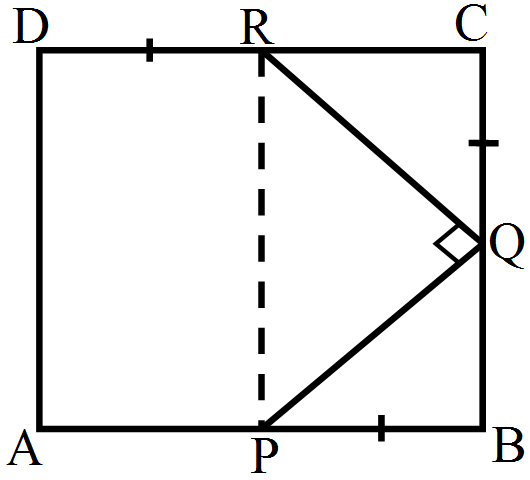
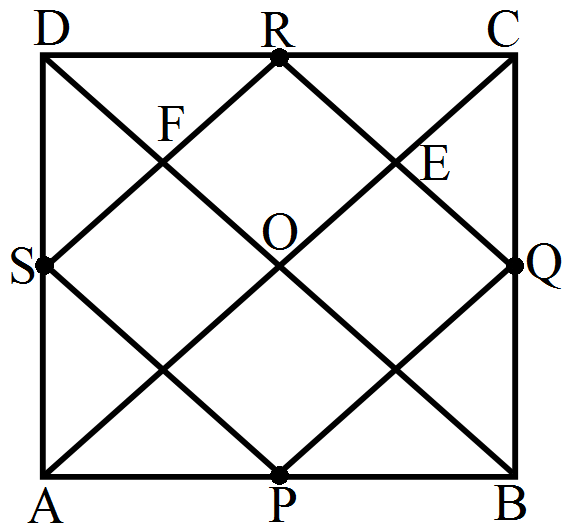 Let ABCD be a square and P, Q, R and S be the midpoints of AB, BC, CD and DA,respectively.
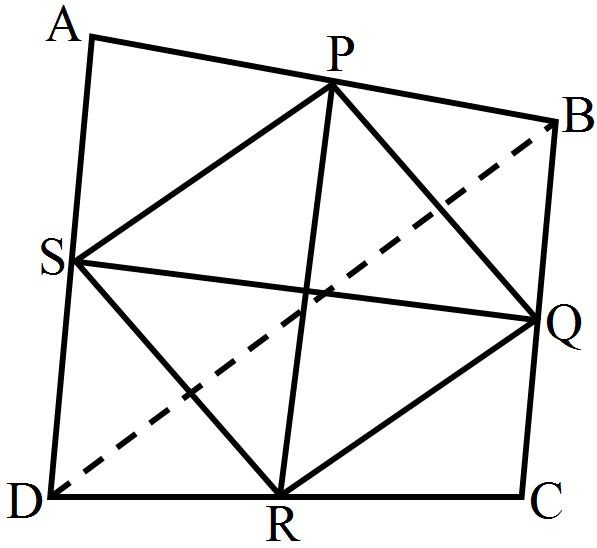
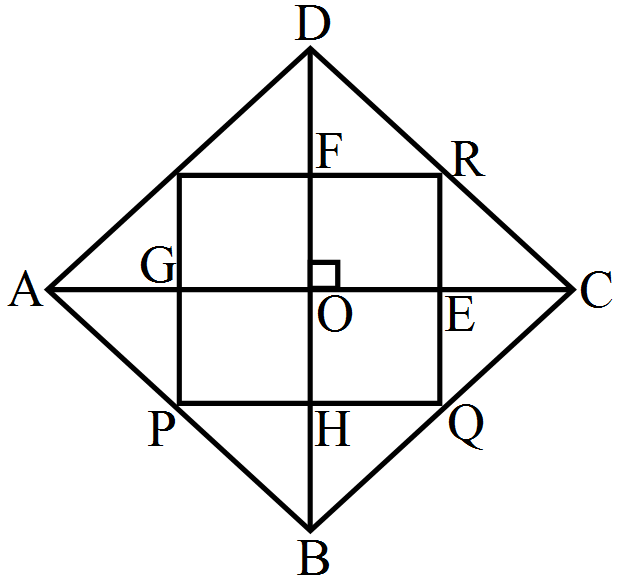
 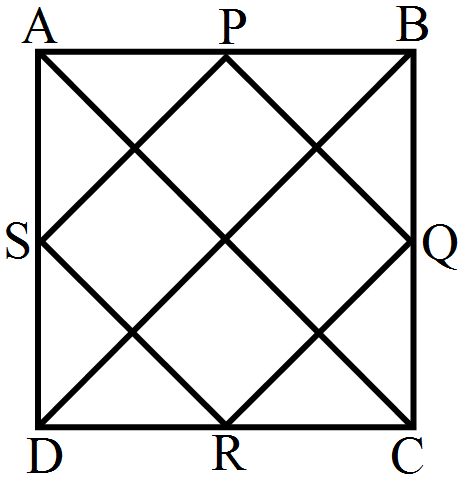 Given: In quadrilateral ABCD, AC = BD and $\text{AC}\perp\text{BD}.$ P, Q, R and S are the mid-points of AB, BC, CD and AD, respectively.
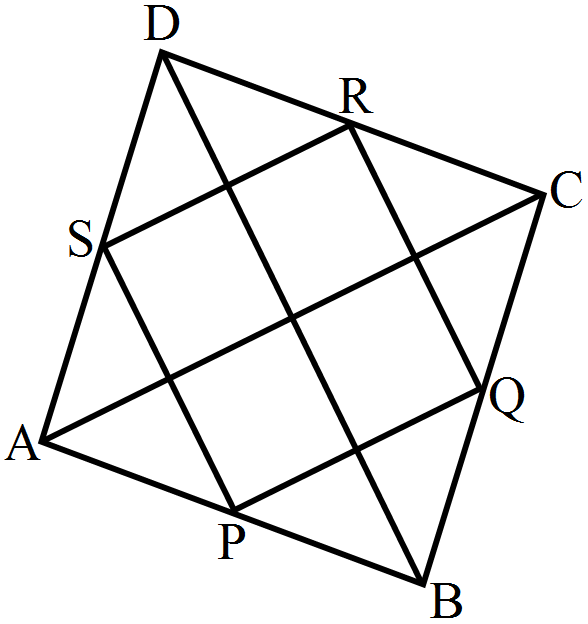 Given: In quadrilateral ABCD, $\text{AC}\perp\text{BD},$ P, Q, R and S are the mid-points of AB, BC, CD and AD, respectively.
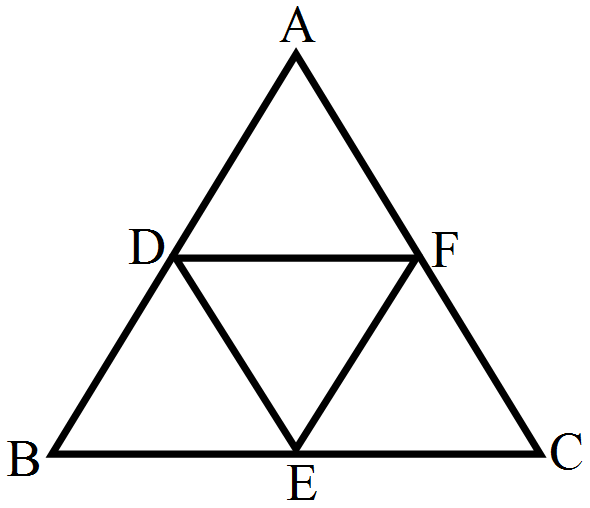 As, D and Eare the mid points of sides AB, and BC of $\triangle\text{ABC}.$