Question 11 Mark
Three statements are given below:
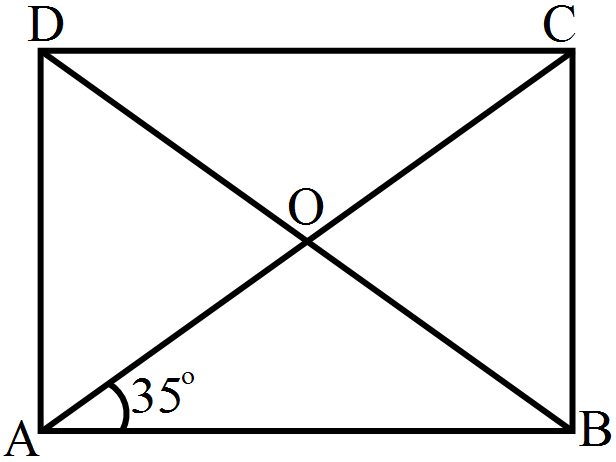
- In a rectangle ABCD, the diagonal AC bisects $\angle\text{A}$ as well as $\angle\text{C}.$
- In a square ABCD, the diagonal AC bisects $\angle\text{A}$ as well as $\angle\text{C}.$
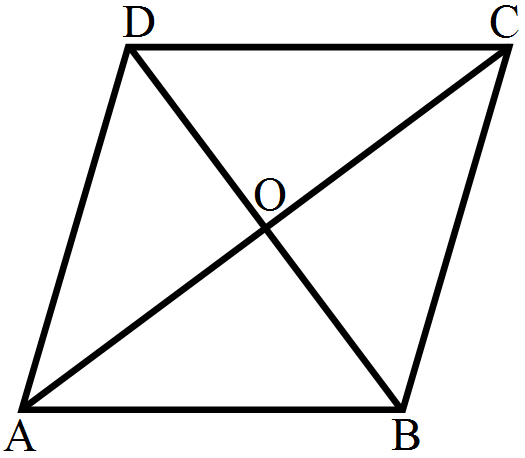
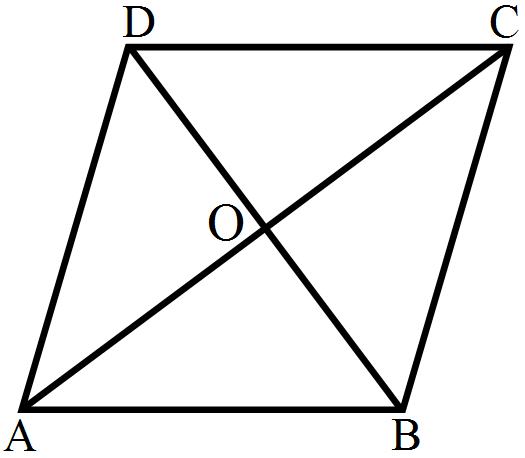
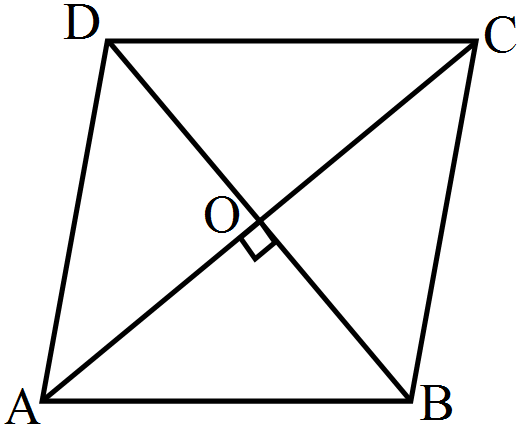
- In a rhombus ABCD, the diagonal AC bisects $\angle\text{A}$ as well as $\angle\text{C}.$
- I only
- II and III
- I and III
- I and II
Answer
Consider I.
We know that, in a rectangle the diagonals are not bisectors of each other, since the adjacent side.
Thus, I is false.
Consider II.
We know that, in a square the diagonals bisect the opposite angles.
So, in a square ABCD, the diagonals AC bisects $\angle\text{A}$ as well as $\angle\text{C}.$
Thus, II is true.
Consider III.
We know that, in a rhombus the diagonals bisect the opposite angles.
So, in a rhombus ABCD, the diagonals AC bisects $\angle\text{A}$ as well as $\angle\text{C}.$
Thus, III is true.
View full question & answer→- II and III
Consider I.
We know that, in a rectangle the diagonals are not bisectors of each other, since the adjacent side.
Thus, I is false.
Consider II.
We know that, in a square the diagonals bisect the opposite angles.
So, in a square ABCD, the diagonals AC bisects $\angle\text{A}$ as well as $\angle\text{C}.$
Thus, II is true.
Consider III.
We know that, in a rhombus the diagonals bisect the opposite angles.
So, in a rhombus ABCD, the diagonals AC bisects $\angle\text{A}$ as well as $\angle\text{C}.$
Thus, III is true.