Question 11 Mark
If a sphere is inscribed in a cube, then the ratio of the volume of the sphere to the volume of the cube is:
Answer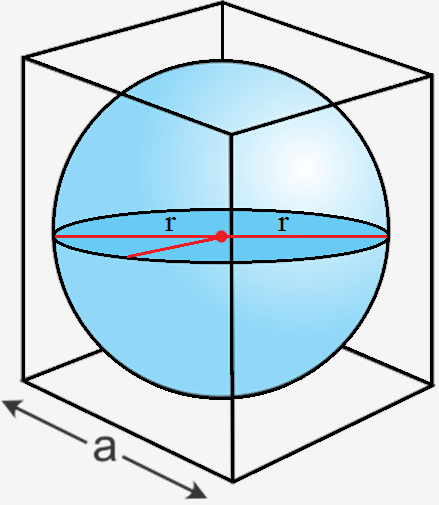
Edge of cube $= a$
$\Rightarrow$ Volume of cube $= a^3$
If Sphere is inscribed inside cube then $a =2\text{r}$
$\Rightarrow\text{r}=\frac{\text{a}}{2}$
Volume of sphere $=\frac{4}{3}\pi\text{r}^3=\frac{4}{3}\pi\Big(\frac{\text{a}}{2}\Big)^3=\frac{\pi}{6}\text{ a}^3$
Ratio of volume of sphere to volume of cube $=\frac{\frac{\pi}{6}\text{a}^3}{\text{a}^3}\frac{\pi}{6}$ View full question & answer→Question 21 Mark
A cylindrical rod whose height is 8 times of its radius is melted and recast into spherical balls of same radius. The number of balls will be
Answer
- 6
Solution:
Volume of cylindrical rod $=\pi\text{r}^\text{h}$
$=\pi\text{r}^2(8\text{r})$ [h = 8r (given)]
$=8\pi\text{r}^3$
Now, if spherical balls have same radius, then the volume of one ball $=\frac{4}{3}\pi\text{r}^3$
$\therefore$ No. of balls $=\frac{\text{Volume of Cylindrical Rod}}{\text{Volume of one Rod}}=\frac{8\pi\text{r}^3}{\frac{4}{3}\pi\text{r}^3}=6$
Hence, correct option is (c). View full question & answer→Question 31 Mark
The volume of a cylinder of radius r is $\frac{1}{4}$ of the volume of a rectangular box with a square base of side length x. If the cylinder and the box have equal heights, what is r in terms of x?
Answer
- $\frac{\text{x}}{2\sqrt{\pi}}$
Solution:
Area of base of cylinder $=\pi\text{r}^2$
Area of base of box $=\text{x}^2$
Let the height of both objects = h
Then, $\text{v}_\text{cylinder}=\pi\text{r}^2\text{h}$
$\text{v}_\text{box}=\text{x}^2\text{h}$
Now, $\text{v}_\text{cylinder}=\frac{1}{4}\text{v}_\text{box}$
$\Rightarrow\pi\text{r}^2\not\text{h}=\frac{1}{4}\text{x}^2\not\text{h}$
$\Rightarrow\text{r}^2=\frac{\text{x}^2}{4\pi}$
$\Rightarrow\text{r}=\frac{\text{x}}{2\sqrt{\pi}}$ View full question & answer→Question 41 Mark
To make a closed hollow cone of base radius $7\ cm$ and height $24\ cm,$ the area of metal sheet required is:
AnswerGiven,
$r = 7\ cm, h = 24\ cm$
So, slant height, $\text{l}=\sqrt{\text{r}^2+\text{h}^2}$
$=\sqrt{7^2+24^2}$
$=\sqrt{49+576}$
$=\sqrt{625}$
$=25\text{ cm}$
So, surface area of hollow cone $=$ curved surface area $+$ area of base
$=\pi\text{rl}+\pi\text{r}^2$
$=\pi\text{r}(\text{l}+\text{r})$
$=\frac{22}{7}\times7(25+7)$
$=22\times32$
$=704\text{ cm}^2$
View full question & answer→Question 51 Mark
A sphere of diameter 12.6cm is melted and cast into a right circular cone of height 25.2cm. The radius of the base of the cone is:
Answer
- 6.3cm
Solution:
Radius of the sphere = 6.3cm
Volume of a sphere $=\frac{4}{3}\pi\text{r}^3$
Volume of a sphere $=\frac{4}{3}\pi(6.3)^3\text{cm}^3$
Volume of a cone $=\frac{1}{3\pi\text{r}^2\text{h}}$
Volume of a cone $=\frac{1}{3\pi\text{r}^2\text{h}}\times25.2$
$=8.4\pi\text{r}^2\text{cm}^3$
On recasting a sphere into a cone, volume will remain same
$8.4\pi\text{r}^2=\frac{4}{3}(6.3)^3$
$\Rightarrow\text{r}^2=\frac{4}{3}(6.3)^3\times\frac{1}{8.4}=39.69$
$\Rightarrow\text{r}=6.3\text{cm}$ View full question & answer→Question 61 Mark
The volume of a sphere is numerically equal to its surface area, then its diameter is:
Answer
- 6 units.
Solution:
Volume of sphere = surface area of sphere
$\frac{4}{3\pi\text{r}^3}=4\pi\text{r}^2$
r = 3 units
So, diameter = 6 units View full question & answer→Question 71 Mark
He surface areas of two spheres are in the ratio $16 : 9.$ The ratio of their volumes is:
AnswerLet $r_1$ and $r_2$ be the radius of the two spheres, respectively.
Therefore, the ratio of their surface Areas,
$\frac{4\pi\text{r}^2_1}{4\pi\text{r}^2_2}=\frac{16}{19}$
$\Rightarrow\frac{\text{r}^2_1}{\text{r}^3_2}=\frac{(4)^2}{(3)^2}\frac{\text{r}^1}{\text{r}^2}=\frac{4}{3}$
Now, ratio of their Volumes
$\frac{4\pi\text{r}^3_1}{4\pi\text{r}^3_2}=\frac{\text{r}^2_1}{\text{r}^3_2}=\Big(\frac{\text{r}^1}{\text{r}^2}\Big)^3=\big(\frac{4}{3}\big)^3=\frac{64}{27}$
$=64:27$
View full question & answer→Question 81 Mark
A cube of side $4\ cm$ contains a sphere touching its sides. Find the approximate volume of the gap in between.
AnswerGap between the two $=$ volume of cube $-$ volume of sphere
$=$ edge$^3-\frac{14}{3}\pi\text{r}^3$
$=4^3-\frac{4}{3}\times\frac{22}{7}\times2^3 ($sphere touches cube, so diameter of sphere would be $4)$
$= 64 - 33.52$
$= 30.48\ cm^3$
View full question & answer→Question 91 Mark
The diameter of a right circular cylinder is 21cm and its height is 8cm. The Volume of the cylinder is:
Answer
- 2772 cu.cm
Solution:
Volume of cylinder, $\text{V}=\pi\text{r}^2\text{h}\ (\text{Where }\pi =\frac{22}{7})$
Given diameter, d = 21cm, height, h = 8cm
For radius, $\text{r}=\frac{\text{d}}{2}=\frac{21}{2}$
$\text{V}=\Big(\frac{22}{7}\Big)\times\Big(\frac{21}{2}\Big)^2\times8=2772\text{ cu cm}$ View full question & answer→Question 101 Mark
If the diameter of the base of a closed right circular cylinder be equal to its height h, then its whole surface area is:
Answer
- $\frac{3}{2}\pi\text{rh}^2$
Solution:
Let r be the radius of the cylinder and h be its height
It is given that
$2\text{r}=\text{h}\Rightarrow\text{r}=\frac{\text{h}}{2}$
Therefore, total surface area S is:
$\text{S}=2\pi\text{r}^2+2\pi\text{rh}$
$\Rightarrow\text{S}=2\pi\text{r}+(\text{r}+\text{h})$
$\Rightarrow\text{S}=2\pi\times(\frac{\text{h}}{2}+\text{h})$
$\Rightarrow\text{S}=\frac{3\pi\text{h}^2}{2}$ View full question & answer→Question 111 Mark
The volume of a cylinder of radius r is $\frac{1}{4}$ of the volume of a rectangular box with a square base of side length $x.$ If the cylinder and the box have equal heights, what is r in terms of $x$?
AnswerLet $V_1$ be the volume of the cylinder with radius r and height h, then
$\text{V}_1=\pi\text{r}^2\text{h}...(\text{i})$
Now, let $V_2$ be the volume of the box, then
$V_2 = x^2h$
It is given that $\text{V}_1=\frac{1}{4}\text{V}_2$
Therefore, $\pi\text{r}^2\text{h}=\frac{1}{4}\text{x}^2\text{h}$
$\Rightarrow\text{r}^2=\frac{\text{x}^2}{4\pi}$
$\Rightarrow\text{r}=\frac{\text{x}}{2{\sqrt{\pi}}}$
View full question & answer→Question 121 Mark
If the curved surface area of a cylinder is $1760\ cm^2$ and its base radius is $14\ cm$ then its height is:
AnswerCurved surface area $= 1760\ cm^2$
Suppose that $h \ cm$ is the height of the cylinder.
Then we have:
$2\pi\text{rh}=1760$
$\Rightarrow2\times\frac{22}{7}\times14\times\text{h}=1760$
$\Rightarrow\text{h}=\frac{1760\text{x}}{44\times14}$
$=20\text{ cm}$
View full question & answer→Question 131 Mark
The number of spherical bullets each 5dm in diameter which can be cast from a rectangular block of lead 11m long, 10m broad and 5 high is:
Answer
- 8400.
Solution:
Here, radius of spherical bullets = 2.5dm or 0.25m(1dm = 0.1m)
Let the number of bullets be n
Now, volume of n number of bullets = volume of rectangular block
$\text{n}\times\frac{4}{3}\pi\text{r}^3=\text{l}\times\text{b}\times\text{h}$
$\text{n}\times\frac{4}{3}\times\frac{22}{7}\times0.25\times0.25\times0.25=11\times10\times5$
$\text{n}=\frac{11\times10\times5\times21}{88\times0.25\times0.25\times0.25}$
$\text{n}=8400$ View full question & answer→Question 141 Mark
If a cone is cut into two parts by a horizontal plane passing through the mid$-$point of its axis, the ratio of the volumes of upper and lower part is:
Answer$\therefore\triangle\text{PDC}\sim\triangle\text{PBA}(\text{AA axiom)}$
And $O$' is mid point $PO$
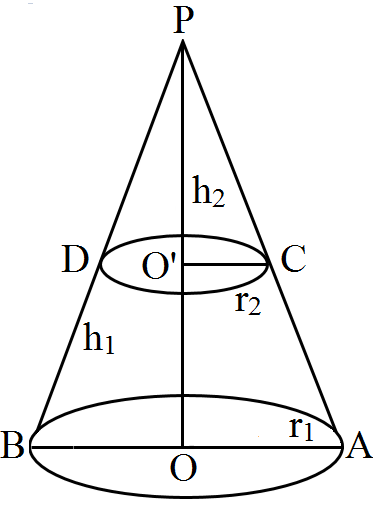
And $\text{O}'\text{C}=\frac{1}{2}\text{OA}$
$\Rightarrow\text{r}_2=\frac{1}{2}\text{r}_1$
And $\text{P}\text{O}'=\frac{1}{2}\text{PO}$
$\Rightarrow\text{h}_2=\frac{1}{2}\text{h}_1$
Let$ V_1$ and $V_2$ be the volume of cone $\text{PBA}$ and $\text{PDC}$ respectively
$\text{v}_1=\frac{1}{3}\pi\text{r}^2_1\text{h}_1$
$\text{V}_1=\frac{1}{3}\pi\text{r}^2_1\text{h}_1$
$=\frac{1}{3}\pi\big(\frac{\text{r}_1}{2}\big)^2\Big(\frac{\text{h}_1}{2}\Big)$
$=\frac{1}{3}\pi\frac{\text{r}^2_1\text{h}_1}{4\times2}$
$=\frac{1}{8\times3}\pi\text{r}^2_1\text{h}_1$
$\therefore$ Volume of $\text{DCAB} =\frac{1}{3}\pi\text{r}^2_1\text{h}_1-\frac{1}{24}\pi\text{r}^2_1\text{h}_1$
$=\frac{7}{24}\text{r}^2_1\text{h}_1$
$\therefore$ Ratio between upper part and lower part
$-\frac{1}{24}\pi\text{r}^2_1\text{h}_1:\frac{1}{3}\pi\text{r}^2_1\text{h}_1$
$=\frac{1}{24}:\frac{7}{24}$
$=1:7$ View full question & answer→Question 151 Mark
Two steel sheets each of length $a_1$ and breadth $a_2$ are used to prepare the surfaces of two right circular cylinders $-$ one having volume $v_1$ and height $a_2$ and other having volume $v_2$ and height $a_1.$ Then:
AnswerSurface area of both cylinder is going to be same because same sheet is used.
$S.A = a_1a_2$
Surface area of cylinder is same
$\text{S}_1=(2\pi\text{r}_1)\text{a}_2=\text{a}_1\text{a}_2...(1)$
$\text{S}_2=(2\pi\text{r}_2)\text{a}_2=\text{a}_1\text{a}_2...(2)$
From equation $(1) (2)$
$2\pi\text{r}_1=\text{a}_1$ and $2\pi\text{r}_2=\text{a}_2$
Volume of cylinder $1, \text{v}_1=(\pi\text{r}_1^2)\text{a}_2...(3)$
Volume of cylinder $2, \text{v}_2=(\pi\text{r}_2^2)\text{a}_1...(4)$
Divinding equation $(3)$ by equation $(4)$
$\frac{\text{V}_1}{\text{V}_2}=\frac{\text{r}_1^2}{\text{r}_2^2}\frac{\text{a}_2}{\text{a}_1}=\frac{\Big(\frac{\text {a}_1}{\not2\pi}\Big)^2}{\Big(\frac{\text{a}_2}{\not2\pi}\Big)^2}\frac{\text{a}_2}{\text{a}_1}$
$=\frac{\text{a}_1\not2}{\text{a}_2\not2}\times \frac{\not\text{a}_2^2}{\not\text{a}_1}=\frac{\text{a}_1}{\text{a}_2}$
$\Rightarrow\text{a}_2\text{v}_1=\text{a}_1\text{v}_2$
View full question & answer→Question 161 Mark
The sum of the length, breadth and depth of a cuboid is $19\ cm$ and its diagonal is $5\sqrt{5}\text{cm}.$ Its surface area is:
Answer$l \rightarrow$ Length of the cuboid
$b \rightarrow$ Breadth of the cuboid
$h \rightarrow$ Height of the cuboid
We have,
$l + b + h = 19\ cm,$ diagonal of the cuboid $\Big(\sqrt{\text{l}^2+\text{b}^2+\text{h}^2}\Big)$
$=5\sqrt{5}\text{cm}$
We are asked to find the surface area,
$= 2(lb + bh + hl)$
$= (l + b + h)^2 - (l^2 + b^2 + h^2)$
$=(\text{l}+\text{b}+\text{h})^2=\Big(\sqrt{\text{l}^2+\text{b}^2+\text{h}^2}\Big)$
$=19^2=\Big(5\sqrt{5}\Big)^2$
$= 361 = 125$
$= 236\text{ cm}^2$
Thus, the surface area is $236\ cm^2.$
View full question & answer→Question 171 Mark
The length, breadth and height of a cuboid are $15\ m, 6\ m$ and $5\ dm$ respectively. The lateral area of the cuboid is:
AnswerLateral surface area of the cuboid $= 2(l + b) \times h$
$=2(15+6)\times\frac{5}{10} ...\Big(1\text{ dm}=\frac{1}{10}\text{ m}\Rightarrow5\text{ dm}=\frac{5}{10}\text{ m}\Big)$
$=2(21)\times\frac{1}{2}$
$=21\text{ m}^2$
View full question & answer→Question 181 Mark
A cone and a hemisphere have equal bases and equal volumes the ratio of their heights is:
Answer
- 1 : 2
Solution:
Volume of a hemisphere $=\big(\frac{2}{3}\big)\pi\text{r}^3$
Volume of a right circular cone $=\big(\frac{1}{3}\big)\pi\text{r}^2\text{h}$
Given, cone and a hemisphere have equal bases and equal volume
Height of a hemisphere is the radius and equal bases implies equal base radius.
$=\big(\frac{2}{3}\big)\pi\text{r}^3=\big(\frac{1}{3}\big)\pi\text{r}^2\text{h}$
$\Rightarrow\text{r}:\text{h}=1:2$ View full question & answer→Question 191 Mark
If r is the radius and h is height of the cylinder the volume will be:
Answer
- $\pi\text{r}^2\text{h}$
Solution:
Volume of cylinder
= Area of Base × Height
$=(\pi\text{r}^2)\times\text{h}$
$\text{V}=\pi\text{r}^2\text{h}$ View full question & answer→Question 201 Mark
If the diameter of a cylinder is $28\ cm$ and its height is $20\ cm$ then its curved surface area is:
AnswerCurved surface area of a cylinder $=2\pi\text{rh}$
Diameter $= 28\ cm$
$\Rightarrow$ radius $= 14\ cm$
$\Rightarrow$ Curved surface area
$=2\times\frac{22}{7}\times7\times14\times20$
$= 44 \times 40 $
$= 1760\ cm^2$
View full question & answer→Question 211 Mark
Given that the surface area of a spherical shot put is $616\ cm^2$ its diameter is:
AnswerGiven,
Surface area of sphere $=4\pi\text{r}^2=616$
$4\times\frac{22}{7}\times\text{r}^2=616$
$\text{r}^2=49$
$\text{r}=7\text{cm}$
So diameter $= 2 \times 7 $
$= 14\ cm$
View full question & answer→Question 221 Mark
In a cylinder, if radius is halved and height is doubled, the volume will be:
Answer
- Halved.
Solution:
Volume of cylinder $\text{V}=\pi\text{r}^2\text{h}$
If $\text{r}'=\frac{\text{r}}{2}$ and $\text{h}'=2\text{h}$ then
Then $\text{V}'=\pi\Big(\frac{\text{r}}{2}\Big)^22\text{h}$
$=\frac{\pi\text{r}^2}{\not4_2}\times\not2\text{h}$
$\frac{\pi\text{r}^2\text{h}}{2}=\frac{\text{V}}{2}$ View full question & answer→Question 231 Mark
If the perimeter of one of the faces of a cube is $40\ cm,$ then its volume is:
AnswerPerimeter of one face of a cube $= 4a = 40\ cm ($where a $=$ side of the cube$)$
Sides of face of a cube $= 4$
Therefore side of the cube $=\frac{4\text{a}}{4}=\frac{40}{4}=10\text{cm}$
Therefore volume of the cube $= a^3 = 10^3 = 1000\ cu \ cm$
View full question & answer→Question 241 Mark
In a shower, $5\ cm$ of rain falls. What is the volume of water that falls on $2$ hectares of ground?
Answer$1$ hectare $= 10000m^2$
$2$ hectare $= 20000m^2$
$1\ cm = 0.01m$
$\Rightarrow 5\ cm = 0.05m$
Volume of water that falls on $2$ hectares of ground $= 20000 \times 0.05m^3 $
$= 1000\ m^3$
View full question & answer→Question 251 Mark
The altitude of a circular cylinder is increased six times and the base area is decreased one-ninth of its value. The factor by which the lateral surface of the cylinder increases, is:
Answer
- $2$
Solution:
If h is initial altitude, then h' = 6h
initial Base Area $=\pi\text{r}^2=\text{B}$
New base Area $=\text{B}'=\pi\text{r}'^2$
Now, $\text{B}'=\frac{\text{B}}{9}$
$\Rightarrow\pi\text{r}'^2=\frac{\pi\text{r}^2}{9}$
$\Rightarrow\text{r}'^2=\frac{\text{r}^2}{9}$
$\Rightarrow\text{r}'=\frac{\text{r}}{3}$
Intial Lateral surface Area $=2\pi\text{rh}$
New Lateral surface Area $=2\pi\text{r}'\text{h}'$
$=2\pi\Big(\frac{\text{r}}{3}\Big)6\text{h}$
$=2(2\pi\text{rh})$
= 2(Intial Lateral surface Area) View full question & answer→Question 261 Mark
A solid cylinder of radius ‘r’ and height ‘h’ is placed over another cylinder of same height and radius. The total surface area of the shape so formed is:
Answer
- $4\pi\text{rh}+2\pi\text{r}^2$
Solution:
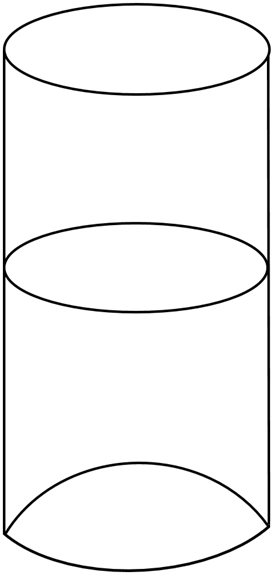
Here,
TSA of new shape $=2\pi\text{rh}+2\pi\text{rh}+\pi\text{r}^2+\pi\text{r}^2$
$=4\pi\text{rh}+2\pi\text{r}^2$ View full question & answer→Question 271 Mark
If the volumes of two cubes are in the ratio 8 : 1, then the ratio of their edges is.
Answer
- 2 : 1
Solution:
The ratio of their volumes = 8 : 1
$\frac{\text{a}^3}{\text{S}^3}=\frac{8}{1}$
$\Big(\frac{\text{a}}{\text{S}}\Big)^3=\big(\frac{2}{1}\big)^3$
a : s = 2 : 1
Ratio of edges = a : s = 2 : 1 View full question & answer→Question 281 Mark
A right circular cylindrical tunnel of diameter $2\ m$ and length $40\ m$ is to be constructed from a sheet of iron. The area of the iron sheet required in $m^2,$ is:
AnswerLet r be the radius of the cylinder and h be its height
It is given that:
$2r = 2 $
$\Rightarrow r = 1\ m$
And,
$h = 40,$
Therefore, total surface area $S$ of the sheet required is:
$\text{S}=2\pi\text{rh}$
$\Rightarrow\text{ S}=2\pi\times1\times40$
$\Rightarrow\text{S}=80\pi\text{m}^2$
View full question & answer→Question 291 Mark
If the ratio of volumes of two spheres is 1 : 8, then the ratio of their surface areas is
Answer
- 1 : 4
Solution:
Volume of sphere $=\frac{4}{3}\pi\text{r}^3=\text{v}$
$\frac{\text{V}_1}{\text{V}_1}=\frac{\frac{4}{3}\pi\text{r}^3}{\frac{4}{3}\pi\text{r}^3_2}=\frac{\text{r}^3_1}{\text{r}^3_2}=\frac{1}{8}$
$\Rightarrow\frac{\text{r}_1}{\text{r}_2}=\frac{1}{2}$
now, Surface Area of Sphere $=4\pi\text{r}^2=\text{S}$
$\frac{\text{S}_1}{\text{S}_2}=\frac{4\pi\text{r}^2_1}{4\pi\text{r}^2_2}=\Big(\frac{\text{r}_1}{\text{r}_2}\Big)^2=\frac{1}{4}=1:4$
Hence, correct option is (b). View full question & answer→Question 301 Mark
A sphere of diameter 12.6cm is melted and cast into a right circular cone of height 25.2cm. The radius of the base of the cone is:
Answer
- 6.3cm
Solution:
Let the radius of the base be r cm.
Since the sphere is melted and cast into a cone,
Volume of the sphere = volume of the cone
$\Rightarrow\frac{4}{3}\pi(6.3)^3=\frac{1}{3}\pi\text{r}^2(25.2)$
$\Rightarrow4(6.3)^3=\text{r}^2(25.2)$
$\Rightarrow\frac{4\times(6.3)^3}{(25.2)}=\text{r}^2$
$\Rightarrow\text{r}=6.3\text{cm}$ View full question & answer→Question 311 Mark
A solid metallic cylinder of base radius 3cm and height 5cm is melted to make n solid cones of height 1cm and base radius 1mm. The value of n is:
Answer
- 13500
Solution:
n = number of cones $=\frac{\text{Volume}\ \text{of}\ \text{the}\ \text{cylinder}}{\text{Volume}\ \text{of}\ \text{one}\ \text{cone}}$
$=\frac{\pi(3)^2\times5}{\frac{1}{3}\pi\Big(\frac{1}{10}\Big)^2\times1}$
$=\frac{9\times5}{\frac{1}{3}\times\frac{1}{100}}$
$=\frac{45}{\frac{1}{300}}$
$=45\times300$
$=13500$ View full question & answer→Question 321 Mark
The number of surfaces of a hollow cylindrical object is:
Answer
- 4
Solution:
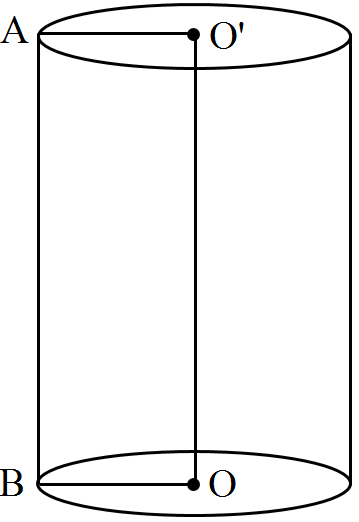
In a hollow cylinder, there are two curved surface areas: inner and outer and one circular base with inner and outer surface area.
View full question & answer→Question 331 Mark
A conical pandal 240m in radius and 100m high is made of cloth which is $100\pi\text{m}$' wide. Then, the length of cloth used to make the pandal is.
Answer
- 624m.
Solution:
Surface area of conical pandal $=\pi\text{rl}$
$\text{l}=\sqrt{\text{r}^2+\text{h}^2}$
$ \text{l}=\sqrt{240^2+100^2}$
$\text{l}=\sqrt{67600}$
$\text{l}=260\text{m}$
Now surfcae area of pandal $=\pi\times240\times260=$ area of cloths used
$=\pi\times240\times260=100\pi\times\text{length}$
Length of cloth $=\frac{240\times260}{100}$
$=624\text{m}$ View full question & answer→Question 341 Mark
If the volume of two cubes are in the ratio $8 : 1,$ then the ratio of their edges is:
AnswerLet,
$V_1, V_2$
$\rightarrow$ Volume of the two cubes
$a_1, a_2$
$\rightarrow$ Edges of the two cubes
We know that,
$V = a^3$
So,
$\frac{\text{V}_1}{\text{V}_2}=\frac{\text{a}^3_1}{\text{a}^3_2}$
$\frac81=\Big(\frac{\text{a}_1}{\text{a}_2}\Big)^3$
$\frac{\text{a}_1}{\text{a}_2}=2:1$
Ratio of their edges is $2 : 1.$
View full question & answer→Question 351 Mark
If the area of the adjacent faces of a rectangular block are in the ratio $2 : 3 : 4$ and its volume is $9000\ cm^3,$ then the length of the shortest edge is:
AnswerLet, the edges of the cuboid be $a \ cm, b \ cm$ and $c \ cm.$
And$, a < b < c.$
The area of the three adjacent faces are in the ratio $2 : 3 : 4.$
So,
$ab : ca : bc = 2 : 3 : 4,$ and its volume is $9000\ cm^3$
We have to find the shortest edge of the cuboid
Since;
$\frac{\text{ab}}{\text{bc}}=\frac{2}{4}$
$\frac{\text{a}}{\text{c}}=\frac12$
$c = 2a$
Similariy,
$\frac{\text{ca}}{\text{bc}}=\frac{3}{4}$
$\frac{\text{a}}{\text{b}}=\frac{3}{4}$
$\text{b}=\frac{4\text{a}}{3}$
Volume of the cuboid,
$V = abc$
$9000=\text{a}\Big(\frac{4\text{a}}{3}\Big)(2\text{a})$
$27000 =8\text{a}^3$
$\text{a}^3=\frac{27\times1000}{8}$
$\text{a}=\frac{3\times10}{2}$
$\text{a}=15\text{cm}$
As $\text{b}=\frac{4\text{a}}{3}$ and $c = 2a$
Thus, length of the shortest edge is $15\ cm.$
View full question & answer→Question 361 Mark
The radius of a wire is decreased to one$-$third. If volume remains the same, the length will become:
AnswerLet $V_1$ and $V_2$ be the volume of the two cylinders with $h_1$ and $h_2$ as their heights:
Let $r_1$ and $r_2$ be their base radius.
It is given that
$\pi\text{r}^2_1\text{h}_1=\pi\text{r}^2_2\text{h}_2$
$\text{V}_1=\text{V}_2\text{ and }=\frac{1}{3}\text{r}_1$
$\Rightarrow\text{r}^2_1\text{h}_1=\Big(\frac{1}{3}\text{r}_1\Big)^2\text{h}_2$
$\Rightarrow\text{h}_2=\text{9h}_1$
Hence, the length will becomes $9$ times.
View full question & answer→Question 371 Mark
A sphere and a cube are of the same height. The ratio of their volumes is
Answer
- 11 : 21
Solution:
Height of sphere = diameter = 2r
Height of cube = Side of cube = Height of sphere = 2r
Volume of sphere $=\frac{4}{3}\pi\text{r}^3$
Volume of cube $(2\text{r})^3=8\text{r}^3$
Ratio of their volumes $=\frac{\frac{4}{3}\pi\text{r}^3}{8\text{r}^3}=\frac{\pi}{6}=\frac{22^{11}}{7\times6_3}=\frac{11}{21}=11:21$
Hence, correct option is (d). View full question & answer→Question 381 Mark
$2\pi\text{cm}^2$ The surface area of a cube whose volume is $64\ cm^3$ is:
AnswerGiven: Volume of cube $= 64\ cm^3$
$\Rightarrow a^3 = 64$
$\Rightarrow a^3 = (4)^3$
$\Rightarrow a = 4\ cm$
$\therefore$ Surface Area of cube $= 6a^2 $
$= 6(4)^2$
$= 96 sq. \ cm$
View full question & answer→Question 391 Mark
The ratio of the volumes of two cones with equal heights and ratio of their radii as $2 : 5$ is:
AnswerLet $r_1, r_2$ be the radii of the two cones respectively, then Required ratio,
$\frac{\frac{1}{3}\pi^2_1\text{h}}{\frac{1}{3}\pi\text{r}^2_2\text{h}}$
$=\frac{\text{r}^2_1}{\text{r}^2_2}\bigg(\frac{\text{r}_1}{\text{r}_2}\bigg)$
$=\Big(\frac{2}{5}\Big)^2=\frac{4}{25}$
$=4:25$
View full question & answer→Question 401 Mark
If the slant height of a cone of base radius $7\ cm$ is $25\ cm$, then its height is:
Answer$l^2 + r^2 + h^2$
$h^2 + r^2 - h^2$
$= 25^2 - 7^2$
$= 625 - 49$
$= 576$
$\text{h}=\sqrt{576}$
$\text{h}=24\text{cm}$
View full question & answer→Question 411 Mark
In a cylindrical drum of radius 4.2m and height 3.5m, the number of full bags of wheat can be emptied if the space required for wheat in each bag is 2.1 cu. M, is:
Answer
- 92
Solution:
Let number of bags be n
Volume of drum = n(volume of each bag)
$\pi\text{R}^2\text{h}=\text{n}(2.1)$
$\frac{22}{7}\times(4.2)^2\times35=\text{n}(2.1)$
$\text{n}=\frac{\frac{22}{7}\times(4.2)^2\times35}{2.1}$
$=92$ View full question & answer→Question 421 Mark
Directions: In the following questions, the Assertions (A) and Reason(s) (R) have been put forward. Read both the statements carefully and choose the correct alternative from the following:
Assertion: The length of the minute hand of a clock is 7cm. Then the area swept by the minute hand in 5 minute is $\frac{77}{6}\text{cm}^2.$
Reason: The length of an arc of a sector of angle q and radius r is given by $\text{I}=\frac{\theta}{360^\circ}\times2\pi\text{r}.$
Answer
- Both assertion (A) and reason (R) are true but reason (R) is not the correct explanation of assertion (A).
View full question & answer→Question 431 Mark
If V is the volume of a cuboid of Dimensions x, y, z and A is its surface area, then $\frac{\text{A}}{\text{V}}$
Answer
- $\Big(\frac{1}{\text{x}}+\frac{1}{\text{y}}+\frac{1}{\text{z}}\Big)$
Solution:
Dimensions of the cuboid are x, y, z.
So, the surface area of the cuboid (A) = 2(xy + yz + zx)
Volume of the cuboid (V) = xyz
$\frac{\text{A}}{\text{V}}=\frac{2(\text{xy}+\text{yz}+\text{zx})}{\text{xyz}}$
$=2\Big(\frac{\text{xy}}{\text{xyz}}+\frac{\text{yz}}{\text{xyz}}+\frac{\text{zx}}{\text{xyz}}\Big)$
$=2\Big(\frac{1}{\text{x}}+\frac{1}{\text{y}}+\frac{1}{\text{z}}\Big)$
Hence, the correct choice is (c). View full question & answer→Question 441 Mark
The volume of a sphere of radius 2r is:
Answer
- $\frac{32\pi\text{r}^3}{3}$
Solution:
Volume of sphere $=\frac{4}{3}\pi\text{r}^3$
$=\frac{4}{3}\pi\times(2\text{r})^3$
$=\frac{4}{3}\pi\times8\text{r}^3$
$=\frac{32\pi\text{r}^3}{3}$ View full question & answer→Question 451 Mark
The base radii of two circular cones of the same height are in the ratio $3 : 5. $The ratio of their volumes is:
AnswerLet base radii of two circular cones be $r_1$ and $r_2$ and height be $h \ cm.$
Then, the required ratio is $\frac{\pi\text{r}^2_1\text{h}}{\pi\text{r}^2_2\text{h}}=\frac{\text{r}^2_1}{\text{r}^2_2}=\Big(\frac{\text{r}_1}{\text{r}_2}\Big)^2$
$=\Big(\frac{3}{5}\Big)^2$
$=\frac{9}{25}$
$=9:25$
View full question & answer→Question 461 Mark
If a solid sphere of radius 10cm is moulded into 8 spherical solid balls of equal radius, then the surface area of each ball (in sq. cm) is:
Answer
- $100\pi$
Solution:
Volume of sphere $=\big(\frac{4}{3}\big)\pi\text{r}^3$
Given, solid sphere of radius 10cm is moulded into 8 spherical solid balls of equal radius
$=\big(\frac{4}{3}\big)\pi\times10^3=8\times\big(\frac{4}{3}\big)\pi\text{r}^3$
$\Rightarrow\text{r}=\frac{10}{2}=5\text{m}$
Surface area of a sphere $=4\pi\text{r}^2$
Thus, the surface area of each sphere $=4\times\pi\times5^2=100\pi$ View full question & answer→Question 471 Mark
A solid cylinder is melted and cast into a cone of same radius. The heights of the cone and cylinder are in the ratio:
AnswerSince the cylinder is re cast into a cone both their volumes should be equal.
So, let Volume of the cylinder $=$ Volume of the cone
$= V$
It is also given that their base radii are the same
$= r$
Let the height of the cylinder and the cone be $h_\text{{cylinder}}$ and $h_\text{{cone}}$ respectively.
The formula of the volume of a cone with base radius $'r\ '$ and vertical height $'h\ '$ is given as
Volume of cone $=\frac{1}{3}\pi\text{r}^2\text{h}$
The formula of the volume of a cylinder with base radius $'r\ '$ and vertical height $'h\ '$ is given as
Volume of cylinder $=\pi\text{r}^2\text{h}$
So, we have
$\frac{\text{Volume of cone}}{\text{Volume of cylinder}}=\frac{\frac{1}{3}\pi\text{r}^2\text{h}_\text{cone}}{\pi\text{r}^2\text{h}_\text{cylinder}}$
$\Rightarrow\frac{\text{V}}{\text{V}}=\frac{\frac{1}{3}\text{h}_\text{cose}}{\text{h}_\text{cylinder}}$
$=\frac{\text{h}_\text{cose}}{\text{h}_\text{cylinder}}=\frac{3}{1}$
View full question & answer→Question 481 Mark
The volume of a right circular cone of height 12cm and base radius 6cm, is.
Answer
- $(144\pi)\text{cm}^3$
Solution:
Volume of cone $=\frac{1}{3}\pi\text{r}^2\text{h}$
$=\frac{1}{3}\pi\times6^2\times12$
$=\pi\times36\times4$
$=144\pi\text{cm}^3$ View full question & answer→Question 491 Mark
Write the correct answer in the following: The total surface area of a cube is $96\ cm^2.$ The volume of the cube is:
AnswerSurface area of a cube $= 96\ cm^2$
Surface area of a cube $= 6(Side)^2 = 96$
$\Rightarrow (Side)^2 = 16$
$\Rightarrow (Side) = 4\ cm.$
$[$taking positive square root because side is always a positive quantity$]$
Volume of cobe $= (Side)^3 = (4)^3 = 64\ cm^3.$
Hence, the volume of the cube is $64\ cm^3.$
View full question & answer→Question 501 Mark
Let m be the midpoint and u be the upper class limit of a class in a continuous frequency distribution. The lower class limit of the class is:
Answer
- 2m - u
Solution:
Given:
Mid value = m
Upper limit = u
We know,
$\frac{\text{Upper}\ \text{limit}+\text{Lower}\ \text{limit}}{2}=\text{Mid}\ \text{value}$
$\Rightarrow\frac{\text{Lower}\ \text{limit}+\text{u}}{2}=\text{m}$
⇒ Lower limit + u = 2m
⇒ Lower limit = 2m - u View full question & answer→