Questions · Page 1 of 4

M.C.Q. [1 M]

🎯

Test yourself on this topic

50 questions · timed · auto-graded

Question 11 Mark
If the tip of the sugarcane plant is removed from the field, even then it keeps on growing in length. It is due to the presence of:
Answer
  1. Intercalary meristem
View full question & answer
Question 21 Mark
Intestine absorbs the digested food materials. What type of epithelial cells are responsible for that?
Answer
  1. Columnar epithelium
View full question & answer
Question 31 Mark
Major constituent of bone is:
Answer
  1. Ca
Explanation:
The mineral constituent of bone is composed of a salt of calcium and phosphorus called calcium phosphate.
This makes the bony framework hard and strong.
View full question & answer
Question 61 Mark
Rhythmic contraction and relaxation throughout life, are shown by:
Answer
  1. Cardiac muscles of heart.
Explanation:
Cardiac muscles show rhythmic contraction and relaxation.
View full question & answer
Question 71 Mark
Survival of plants in terrestrial environment has been made possible by the presence of:
Answer
  1. Conducting tissue.
Explanation:
It is because of conducing tissues that plants are able to take up water from soil. Thus, plants could be able to survive in terrestrial environment where availability of water can be a major issue.
View full question & answer
Question 81 Mark
Parenchyma cells are:
Answer
  1. Relatively unspecified and thin walled.
Explanation:
Parenchyma cells form the bulk of the plant body. Its cells are living and they possess the power of division. The cells are rounded or isodiametric, i.e., equally expanded on all sides. The cells are oval, round, polygonal or elongated in shape with a thin cell wall. It encloses a dense cytoplasm, which contains small nucleus and surrounds large central vacoule.
View full question & answer
Question 91 Mark
Simple epithelium is:
Answer
  1. One cell thick
Explanation:
Epithelial tissue that is only one cell thick is called the simple epithelium.
Simple squamous, simple cuboidal, simple columnar and simple pseudostratified are four types of simple epithelium.
Epithelium that is two or more cells thick is called the stratified epithelium.
View full question & answer
Question 111 Mark
Heart muscles are:
Answer
  1. Involuntary, striated and uninucleate.
Explanation:
Cardiac muscle fibres are branched, striated and uninucleate. These muscles are involuntary. These muscles are exclusively present in the heart and show rhythmic contraction and relaxation throughout life.
View full question & answer
Question 131 Mark
The efferent part of neqron is:
Answer
  1. Axon.
Explanation:
Axon is long, branch process of neuron which carries impulses away from cyton.
View full question & answer
Question 141 Mark
Simple epithelium is a tissue, which form the outer protective layer of the skin of the animal body, is composed of cells which are:
Answer
  1. Cemented directly to one another to form an irregular layer.
View full question & answer
Question 151 Mark
Epithelial tissue always has an exposed outer surface and an inner surface anchored to connective tissue by a thin, non-cellular structure called the:
Answer
  1. Basement membrane.
Explanation:
Epithelial tissue always has an exposed outer surface and an inner surface anchored to connective tissue by a thin, non-cellular structure called the basement membrane.
View full question & answer
Question 161 Mark
Which of the following components of phloem is absent in monocot stem:
Answer
  1. Phloem parenchyma.
Explanation:
The phloem parenchyma stores food material and other substances like resins, latex and mucilage. It is absent in monocot stem.
View full question & answer
Question 201 Mark
Tissue means _________________?
Answer
  1. Similar cells having common origin and functions
Explanation:
Generally, some group of cells have same function and structure and also are derived from same origin.These group of cells are called tissue.
View full question & answer
Question 211 Mark
Cartilage is not found in:
Answer
  1. kidney
Explanation:
Kidney is composed of different kinds of epithelial tissues.
View full question & answer
Question 221 Mark
Short branched process coming out of a soma of neuron are:
Answer
  1. Dendrites
Explanation:
Each neuron has a single long part, called th axon and many short, branched parts called dendrites.
View full question & answer
Question 241 Mark
The water conducting tissue generally present in gymnosperm is:
Answer
  1. Tracheids.
Explanation:
The gymnosperms are characterised by the presence of tracheids as their major conducting tissue. These are elongated dead cells with hard lignified walls. They conduct water and do not have open ends like the vessels.
View full question & answer
Question 251 Mark
Complete the analogy given below and choose the correct option Cutin: Epidermis; Suberin:
Answer
  1. Cork cells.
Explanation:
As epidermis is formed of cutin, suberin gives rise to cork cells which makes them impervious to gas and water. No other given option is formed from suberin.
View full question & answer
Question 261 Mark
A fat person is less affected by the cold wheather because of the presence of more.
Answer
  1. Adipose tissue.
Explanation:
Adipose tissue stores fat and since fat is a bad conductor it acts as an insulator and prevents loss of heat from the body. Therefore, a fatty person is less affected by cold.
View full question & answer
Question 271 Mark
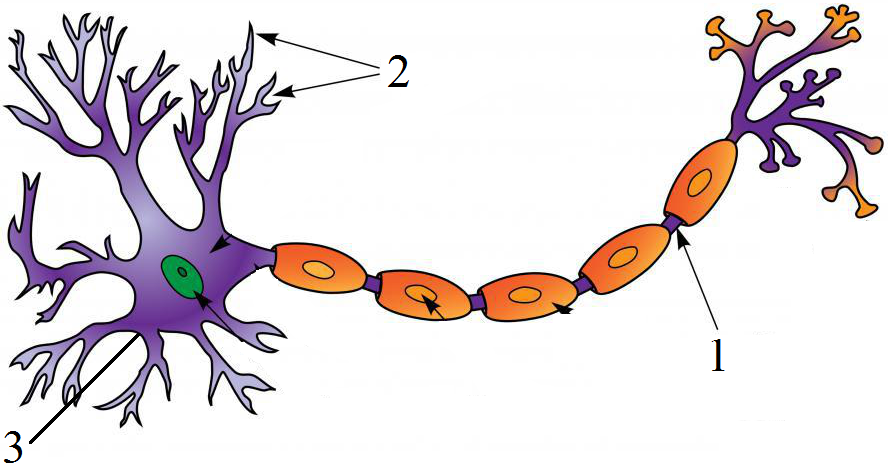
In the given figure, which of the following parts transmits impulse away from the cell body?
Answer
  1. 1
Explanation:
1 represents axon here through which impulse travels away from the cell body and toward the axon terminals.
View full question & answer
Question 281 Mark
The mast cells secrete which of the following substances:
Answer
  1. All of the above
Explanation:
Mast cells are scattered throughout the connective tissues of the body and they mediate inflammatory responses such as hypersensitivity and allergic reactions.
Mast cells secrete a number of different chemical mediators including heparin, histamine, serotonin, interleukins, proteoglycan (like heparin) and various enzymes in coarse granules found throughout the cytoplasm of cells.
View full question & answer
Question 291 Mark
Blubber of whale and hump of camel are:
Answer
  1. Adipose tissue.
Explanation:
A dipose tissue is fat storing connective tissue which is found mainly beneath the skin. Blubber of whale and hump of camel are adipose tissue which store fat.
View full question & answer
Question 311 Mark
Contractile proteins are found in:
Answer
  1. Muscles
Explanation:
Contractile proteins are found in muscles, as they are associated with the movement of body or limbs. The contraction and relaxation of contractile proteins, present in muscles bring about movements of limbs, internal organs, etc. The bones are the major supporting tissue which form the endoskeleton of a vertebrate body. Blood is a fluid connective tissue responsible for transport of oxygen, nutrients, hormones etc,, and for producing antitoxins and antibodies, etc.
Cartilage provides support and flexibility to the body parts and smoothens surface at joints.
View full question & answer
Question 321 Mark
Tendon is a structure which connects:
Answer
  1. A muscle with a bone.
Explanation:
Tendon is a form of dense connective tissue which connects a muscle with a bone.
View full question & answer
Question 341 Mark
$pH$ of blood in artery and vein is:
Answer

$pH$ of blood is more in the vein as compared to that in the artery as the plasma of the vein contains deoxygenated blood and dissolved $CO_{2​}$ in the form of bicarbonate ions.
These ions increase the alkalinity of the plasma, therefore the $pH$ value of blood is greater in the vein as to that of the artery
So, the correct answer is 'More in vein and less in artery'

View full question & answer
Question 351 Mark
Which of the following is not a type of WBC:
Answer
  1. Erythrocytes
Explanation:
 
Erythrocytes are the RBCs. White blood cells are the cells that help the body fight infection.
There are a number of different types and sub-types of white blood cells which each have different roles to play.
The two major types of white blood cells are:
Granulocytes
Agranulocytes
View full question & answer
Question 361 Mark
The cell division is restricted to:
Answer
  1. Meristematic cells.
Explanation:
Permanent tissues formed by meristematic tissues take up a specific role and lose the ability to divide further.
View full question & answer
Question 371 Mark
Lignified, narrow, elongated and dead cells are found in:
Answer
  1. Sclerenchyma.
Explanation:
The cells of the sclerencyma are dead. They are long, elongated, narrow, thick walled and lignified.
View full question & answer
Question 391 Mark
Which type of tissue forms the inner lining of a blood vessel?
Answer
  1. Epithelial.
Explanation:
Simple squamous epithelial cells are extremely thin and flat and form a delicate lining. Squamous epithelial tissue forms the inner lining of a blood vessel.
View full question & answer
Question 401 Mark
Which one is made of dead cells?
Answer
  1. All the above
Explanation:
Sclerenchyma is a type of simple permanent tissue. The cells of this tissue are dead. Tracheids and vessel are elongated, tubular cells of xylem (complex permanent tissue). These are non-living cells.
View full question & answer
Question 411 Mark
Contractile proteins are found in:
Answer
  1. Muscles.
Explanation:
Muscles help in movement and therefore contains contractile proteins.
View full question & answer
Question 421 Mark
Nucleus is located at the periphery in:
Answer
  1. Striated muscles.
Explanation:
Nucleus is located at the periphery in striated muscles.
View full question & answer
Question 431 Mark
If the tip of sugarcane plant is removed from the field, even then it keeps on growing in length. It is due to the presence of:
Answer
  1. Intercalary meristem.
Explanation:
It is because of the intercalary meristem which is found at the base of the nodes of the sugarcane which divides to form long stems of the sugarcane.
View full question & answer
Question 441 Mark
Select the incorrect sentence:
Answer
  1. Tendons are non-fibrous tissue and fragile.
Explanation:
A tendon is a white fibrous tissue which has great strength but limited flexibility. It consists of parallel bundles of collagen fibres, between which are present, rows of fibroblasts (called tendinocytes).
View full question & answer
Question 461 Mark
A long tree has several branches. The tissue that helps in the side ways conduction of water in the branches is:
Answer
  1. Xylem vessels.
Explanation:
Collenchyma has no role in transport of water. Parenchyma is a supportive tissue and has nothing to do with conduction of water. The xylem vessels also known as xylem tracheae are the most active water conducting elements.
View full question & answer
Question 471 Mark
Ligaments and tendons are formed of:
Answer
  1. Connective tissue.
Explanation:
Dense connective tissue is of two types- tenonds and ligaments.
View full question & answer
Question 481 Mark
Which is not a function of epidermis?
Answer
  1. Conduction of water.
Explanation:
Conduction of water is a function of the xylem tissues and not of epidermis.
View full question & answer
Question 501 Mark
Dermal tissue is derived from:
Answer
  1. Dermatogen
Explanation:
Dermatogen is also known as protoderm. It further divides to form the three dermal layers - epidermis, endodermis and hypodermis.These form the protective layers of the plant.
View full question & answer
M.C.Q. [1 M] - Science STD 9 Questions - Vidyadip