Questions · Page 1 of 3

MCQ

🎯

Test yourself on this topic

50 questions · timed · auto-graded

MCQ 11 Mark
A body is projected vertically upward with the velocity $y=3 \hat{i}+4 \hat{j} ms ^{-1}$. The maximum height attained by the body is $\left( g =10\  ms ^{-2}\right)$.
  • A
    $7 m$
  • $1.25 m$
  • C
    $8 m$
  • D
    $0.08 m$
Answer
Correct option: B.
$1.25 m$
$v =3 \hat{i}+4 \hat{j} $
$ H _{\max }=\frac{v^2 \sin ^2 \theta}{2 g}=\frac{v^2}{2 g}[\theta=90] $
$ v =\sqrt{9+16}=\sqrt{25} $
$ v ^2=25 $
$ H _{\max }=\frac{25}{20}=\frac{5}{4}=1.25 m $
View full question & answer
MCQ 21 Mark
If a body moving in a circular path with uniform speed, then –
  • A
    the acceleration is directed towards its center
  • B
    velocity and acceleration are perpendicular to each other
  • C
    speed of the body is constant but its velocity is varying
  • all the above
Answer
Correct option: D.
all the above
all the above
View full question & answer
MCQ 31 Mark
A constant force is acting on a particle and also acting perpendicular to the velocity of the particle. The particle describes the motion in a plane. Then –
  • A
    angular displacement is zero
  • B
    its velocity is zero
  • C
    it velocity is constant
  • it moves in a circular path
Answer
Correct option: D.
it moves in a circular path
View full question & answer
MCQ 41 Mark
The range of the projectile depends –
  • A
    The angle of projection
  • B
    Velocity of projection
  • C
    g
  • all the above
Answer
Correct option: D.
all the above
all the above
View full question & answer
MCQ 51 Mark
At the highest point of oblique projection, which of the following is correct?
  • A
    velocity of the projectile is zero
  • B
    acceleration of the projectile is zero
  • acceleration of the projectile is vertically downwards
  • D
    velocity of the projectile is vertically downwards
Answer
Correct option: C.
acceleration of the projectile is vertically downwards
acceleration of the projectile Is vertically downwards
View full question & answer
MCQ 61 Mark
When a projectile is at its maximum height, the direction of its velocity and acceleration are –
  • A
    parallel to each other
  • perpendicular to each other
  • C
    anti – parallel to each other
  • D
    depends on its speed
Answer
Correct option: B.
perpendicular to each other
View full question & answer
MCQ 71 Mark
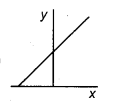
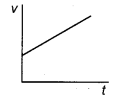
From this velocity – time graph, which of the following is correct?
  • A
    Constant acceleration
  • Variable acceleration
  • C
    Constant velocity
  • D
    Variable acceleration
Answer
Correct option: B.
Variable acceleration
View full question & answer
MCQ 81 Mark
A bullet is dropped from some height, when another bullet is fired horizontally from the same height. They will hit the ground –
Image
  • A
    depends upon mass of bullet
  • B
    depends upon the observer
  • C
    one after another
  • simultaneously
Answer
Correct option: D.
simultaneously
simultaneously
View full question & answer
MCQ 91 Mark
The angle for which maximum height and horizontal range are same for a projectile is –
  • A
    $32°$
  • $48°$
  • C
    $76°$
  • D
    $84°$
Answer
Correct option: B.
$48°$
$76^{\circ}$
$H _{\max }=$ horizontal range
$ \frac{u^2 \sin ^2 \theta}{2 g}=\frac{u^2 \sin 2 \theta}{g}$
$\frac{\sin ^2 \theta}{2}=2 \sin \theta \cos \theta=\sin \theta=4 \cos \theta \tan \theta=4 \theta=76^{\circ}$
View full question & answer
MCQ 101 Mark
A n object of mass $3 kg$ is at rest. Now a force of $\overrightarrow{ F }=6 t ^2 \hat{i}+4 t \hat{j}$ is applied on the object, then the velocity of object at $t=3$ second is -
  • A
    $18 \hat{i}+3 \hat{j}$
  • $18 \hat{i}+6 \hat{j}$
  • C
    $3 \hat{i}+18 \hat{j}$
  • D
    $18 \hat{i}+4 \hat{j}$
Answer
Correct option: B.
$18 \hat{i}+6 \hat{j}$
$F =6 t ^2 \hat{i}+4 t \hat{j}$
$\begin{aligned}F =m a & \therefore a=\frac{\overline{ F }}{m}=\frac{1}{3}\left(6 t^2 \hat{i}+4 t \hat{j}\right)=2 t^2 \hat{i}+\frac{4}{3} t \hat{j} \\\text {} & \\a & =\frac{d V }{d t} \quad \therefore v=\int_0^t a d t=\int_0^3 2 t^2 \hat{i} d t+\int_0^3 \frac{4}{3} t \hat{j} d t=18 \hat{i}+6 \hat{j}\end{aligned}$
View full question & answer
MCQ 111 Mark
Two projectiles of same mass and with same velocity are thrown at an angle of 60° and 30° with the horizontal then which of the following will remain same?
  • A
    time of flight
  • range of projectile
  • C
    maximum height reached
  • D
    all the above
Answer
Correct option: B.
range of projectile
range of projectile
View full question & answer
MCQ 121 Mark
A car moves from X to Y with a uniform speed Vn  and returns to Y with a uniform speed Vd The average speed for this round trip is –
  • A
    $\sqrt{v_u v_d}$
  • B
    $\frac{v_u v_d}{v_d+v_u}$
  • C
    $\frac{v_u+v_d}{2}$
  • $\frac{2 v_d v_u}{v_d+v_u}$
Answer
Correct option: D.
$\frac{2 v_d v_u}{v_d+v_u}$
View full question & answer
MCQ 131 Mark
A ball is thrown vertically upward. it is a speed of lo $m / s$. When it has reached one halt of its maximum height. I-low high does the ball rise? $\left( g =10 ms ^{-2}\right)$
  • A
    5 m
  • B
    7 m
  • 10 m
  • D
    12 m
Answer
Correct option: C.
10 m
10 m
View full question & answer
MCQ 141 Mark
A gun fires two bullets with same velocity at 60° and 30° with horizontal. The bullets strike at the same horizontal distance. The ratio of maximum height for the two bullets is in the ratio of –
  • A
    $1: 2$
  • $3: 1$
  • C
    $2: 1$
  • D
    $1: 3$
Answer
Correct option: B.
$3: 1$
$3: 1$
Max height attained $h _{\max }=\frac{u^2 \sin ^2 \theta}{2 g}$
$\therefore h _{\max } \alpha \sin ^2 \theta$ i.e $h _{\max } \alpha \frac{1-\cos 2 \theta}{2}$
$\frac{h_{\max 1}}{h_{\max } 2}=\frac{3 / 2}{1 / 2}=3$
View full question & answer
MCQ 151 Mark
For a particle, revolving in a circle with speed, the acceleration of the particle is –
  • A
    along the tangent
  • along the radius
  • C
    along its circumference
  • D
    zero
Answer
Correct option: B.
along the radius
along the radius
View full question & answer
MCQ 161 Mark
A particle moves along a circular path under the action of a force. The work done by the force is
  • A
    positive and non zero
  • zero
  • C
    negative and non-zero
  • D
    none
Answer
Correct option: B.
zero
zero
View full question & answer
MCQ 171 Mark
Two bullets are fired at an angle of $θ$ and $(90 – θ)$ to the horizontal with same speed. The ratio of their times of flight is –
  • A
    $1 : 1$
  • B
    $1: tan θ$
  • $tan θ : 1$
  • D
    $\tan ^2 \theta: 1$
Answer
Correct option: C.
$tan θ : 1$
Time of flight $t _{ f }=\frac{2 x \sin \theta}{9}$
$t_f \alpha \sin \theta$
$\therefore \frac{t_{f_1}}{t_{f_2}}=\frac{\sin \theta}{\sin (90-\theta)}=\frac{\sin \theta}{\cos \theta}=\tan \theta $
$t_{f_1}: t_{f_2}=\tan \theta: 1$
View full question & answer
MCQ 181 Mark
The displacement of the particle along a straight line at time i is given by $X = a + ht + ct^2$ where $a, b, c$ are constants. The acceleration of the particle is-
  • A
    $a$
  • B
    $b$
  • C
    $c$
  • $2c$
Answer
Correct option: D.
$2c$
$D$
$X = a + bt + ct ^2 $
$ \frac{d X}{d t}= v = b +2 ct $
$ \text { Acceleration }=\frac{d^2 X}{d t^2}=2 c .$
View full question & answer
MCQ 191 Mark
The distance travelled by a body, falling freely from rest in t = 1s, t = 2s and t = 3s are in the ratio of –
  • A
    $1: 2: 3$
  • B
    $1: 3: 5$
  • $1: 4: 9$
  • D
    $9: 4: 1$
Answer
Correct option: C.
$1: 4: 9$
The distance travelled by a free falling body $S =\frac{1}{2} gt ^2$
$\therefore S\ \\ \alpha\ \\ t ^2$
$\therefore S _1: S _2: S _3: 1^2: 2^2: 3^2=1: 4: 9$.
View full question & answer
MCQ 201 Mark
A particle at rest starts moving in a horizontal straight line with uniform acceleration. The ratio of the distance covered during the fourth and the third second is –
  • A
    $\frac{4}{3}$
  • B
    $\frac{26}{9}$
  • $\frac{7}{5}$
  • D
    2
Answer
Correct option: C.
$\frac{7}{5}$
The distance travelled during nth second -
$S _{ n }= u +\frac{1}{2} a (2 n -1)$
Distance travelled during 4 th second $S _1=\frac{1}{2}(8-1)$
Distance travelled during 3rd second $S_2=\frac{1}{2} a(6-1)$
$\frac{ S _1}{ S _2}=\frac{7}{5}$
View full question & answer
MCQ 211 Mark
Let y =f(x) is a function. Its maxima (or) minima can be obtained by –
  • A
    y = 0
  • B
    f(x) = 0
  • $\frac{d y}{d x}=0$
  • D
    $\frac{d^2 y}{d x^2}=0$
Answer
Correct option: C.
$\frac{d y}{d x}=0$
$\frac{d y}{d x}=0$
View full question & answer
MCQ 341 Mark
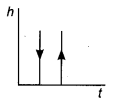
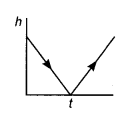
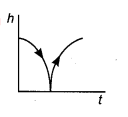
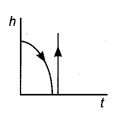
When a ball hits the ground as free fall and renounces but less than its original height? Which is represented by –
  • A
    Image
  • B
    Image
  • Image
  • D
    Image
Answer
Correct option: C.
Image
View full question & answer
MCQ 361 Mark
A compartment of an uniformly moving train is suddenly detached from the train and stops after covering some distance. The distance covered by the compartment and distance covered by the train in the given time –
  • A
    both will be equal
  • B
    second will be half of first
  • first will be half of second
  • D
    none
Answer
Correct option: C.
first will be half of second
View full question & answer
MCQ 371 Mark
In non – uniform circular motion, the resultant acceleration makes an angle with the radius vector is –
  • $\tan ^{-1}\left(\frac{r a_t}{v^2}\right)$
  • B
    $\tan ^{-1}\left(\frac{a_t}{\left(\frac{r}{v^2}\right)}\right)$
  • C
    $\tan ^{-1}\left(\frac{r v^2}{a t}\right)$
  • D
    $\tan ^{-1}\left(\frac{r+a t^2}{v^2}\right)$
Answer
Correct option: A.
$\tan ^{-1}\left(\frac{r a_t}{v^2}\right)$
View full question & answer
MCQ 381 Mark
In non – uniform circular motion, the resultant acceleration is given by –
  • A
    $a_R=\sqrt{a_t^2-\left(\frac{ V ^2}{r}\right)^2}$
  • $a_R=\sqrt{a_t^2+\left(\frac{ V ^2}{r}\right)^2}$
  • C
    $a_R=\sqrt{a_t^2-\left(\frac{r}{ v ^2}\right)^2}$
  • D
    $a_R=\sqrt{a_t^2+\left(\frac{r}{ V ^2}\right)^2}$
Answer
Correct option: B.
$a_R=\sqrt{a_t^2+\left(\frac{ V ^2}{r}\right)^2}$
View full question & answer
MCQ 391 Mark
In uniform circular motion –
  • A
    Speed changes but velocity constant
  • Velocity changes but speed constant
  • C
    both speed and velocity are constant
  • D
    both speed and velocity are variable
Answer
Correct option: B.
Velocity changes but speed constant
View full question & answer
MCQ 401 Mark
Centripetal acceleration is given by –
  • A
    $\frac{v^2}{r}$
  • $-\frac{v^2}{r}$
  • C
    $\frac{r}{v^2}$
  • D
    $\frac{r}{v^2}$
Answer
Correct option: B.
$-\frac{v^2}{r}$
$-\frac{v^2}{r}$
View full question & answer
MCQ 411 Mark
In relation between linear and angular velocity is –
  • A
    $\omega=v r$
  • $\omega=\frac{v}{r}$
  • C
    $\omega=\frac{r}{v}$
  • D
    $\omega=\frac{r}{\omega}$
Answer
Correct option: B.
$\omega=\frac{v}{r}$
View full question & answer
MCQ 421 Mark
One radian is equal to –
  • A
    $\frac{\pi}{180}$ degree
  • B
    $60^{\circ}$
  • $57.295^{\circ}$
  • D
    $53.925^{\circ}$
Answer
Correct option: C.
$57.295^{\circ}$
$57.295^{\circ}$
View full question & answer
MCQ 431 Mark
In oblique projection, maximum horizontal range of the projectile is –
  • A
    $\frac{u^2 \sin ^2 \theta}{2 g}$
  • B
    $\frac{2 u \cos \theta}{g}$
  • C
    $\frac{u^2 \sin 2 \theta}{g}$
  • $\frac{u^2}{g}$
Answer
Correct option: D.
$\frac{u^2}{g}$
$\frac{u^2}{g}$
View full question & answer
MCQ 441 Mark
In oblique projection horizontal range of the projectile is –
  • $\frac{u^2 \sin ^2 \theta}{2 g}$
  • B
    $\frac{2 u \cos \theta}{g}$
  • C
    $\frac{u^2 \sin 2 \theta}{g}$
  • D
    $\frac{u^2}{g}$
Answer
Correct option: A.
$\frac{u^2 \sin ^2 \theta}{2 g}$
View full question & answer
MCQ 451 Mark
In oblique projection time of flight of a projectile is –
  • A
    $\frac{u^2 \sin ^2 \theta}{2 g}$
  • $\frac{2 u \cos \theta}{g}$
  • C
    $\frac{u^2 \sin 2 \theta}{g}$
  • D
    $\frac{u^2}{g}$
Answer
Correct option: B.
$\frac{2 u \cos \theta}{g}$
View full question & answer
MCQ 461 Mark
In oblique projection, maximum height attained by the projectile is –
  • A
    $\frac{t}{u \cos \theta}$
  • B
    $\frac{u \cos \theta}{2 g}$
  • C
    $\frac{2 g}{u \cos \theta}$
  • $\frac{u^2 \sin ^2 \theta}{2 g}$
Answer
Correct option: D.
$\frac{u^2 \sin ^2 \theta}{2 g}$
View full question & answer
MCQ 471 Mark
In the horizontal projection, the range of the projectile is –
  • A
    $\sqrt{\frac{2 h}{g}}$
  • B
    $u \sqrt{\frac{h}{g}}$
  • $u \sqrt{\frac{2 h}{g}}$
  • D
    $u \sqrt{\frac{g}{2 h}}$
Answer
Correct option: C.
$u \sqrt{\frac{2 h}{g}}$
View full question & answer
MCQ 481 Mark
In the absence of air resistance, horizontal velocity of the projectile is –
  • A
    always negative
  • B
    equal to ‘g’
  • C
    directly proportional to g
  • a constant
Answer
Correct option: D.
a constant
a constant
View full question & answer
MCQ 491 Mark
An object falls from a height h (h<< R) the time taken by an object to reaches the ground is –
  • A
    $\frac{1}{2} g t^2$
  • B
    $\sqrt{2 g h}$
  • C
    $\sqrt{\frac{2 h}{g}}$
  • $\sqrt{\frac{2 g}{h}}$
Answer
Correct option: D.
$\sqrt{\frac{2 g}{h}}$
View full question & answer
MCQ 501 Mark
An object falls from a height h (h<
  • A
    $\frac{1}{2} g t^2$
  • B
    $\sqrt{g t}$
  • C
    $gh$
  • $\sqrt{2 g h}$
Answer
Correct option: D.
$\sqrt{2 g h}$
$\sqrt{2 g h}$
View full question & answer
MCQ - Physics STD 11 Questions - Vidyadip