Question 15 Marks
Describe incomplete dominance exhibited by Mirabilis jalapa.
Answer
View full question & answer→The German Botanist Carl Correns's (1905) Experiment - In 4 O' clock plant, Mirabilis jalapa when the pure breeding homozygous red $\left(R^1 R^1\right)$ parent is crossed with homozygous white $\left(R^2 R^2\right)$, the phenotype of the $F_1$ hybrid is heterozygous pink $\left(R^1 R^2\right)$. The $F_1$ heterozygous phenotype differs from both the parental homozygous phenotype. This cross did not exhibit the character of the dominant parent but an intermediate colour pink. When one allele is not completely dominant to another allele it shows incomplete dominance. Such allelic interaction is known as incomplete dominance. $F _1$ generation produces intermediate phenotype pink coloured flower.
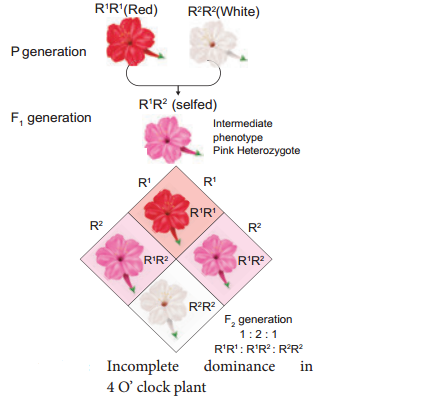
When pink coloured plants of $F_1$ generation were interbred in $F_2$ both phenotypic and genotypic ratios were found to be identical as $1: 2: 1$ (1 red: 2 pink: 1 white). Genotypic ratio is $1 R^1 R^1: 2$ $R^1 R^2: 1 R^2 R^2$. From this we conclude that the alleles themselves remain discrete and unaltered proving the Mendel's Law of Segregation. The phenotypic and genotypic ratios are the same. There is no blending of genes. In the $F^1$ generation $R^1$ and $R^2$ genes segregate and recombine to produce red, pink and white in the ratio of $1: 2: 1 . R^1$ allele codes for an enzyme responsible for the formation of red pigment. $R ^2$ allele codes for defective enzyme.
$R^1$ and $R^2$ genotypes produce only enough red pigments to make the flower pink. Two $R^1 R^2$ are needed for producing red flowers. Two $R^2 R^2$ genes are needed for white flowers. If blending had taken place, the original pure traits would not have appeared and all $F_2$ plants would have pink flowers. It is very clear that Mendel's particulate inheritance takes place in this cross which is confirmed by the reappearance of original phenotype in $F _2$.
When pink coloured plants of $F_1$ generation were interbred in $F_2$ both phenotypic and genotypic ratios were found to be identical as $1: 2: 1$ (1 red: 2 pink: 1 white). Genotypic ratio is $1 R^1 R^1: 2$ $R^1 R^2: 1 R^2 R^2$. From this we conclude that the alleles themselves remain discrete and unaltered proving the Mendel's Law of Segregation. The phenotypic and genotypic ratios are the same. There is no blending of genes. In the $F^1$ generation $R^1$ and $R^2$ genes segregate and recombine to produce red, pink and white in the ratio of $1: 2: 1 . R^1$ allele codes for an enzyme responsible for the formation of red pigment. $R ^2$ allele codes for defective enzyme.
$R^1$ and $R^2$ genotypes produce only enough red pigments to make the flower pink. Two $R^1 R^2$ are needed for producing red flowers. Two $R^2 R^2$ genes are needed for white flowers. If blending had taken place, the original pure traits would not have appeared and all $F_2$ plants would have pink flowers. It is very clear that Mendel's particulate inheritance takes place in this cross which is confirmed by the reappearance of original phenotype in $F _2$.