Questions

[ 2 Marks Questions ]

🎯

Test yourself on this topic

39 questions · timed · auto-graded

Question 12 Marks
Write a short note on hydroboration.
Answer

Diborane adds on to alkenes and alkynes in ether solvent at room temperature. This reaction is called hydroboration and is highly used in synthetic organic chemistry especially for anti-Markovnikov addition.

$B _2 H _6+6 RCH = CHR \longrightarrow 2\left( RCH _2- CHR _3\right) B$

View full question & answer
Question 22 Marks
Give the uses of silicones.
Answer
Uses of silicones:
  1. Silicones are used for low temperature lubrication and in vacuum pumps, high-temperature oil baths, etc.
  2. They are used for making water proofing clothes.
  3. They are used as insulting material in electrical motors and other appliances
  4. They are mixed with paints and enamels to make them resistant towards high temperature, sunlight, dampness and chemicals.
View full question & answer
Question 32 Marks
Write a note on Fisher tropsch synthesis.
Answer

The reaction of carbon monoxide with hydrogen at a pressure of less than 50 atm using metal catalysts at 500-700 K yields saturated and unsaturated hydrocarbons.

$\begin{gathered} nCO +(2 n +1) H _2 \longrightarrow C _{ n } H _{(2 n +2)}+ nH _2 O \\ nCO +2 nH _2 \longrightarrow C _{ n } H _{2 n }+ nH _2 O \end{gathered}$

View full question & answer
Question 42 Marks
Describe briefly the catenation property of carbon.
Answer
The following conditions are necessary for catenation.
  1. The valency of an element is greater than or equal to two.
  2. Element should have the ability to bond with itself.
  3. The self-bond must be as strong as its bond with other elements.
  4. Kinetic inertness of catenated compounds towards other molecules.
  5. Carbon possesses all the above properties and forms a wide range of compounds with itself.
View full question & answer
Question 52 Marks
What is catenation?
Answer
It is the phenomenon of an atom to form a strong covalent bond with the atoms of itself. Carbon shares the property of catenation to maximum extent because it is small in size and can form pn-pn multiple bonds to itself.
View full question & answer
Question 62 Marks
Give the uses of Borax.
Answer
Uses of borax:
  • Borax is used for the identification of coloured metal ions.
  • In the manufacture optical and borosilicate glass, enamels and glazes for pottery.
  • It is also used as a flux in metallurgy and also acts as a good preservative.
View full question & answer
Question 72 Marks
Write a short note on anomalous properties of the first element of the p-block.
Answer
In p-block elements, the first member of each group differs from the other elements of the corresponding group.

The following factors are responsible for this anomalous behaviour.

  1. Small size of the first member.
  2. High ionisation enthalpy and high electronegativity.
  3. Absence of d-orbitals in their valance shell.

The first member of group-13, boron is a metalloid while others are reactive metals. Moreover, boron shows a diagonal relationship with silicon of group -14. The oxides of boron and silicon are similar in their acidic nature.

View full question & answer
Question 82 Marks
CO is a reducing agent. justify with an example.
Answer
Both thermodynamic and kinetic factors make carbon monoxide (CO) a better reducing agent.
When CO is used to reduce a metal oxide, it gets oxidized to $CO _2$ Thermodynamically, $CO _2$ is much more stable than CO .
For example, $CO + Fe _2 O _3 \longrightarrow 2 Fe +3 CO _2$
View full question & answer
Question 92 Marks
A double salt which contains fourth-period alkali metal (A) on heating at 500 K gives (B). aqueous solution of (B) gives white precipitate with $BaCl _2$and gives a red colour compound with alizarin. Identify A and B.
Answer
1. A double salt which contains fourth-period alkali metal (A) is potash alum
$K _2 SO _4 \cdot Al _2\left( SO _4\right)_3 \cdot 24 H _2 O$
2. On heating potash alum (A) 500 k give anhydrous potash alum (or) burnt alum (B).
$\underset{[\text { Potash alum (A)] }}{ K _2 SO _4 \cdot Al _2\left( SO _4\right)_3 \cdot 24 H _2 O } \stackrel{500 K }{\longrightarrow} \underset{[\text { [Burnt alum (B)] }}{ K _2 SO _4 \cdot Al _2\left( SO _4\right)_3}+24 H _2 O$
3. Aqueous solution of burnt alum, has sulphates ion, potassium ion and aluminium ion. Sulphate ion reacts with $BaCl _2$ to form a white precipitate of Barium Sulphate
$\left( SO _4\right)_2+ BaCl _2 \longrightarrow BaSO _4+2 Cl ^{-}$
Aluminium ion reacts with alizarin solution to give a red colour compound.
View full question & answer
Question 102 Marks
How will you identify borate radical?
Answer

When boric acid or borate salt is heated with ethyl alcohol in presence of concentrated $H _2 SO _4$,, an ester triethyl borate is formed. The Vapour of this ester burns with a green-edged flame and this reaction is used to identify the presence of borate.
Image
View full question & answer
Question 112 Marks
Why silicones are water repellent?
Answer
All silicones are water repellent, this is due to the presence of organic side groups that surrounds the silicon which makes the molecule looks like an alkane. Therefore silicones are water repellent.
View full question & answer
Question 122 Marks
What are high-temperature polymers?
Answer
Silicones are high-temperature polymers, because they have high thermal stability.
View full question & answer
Question 132 Marks
What are silicones?
Answer
Silicones or poly siloxanes are organo silicon polymers with general empirical formula ( $\left.R _2 SiO \right)$. Since their empirical formula is similar to that of ketone $\left( R _2 CO \right)$, they were named silicones.
View full question & answer
Question 142 Marks
Mention the uses of silicon tetrachloride.
Answer
  1. Silicon tetrachloride is used in the production of semiconducting silicon.
  2. It is used as a starting material in the synthesis of silica gel, silicic esters, a binder for ceramic materials.
View full question & answer
Question 152 Marks
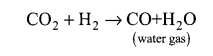
What are water gas equilibrium?
Answer
The equilibrium involved in the reaction between carbon dioxide and hydrogen, has many industrial applications and is called water gas equilibrium.
Image
View full question & answer
Question 162 Marks
How will you prepare propanal by oxoprocess?
Answer
In oxoprocess, ethene is mixed with carbon monoxide and hydrogen gas to produce propanal.
$
CO + C _2 H _4+ H _2 \rightarrow CH _3 CH _2 CHO
$
View full question & answer
Question 172 Marks
What is phosgene?
Answer
When carbon monoxide is treated with chlorine in presence of light or charcoal, it forms a poisonous gas carbonyl chloride, when is also known as phosgene.
$
CO + Cl _2 \rightarrow COCl _2
$
View full question & answer
Question 192 Marks
What is producer gas? How will you prepare producer gas?
Answer
On industrial scale carbon monoxide is produced by the reaction of carbon with air. The carbon monoxide formed will contain nitrogen gas also and the mixture of nitrogen and carbon monoxide is called producer gas.
$
2 C + O _2 / N _2 \text { (air) } \rightarrow 2 CO + N _2
$
View full question & answer
Question 202 Marks
What happen when potash alum is treated with ammonium hydroxide?
Answer
Potash alum forms aluminium hydroxide, when, treated with ammonium hydroxide
$\begin{aligned} & K _2 SO _4 \cdot A _{12}\left( SO _4\right)_3 \cdot 24 H _2 O +6 NH _4 OH \rightarrow K _2 SO _4+3\left( NH _4\right) 2 SO _4+24 H _2 O + \\ & 3 Al ( OH )_3\end{aligned}$
View full question & answer
Question 212 Marks
What is MCA fee process?
Answer
Aluminium chloride is obtained by heating a mixture of alumina and coke in a current of chloride.
Image
View full question & answer
Question 222 Marks
Mention the uses o boron trifluoride.
Answer
1. Boron trifluoride is used for preparing $HBF _4$, a catalyst in organic chemistry
2. It is also used as a fluorinating reagent.
View full question & answer
Question 232 Marks
How will you convert diborane into sodium borohydride?
Answer
Diborane reacts with sodium hydride in the presence of diglyme to give sodim borohydride.
Image
View full question & answer
Question 242 Marks
Explain the action of air on diborane.
Answer
At room temperature pure diborane does not react with air or oxygen but in impure form it gives $B _2 O _3$ along with large amount of heat.
$
B _2 H _6+3 O _2 \rightarrow B _2 O _3+3 H _2 O
$
View full question & answer
Question 252 Marks
Explain the action of air on diborane.
Answer
At room temperature pure diborane does not react with air or oxygen but in impure form it gives$\left[ B _2 O _3\right]^{3-}$along with large amount of heat.

Image
View full question & answer
Question 272 Marks
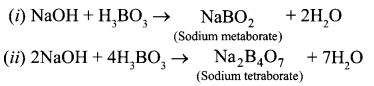
What happen when boric acids reacts with sodium hydroxide?
Answer
Boric acid reacts with sodium hydroxide to form sodium metaborate and sodium tetraborate.
Image
View full question & answer
Question 282 Marks
What happen when borax treated with ammonium chloride?
Answer
When borax treated with ammonium chloride, it forms boron nitride.
Image
View full question & answer
Question 302 Marks
Define Borax is basic in nature.
Answer
Borax is basic in nature and its solution in hot-water is alkaline as it dissociates into boric acid and sodium hydroxide,
$
Na _2 B _4 O _7+7 H _2 O \rightarrow 4 H _3 BO _3+2 NaOH
$
View full question & answer
Question 312 Marks
Why boron compounds are covalent in nature?
Answer
Many of boron compounds are electron deficient and has unusual type of covalent bonding, which is due to its small size, high ionisation energy and similarity in electronegativity with carbon and hydrogen.
View full question & answer
Question 332 Marks
Mention the allotropes of phosphorous?
Answer
  1. White phosphorous
  2. Red phosphorous (v)
  3. Scarlet phosphorous
  4. Violet phosphorous
  5. Black phosphorous
View full question & answer
Question 352 Marks
Mention the allotropes of boron.
Answer
  1. Amorphous boron
  2. a-rhombohedral boron
  3. p-rhombohedral boron
  4. γ – rhombohedral boron
  5. α – tetragonal boron
  6. β – tetragonal boron
View full question & answer
Question 362 Marks
Define inert pair effect.
Answer
In heavier post-transition metals, the outer s-electron(m) has a tendency to remain inert and show reluctance to take part in the bonding (only p-orbital involved in chemical bonding), which is known as the inert pair effect.
View full question & answer
Question 372 Marks
Why boron has a non-metallic character?
Answer
The atomic radius of the boron is very small and it has a relatively high nuclear charge and these properties are responsible for its non-metallic character.
View full question & answer
Question 382 Marks
Why-1 oxidation state is more common in halogens. Explain.
Answer
The halogens have a strong tendency to gain an electron to give a stable halide ion with completely filled electronic configuration $\left( ns _2 sp _6\right)$ and hence-1 oxidation state is more common in halogens.
View full question & answer
Question 392 Marks
What are Wade’s Rule?
Answer
Wade’s rules are used to rationalize the shape of borane clusters by calculating the total number of skeletal electron pairs (SEP) available for cluster bonding.
View full question & answer
[ 2 Marks Questions ] - Chemistry STD 12 Questions - Vidyadip