Questions

[ 2 Marks Questions ]

🎯

Test yourself on this topic

38 questions · timed · auto-graded

Question 12 Marks
Give any three characteristics of ionic crystals.
Answer
  1. Ionic solids have high melting points.
  2. These solids do not conduct electricity, because the ions are fixed in their lattice positions.
  3. They do conduct electricity in a molten state (or) when dissolved in water because the ions are free to move in the molten state or solution.
View full question & answer
Question 22 Marks
Write a note on Frenkel defect.
Answer
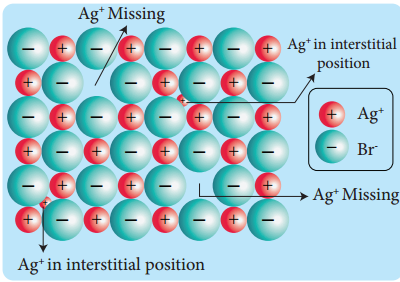
Frenkel defect arises due to the dislocation of ions from its crystal lattice. The ion which is missing from the lattice point occupies an interstitial position. This defect is shown by ionic solids in which cation and anion differ in size.
Unlike Schottky defect, this defect does not affect the density of the crystal. For example AgBr , in this case, a small $Ag ^{+}$ion leaves its normal site and occupies an interstitial position as shown in the figure.
Image
Frenkel Defect
View full question & answer
Question 32 Marks
Sodium metal crystallizes in bcc structure with the edge length of the unit cell $4.3 \times 10^{-8} cm$. calculate the radius of a sodium atom.
Answer
Edge length of the unit cell $(a)=4.3 \times 10^{-8} cm$
Radius of sodium atom $(r)=$ ?
For bcc structure, $r=\frac{\sqrt{3}}{4} a$
$
\begin{aligned}
& =\frac{\sqrt{3}}{4}\left(4.3 \times 10^{-8} cm \right) \\
& =\frac{1.732 \times 4.3 \times 10^{-8}}{4} \\
& =\frac{1.732}{4} \times 10^{-8} cm \\
& =1.86 \times 10^{-8} cm \\
& =1.86 \AA
\end{aligned}
$
View full question & answer
Question 42 Marks
Atoms X and Y form bcc crystalline structure. Atom X is present at the corners of the cube and Y is at the centre of the cube. What is the formula of the compound?
Answer
Atoms $X$ and $Y$ form bcc crystalline structure. Atom $X$ is present at the corners of the cube Atom $Y$ is present at the centre of the cube.
No. of atoms of $X$ in the unit cell $=\frac{ N _{ c }}{8}=\frac{8}{8}=1$
No. of atoms of $Y$ in the unit cell $=\frac{N_b}{1}=\frac{1}{1}=1$
Ratio of atoms $X: Y=1: 1$
Hence formula of the compound $=X Y$.
View full question & answer
Question 52 Marks
 An atom crystallizes in fcc crystal lattice and has a density of $10 g cm ^{-3}$ with unit cell edge length of 100 pm. calculate the number of atoms present in 1 g of crystal.
Answer
$
\begin{aligned}
& \text { Given, Density }=10 g cm ^{-3} \\
& \text { mass }=1 g \\
& \text { Edge length of unit cell }=100 pm \\
& \text { Volume }=\frac{\text { mass }}{\text { density }}=\frac{1 g }{10 g cm ^{-3}}=0.1 cm ^3 \\
& \text { Volume of unit cell }= a ^3 \\
& =100 \times 10^{-10} cm ^3 \\
& =1 \times 10^{-24} cm ^3
\end{aligned}
$
Number of unit cell in $1 g$ of crystal,
$
\begin{aligned}
& =\frac{\text { Total volume }}{\text { Volume of unit cell }} \\
& =\frac{0.1 cm ^3}{1 \times 10^{-24} cm ^3}
\end{aligned}
$
The given unit cell is of fcc type. Therefore. it contains 4 atoms.
$0.1 \times 10^{24}$ unit cells will contain $4 \times 0.1 \times 10^{24}=4 \times 10^{23}$ atoms
View full question & answer
Question 62 Marks
If NaCl is doped with $10^{-2} mol$ percentage of strontium chloride, what is the concentration of cation vacancy?
Answer
We know that two $Na +$ ions are replaced by each of the $Sr ^{2+}$ ions while $SrCl _2$, is doped with $NaCl$. But in this case, only one lattice point is occupied by each of the $Sr ^{2+}$ ions and produces one cation vacancy.
Here $10^{-2}$ mole of $SrCl _2$, is doped with 100 moles of $NaCl$. Thus, cation vacancies produced by $NaCi =$ $10^{-2}$ mol. Since 100 moles of $NaCl$ produces cation vacancies after doping $=10^{-2} mol$.
Therefore, 1 mole of $NaCl$ will produce cation vacancies after doping
$
\begin{aligned}
& =\frac{10^{-2}}{100}=10^{-4} mol \\
& \therefore \text { Total cationic vacancies, } \\
& =10^{-4} \times \text { Avogadro's number } \\
& =10 \times 6.023 \times 10^{23} \\
& =6.023 \times 10^{19} \text { vacancies }
\end{aligned}
$
View full question & answer
Question 72 Marks
Aluminium crystallizes in a cubic close packed structure. Its metallic radius is 125 pm. calculate the edge length of the unit cell.
Answer

Cubic close packing is based on face centered cubic unit cell.
For fcc structure $(r)=\frac{a \sqrt{2}}{4}$
Given, Radius $(r)=125$ pm
Edge length of unit cell $( a )=$ ?
$\because r=\frac{a \sqrt{2}}{4}$
$\therefore a =\frac{4 r }{\sqrt{2}}$
$=\frac{4 \times 125}{1.414}$
$a =353.6 pm$

View full question & answer
Question 82 Marks
What is the two dimensional coordination number of a molecule in square close packed layer?
Answer

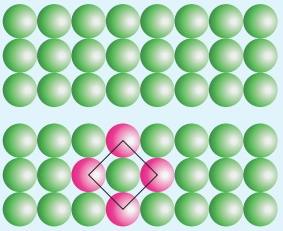
Square close packing: When the spheres of the second row are placed exactly above those of the first row. This way the spheres are aligned horizontally as well as vertically. The arrangement is AAA type. The coordination number is 4.
Image
View full question & answer
Question 92 Marks
Why ionic crystals are hard and brittle?
Answer
The ionic compounds are very hard and brittle. In ionic compounds, the ions are rigidly held in a lattice because the positive and negative ions are strongly attracted to each other and difficult to separate. But the brittleness of a compound is now easy to shift the position of atoms or ions in a lattice.

If we apply pressure on the ionic compounds the layers shifts slightly. The same charged ions in the lattice come closer. A repulsive force arises between the same charged ions, due to this repulsion the lattice structure breaks down chemical bonding.

View full question & answer
Question 102 Marks
Calculate the number of atoms in a fcc unit cell.
Answer

Number of atoms in a fee unit cell,

$\begin{aligned}& \frac{ N _{ c }}{8}+\frac{ N _{ f }}{2} \\& =\frac{8}{8}+\frac{6}{2} \\& =1+3 \\& =4\end{aligned}$

View full question & answer
Question 112 Marks
Assign reason for the following :
  1. phosphorous doped silicon is a semiconductor.
  2. Schottky defect lowers the density of a solid.
Answer
  1. It is because its conductance is intermediate between conductor and insulator.
  2. In Schottky defect, both cations and anions are missing which leads to lowering the density of a solid.
View full question & answer
Question 122 Marks
The energy required to vapourise one mole of copper is smaller than that of energy required to vapourise I mol of diamond. Why?
Answer
Copper is a metallic solid having metal-metal bonds while diamond is a covalent solid having covalent bonds.Metallic bonds are weaker than covalent bonds and thus less amount of energy is required to break metallic bonds than covalent bonds.
View full question & answer
Question 132 Marks
What ¡s the formula of a compound in which the element Y forms ccp Lattice and atoms of X occupy 2/3rd of tetrahedral voids?
Answer
Number of element $Y=n$, Number of element $X=2 n \times \frac{2}{3}$. As number of tetrahedral void $=$
$2 n$
$X : Y =\frac{4 n}{3}: n$
Formula $= X _4 Y _3$
View full question & answer
Question 142 Marks
Classify each of the following solids as ionic, metallic, molecular, network (covalent) or amorphous.
1. Tetra phosphorous decoxide $\left( P _4 O _{10}\right)$
2. Ammonium Phosphate $\left( NH _4\right)_3 PO _4$
3. SIC
4. $I_2$
5. $P _4$
6. Plastic
7. Graphite
8. Brass
9. Rb
10. LiBr
11. Si
Answer
1. Tetra phosphorous decoxide $\left( P _4 O _{10}\right)=$ Molecular solid
2. Ammonium Phosphate $\left( NH _4\right)_3 PO _4=$ Ionic solid
3. SiC = Covalent solid
4. $I_2=$ Molecular solid
5. $P _4=$ Molecular solid
6. Plastic Amorphous solid
7. Graphite $=$ Covalent solid
8. Brass = Metallic solid
9. $Rb =$ Metallic solid
10. $LiBr =$ Ionic solid
11. $Si =$ Covalent solid
View full question & answer
Question 152 Marks
Ionic solids, which have anionic vacancies due to metal excess defect develop colour. Explain with the help of suitable example.
Answer
Taking the example of NaCl, when its crystals arc heated in presence of sodium vapour some chloride ion leave their lattice sites to combine with sodium to form NaCI. For this released diffuses into the crystal to occupy the anion vacancies created by Cl ions.
The crystal now has excess of sodium. The sites occupied by unpaired electrons are called F – centres. They impart yellow colour to the crystal because they absorb energy from the visible light and get excited.
View full question & answer
Question 162 Marks
An element with molar mass $2.7 \times 10^{-2} kg mol ^{-1}$ forms a cubic unit cell with edge length 405 pm. If the density is $2.7 \times 10^3 kg m ^{-3}$, what is the nature of the cubic unit cell?
Answer
Density
$
\begin{aligned}
d & =\frac{ z \times M }{ a ^3 \times N _{ A }} \quad(\rho)=\frac{ n M }{a^3 N _{ A }} \\
n & =\frac{\rho^{\times} a ^3 \times N _{ A }}{ M }=\frac{\left(2.7 \times 10^3 kg m ^{-3}\right)\left(4.05 \times 10^{-10} m \right)^3\left(6.022 \times 10^{23} mol ^{-1}\right)}{\text { } 2.7 \times 10^{-2} kg mol ^{-1}} \\
& =3.99=4
\end{aligned}
$
Thus, there are 4 atoms of elements present per unit cell, hence, the cubic unit cell must be facecentred or cubic close - packed (cep).
View full question & answer
Question 172 Marks
Ionic solids conduct electricity in molten state but not in solid state. Explain.
Answer
In the molten state, ionic solids dissociate to give free ions and hence can conduct electricity. However in the solid state, as the ions are not free to move but remain held together by strong electrostatic forces of attraction, so they cannot conduct electricity in the solid state.
View full question & answer
Question 182 Marks
Solid A is a very hard electrical insulator in solid as well as in molten state, and melts at extremely high temperature. What type of solid is it?
Answer
Covalent or Network solid like $SiO _2$ (quartz) or SIC or C (diamond).
View full question & answer
Question 192 Marks
Classify the following solids in different categories based on the nature of intermolecular forces operating in them: Potassium sulphate, tin, benzene, urea, ammonia, water, zinc sulphide, graphite, rubidium, argon, silicon carbide.
Answer
  1. Potassium sulphate – Ionic
  2. Tin – Metallic
  3. Benzene – Molecular (non polar)
  4. Urea – Molecular (polar)
  5. Ammonia – Molecular (hydrogen bonded)
  6. Water – Molecular (hydrogen bonded)
  7. Zinc Suiphide – Ionic
  8. Graphite – Covalent or Network
  9. Rubidium – Metallic
  10. Argon – Molecular (non polar)
  11. Silicon carbide – Covalent or Network
View full question & answer
Question 202 Marks
Refractive index of a solid is observed to have the same value along all directions. Comment on the nature of this solid. Would it show cleavage property?
Answer
As the solid has same value of refractive index along all directions, this means that it is isotropic and hence amorphous. Being an amorphous solid, it would not show a clean cleavage when cut with a knife. Instead it would break into pieces with irregular surfaces.
View full question & answer
Question 212 Marks
Why is glass considered as super cooled liquid?
Answer
Glass is an amorphous solid. Like liquids it has a tendency to flow, though very slowly. The proof of this fact is that glass panes in the windows or doors of old buildings are invariably found to be slightly thicker at the bottom than at the top.
View full question & answer
Question 222 Marks
Why are solids rigid?
Answer
In a solid, the constituent particles are very closely – packed. Hence, the forces of attraction among these particles are very strong, that is why they are rigid.
View full question & answer
Question 232 Marks
What is meant by piezo electricity?
Answer
Piezo electricity is the appearance of an electrical potential across the sides of a crystal. When you subject it to mechanical stress. The word piezo electricity means electricity resulting from pressure and latent heat. Even the inverse is possible which is known as inverse piezo electric effect.
View full question & answer
Question 242 Marks
What is meant by linear arrangement of spheres in one direction?
Answer
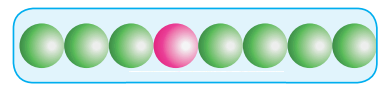
1. In a specific direction, there is only one possibility to arrange the spheres in one direction.
Image
2. In this arrangement, each sphere is in contact with two neighbouring spheres on either.
View full question & answer
Question 252 Marks
What is Bragg’s equation?
Answer
1. X-ray diffraction analysis is the most powerful tool fiw the determination of crystal structure.
2. The interplanar distance (d) between two successive planes of atoms can be calculated using the following equation form the X-ray diffraction data $2 d \sin \theta=n \lambda$. The equation is known as Bragg's equation.
Where $\lambda=$ wavelength of $X$-ray $- d =$ Interplanar distance, $\theta$ The angle of diffraction $- n =$ order of reflection. By knowing the values of $\theta, \lambda$ and $n$. we can calculate the value of $d$. $d=$ $\frac{n \lambda}{2 \operatorname{Sin} \theta}$ Using these values, the edge of the unit cell can be calculated.
View full question & answer
Question 302 Marks
Define coordination number.
Answer
  1. A crystal may be considered to consist of large number of unit cells, each one in direct contact with its nearer neighbour and all similarly oriented in space.
  2. The number of the nearest neighbours that surrounding a particle in a crystal is called coordination number of that particle.
View full question & answer
Question 312 Marks
Define crystal lattice.
Answer
The regular arrangement of these species throughout the crystal is called a crystal lattice.
View full question & answer
Question 322 Marks
What are hydrogen bonded molecular solids? Give example.
Answer
  1. Molecular solids in which the constituents are held together by hydrogen bonds.
  2. They are generally soft solids under room temperature. Examples., Solid ice, Glucose, Urea.
View full question & answer
Question 332 Marks
What are non-polar molecular solids? Give example.
Answer
  1. In non polar molecular solids, constituent molecules are held together by weak dispersion forces or London forces.
  2. They have low melting points and are usually in liquids or gaseous state at room temperature. Eg., Naphthalene, anthrancene.
View full question & answer
Question 342 Marks
Write a note about molecular solids.
Answer
  1. In molecular solids, the constituents are neutral molecules. They are held together by weak vander waals forces.
  2. Molecular solids are soft and they do not conduct electricity. Eg – Solid $CO _2$
View full question & answer
Question 352 Marks
Silicon carbide is very hard. Justify this statement.
Answer
Silicon carbide is very hard. It is a covalent solid contains the atoms which are bound together in a three dimensional network entirely by covalent bonds. So the covalent network crystal SiC is very hard and have high melting point.
View full question & answer
Question 362 Marks
What are covalent solids? Give example.
Answer
In covalent solids, the constituents (atoms) are bound together in a three dimensional network entirely by covalent bonds. Examples. Diamond, Silicon carbide.
View full question & answer
Question 372 Marks
What are amorphous solid? Give example.
Answer
In an amorphous solid, the constituents are randomly arranged. It is a short range arrangement of constituents. Eg – Glass.
View full question & answer
Question 382 Marks
What are crystalline solid? Give example.
Answer
A crystalline solid is one in which its constituents (atoms, ions or molecules) have an orderly arrangement extending over a long range which has three dimensional pattern. Example – NaCl.
View full question & answer
[ 2 Marks Questions ] - Chemistry STD 12 Questions - Vidyadip