Questions

[ 3 Marks Questions ]

🎯

Test yourself on this topic

26 questions · timed · auto-graded

Question 13 Marks
Explain Schottky defect.
Answer
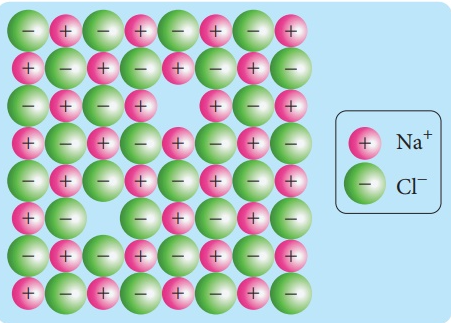
Schottky defect arises due to the missing of an equal number of cations and anions from the crystal lattice. This effect does not change the stoichiometry of the crystal. Ionic solids in which the cation and anion are of almost of similar size show Schottky defect.
Example: NaCl
Image
Schottky Defect
Presence of a large number of Schottky defects in a crystal lowers its density. For example, the theoretical density of vanadium monoxide (VO) calculated using the edge length of the unit cell is $6.5 g cm ^{-3}$ but the actual experimental density is $5.6 g cm ^{-3}$. It indicates that there is approximately $14 \%$ Schottky defect in VO crystal. Presence of the Schottky defect in the crystal provides a simple way by which atoms or ions can move within the crystal lattice.
View full question & answer
Question 23 Marks
What are point defects?
Answer
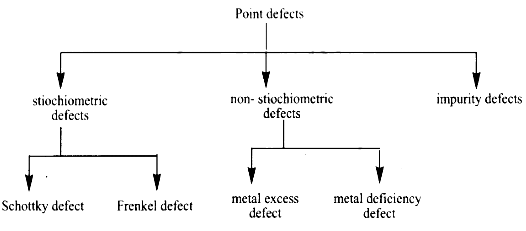
If the deviation occurs due to missing atoms, displaced atoms or extra atoms the imperfection is named as a point defect. Such defects arise due to imperfect packing during the original crystallisation or they may arise from thermal vibrations of atoms at elevated temperatures.

View full question & answer
Question 33 Marks
Distinguish tetrahedral and octahedral voids.
Answer
Sr. No.Tetrahedral voidsOctahedral voids
1.A single triangular void in a crystal is surrounded by four (4) spheres and is called a tetrahedral void.A double triangular void like c is surrounded by six (6) spheres and is called an octahedral void.
2.A sphere of second layer is above the void of the first layer, a tetrahedral void is formed.The voids in the first layer are partially covered by the spheres of the layer.
3.This constitutes four spheres, three in the lower and one in the upper layer. When the centres of these four spheres are joined a tetrahedron is formed.This constitutes six spheres, three in the lower layer and three in the upper layer. When the centers of these six spheres are joined an octahedron is formed.
4.The radius of the sphere which can be accommodated in an octahedral hole without disturbing the structure should not exceed 0.414 times that of the structure forming a sphere.The sphere which can be placed in a tetrahedral hole without disturbing the close-packed structure should not have a radius larger than 0.225 times the radius of the sphere-forming the structure.
5.Radius of a tetrahedral void `"r"/"R"` = 0.225Radius of an octahedral void `"r"/"R"` = 0.414
View full question & answer
Question 43 Marks
Distinguish between hexagonal close packing and cubic close packing.
Answer
Sr. No. Hexagonal close packing Cubic close packing
1. aba arrangement abc arrangement
2. In this case, the spheres of the third layer are exactly aligned with those of the first layer In this case, the spheres of the third layer are not aligned with those of the first layer or second layer. only when the fourth layer is placed, its spheres are aligned with the first layer.
3. In HCP, tetrahedral voids of the second layer may be covered by the spheres of the third layer. In CCP third layer may be placed above the second layer in a manner such that its sphere covers the octahedral voids.
View full question & answer
Question 53 Marks
Differentiate crystalline solids and amorphous solids.
Answer
Sr. No. Crystalline solids Amorphous solids
1. Long range orderly arrangement of constituents. Short range, random arrangement of constituents.
2. Definite shape Irregular shape
3. Generally, crystalline solids are anisotropic in nature. They are isotropic like liquids.
4. Definite Heat of fusion Heat of fusion is not definite
5. They have sharp melting points. Gradually soften over a range of temperature and so can be moulded.
6. Examples: NaCl, diamond, etc. Examples: Rubber, plastics, glass, etc.
View full question & answer
Question 63 Marks
KF crystallizes in fcc structure like sodium chloride. calculate the distance between $K ^{+}$and $F ^{-}$in $KF ^{-}$ (Given: density of KF is $2.48 g cm ^{-3}$ )
Answer
$\begin{aligned} & \text { Density of KF } 2.48 g cm ^{-3} \\ & n =\frac{ nM }{ a ^3 N _{ A }} \\ & \rho=\frac{4 \text { (For fcc) }}{ a ^3 \times 6.023 \times 10^{23}} \\ & 2.48=\frac{4 \times 58}{ a ^3 \times 6.023 \times 10^{23}} \\ & a ^3=\frac{4 \times 58}{2.48 \times 6.023 \times 10^{23}} \\ & d =\frac{232}{14.93 \times 10^{23}} \\ & d =\frac{ a }{ a ^3}=\frac{537.5}{1.414}(\text { For fcc) } \\ & a =537.5 pm \end{aligned}$
View full question & answer
Question 73 Marks
ZnO is colourless at room temperature, while yellow when hot, why?
Answer
ZnO is colourless at room temperature. When it is heated, it becomes yellow in colour. On heating, it loses oxygen and thereby forming free $Zn ^{2+}$ ions. The excess $Zn ^{2+}$ ions move to interstitial sites and the electrons also occupy the interstitial positions.
View full question & answer
Question 83 Marks
Explain:
  1. The basis of similarities and differences between metallic and ionic crystals.
  2. Ionic solids are hard and brittle.
Answer
1. Similarities:
  • Both ionic and metallic crystals have electrostatic forces of attractiàn.
  • In ionic crystals these forces are between oppositely charged ions. In metals,these forces are among the valence electrons and posityely charged kernels.
  • Both have high melting point.
Differences:
  • Ionic bond is strong due to electrostatic forces of attraction whereas metallic bond may be weak or strong depending upon the number of valence electrons and the size of kernels.
  • In ionic bond, ions are not free to move. Hence, they cannot conduct electricity in solid state. They can do so only in molten state or in aqueous solution. ¡n metals, electrons are free to move. Hence, they conduct electricity in solid state.
2. Ionic crystals are hard due to strong electrostatic forces between them. They are brittle because ionic bond is non – directional.
View full question & answer
Question 93 Marks
How many lattice points are there in one unit cell of each of the following lattice?
  1. Face – centred cubic
  2. Face – centred tetragonal
  3. Body – centered
Answer
  1. Lattice points in face-centred cubic lattice = 8 (at corners) + 6 (at the face centre) = 14
  2. Face centred tetragonal = 8 (at corners) + 6 (at the face centre) = 14
  3. Lattice points in body-centred cube = 8 (at corners) +1 (at the body centre) = 9
View full question & answer
Question 103 Marks
A compound is formed by two elements $M$ and $N$. The element $N$ forms $\operatorname{ccp}$ and atoms of $M$ occupy $1 / 3 rd$ of the tetrahedral voids. What is the formula of the compound?
Answer
Suppose the atoms $N$ in the $ccp = n$
$\therefore$ No. of tetrahedral voids $=2 n$
As $1 / 3$ rd of the tetrahedral voids are occupied by atoms $M_{\text {, therefore, }}$
No. of atoms $M =\frac{2 n}{3}$
$\therefore$ Ratio of $M : N =\frac{2 n}{3}: n =2: 3$
Hence, the formula is $M_2 N_3$
View full question & answer
Question 113 Marks
What is meant by impurity defect? Explain with example?
Answer
1. A method of introducing defects in ionic solids by adding impurity ions.
2. If the impurity ions are in different valence state from that of host, vaccancies are creited in the crystal lattice of the host.
3. For cg., addition of $CdCl ^2$ to silver chloride yields solid solutions where the divalent cation $Cd ^{2+}$ occupies the position of $Ag ^{2+}$
4. This will disturb the electrical neutrality of the crystal. In order to maintain the same, proportional number of $Ag$ ions leave the lattice. This produces a cation vaccancy in the lattice, such kind of crystal defects are called impurity defects.
View full question & answer
Question 123 Marks
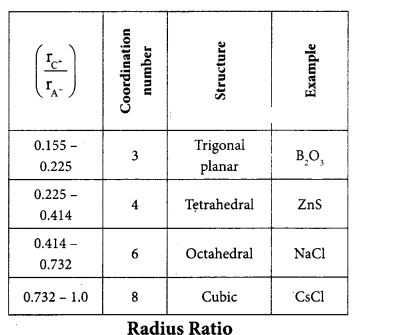
How is radius ratio ¡s useful in determination of structure of an Ionic compound?
Answer
  1. The structure of an ionic compound depends upon the stoichiometry and the size of the ions.
  2. Generally in ionic crystals, the bigger anions are present in the close packed arrangements the cations occupy the voids.
  3. The ratio of radius of cation and anion plays an important role in determining the structure.
  4. For Eg;
    Image
View full question & answer
Question 133 Marks
Calculate the packing efficiency in fcc unit cell?
Answer
Total number of spheres belongs to a single fcc unit cell is $4.$ Volume of the sphere with radius $r$ is $=\frac{n}{2} \pi\left(\frac{\sqrt{2} a}{4}\right)^3$
$\therefore$ Volume of all spheres in fcc unit cell $=4 \times\left(\frac{\sqrt{2} \pi a^3}{24}\right)$
$=\frac{\sqrt{2} \pi a^3}{6} $
$=\frac{\left(\frac{\sqrt{2} \pi a^3}{6}\right)}{a^3} \times 100 $
$=\frac{\sqrt{2} \pi}{6} \times 100 $
$=\frac{1.414 \times 3.14 \times 100}{6}=74 \%$
View full question & answer
Question 143 Marks
What is meant by packing efficiency? How is ¡t measured?
Answer
1. There is some free space between the spheres of a single layer and the spheres of successive layers.
2. The percentage of total volume occupied by these constituent spheres gives the packing efficiency of an arrangement. For eg., in simple cubic arrangement.
Packing fraction (or) efficiency $=\frac{\text { Total volume occupied by spheres in unit cell }}{\text { volume of the unit cell }} \times 100$
View full question & answer
Question 153 Marks
Calculate the packing fraction of siniple cubic arrangement
Answer
In a simple cubic arrangement
Packing fraction (or) efficiency $=\frac{\text { Total volume occupied by spheres in unit cell }}{\text { volume of the unit cell }} \times 100$
Consider the cube with an edge length ' $a$ '
Volume of the cube with edge length $a$ is $=a \times a \times a=a^3$ $\qquad$
Let ' $r$ ' is the radius of the sphere
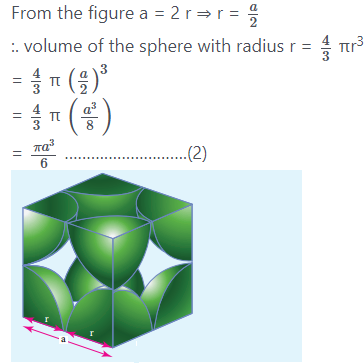
From the figure $a =2 r \Rightarrow r =\frac{a}{2}$
$\therefore$ volume of the sphere with radius $r=\frac{4}{3} \pi r^3$
$=\frac{4}{3} \pi\left(\frac{a}{2}\right)^3$
$=\frac{4}{3} \pi\left(\frac{a^3}{8}\right)$
$=\frac{\pi a^3}{6} \ldots \ldots \ldots \ldots$
Image
In a simple cubic arrangement. number of spheres belongs to a unit cell equal to one.
$\therefore$ Total volume occupied by the spheres in sc unit cell $=1 \times\left(\frac{\pi a^3}{6}\right) \ldots \ldots$(3)
Dividing 3 by 1
Packing fraction $=\left(\frac{\frac{\pi a^3}{6}}{a^3}\right) \times 100=\frac{100 \pi}{6}=52.31 \%$ Only $52.31 \%$ of the available volume is occupied by the spheres in simple cubic packing, making in efficient use of available space and hence minimizing the attractive forces.
View full question & answer
Question 163 Marks
How will derive the formula of density of a unit cell?
Answer
$1.$ Using the edge length of a unit cell, we can calculate the density $(p )$ of the crystal by considering a cubic unit cell as follows.
$\text { Density of the unit cell } \rho=\frac{\text { Mass of the unit cell }}{\text { Volume of the unit cell }}$
Mass of the unit cell $=\left\{\begin{array}{c}\text { Total number of atoms belong } \\ \text { to that unit cell }\end{array}\right\} \times$ mass of one atom
Mass of one atom $=\frac{\text { Molar mass }\left( g mol ^{-1}\right)}{\text { Avagardo number }\left( mol ^{-1}\right)}$
$ =\frac{ M }{ N _{ A }}$
Substitute the value $(3)$ in $(2)$
Mass of the unit cell $= n \times \frac{M}{N_A}$
For a cubic unit cell, all the edge lengths are equal. i.e., $a=b=c$
Volume of the unit cell $= a \times a \times a = a ^3$
$\therefore$ Density of the unit cell $=\rho=\frac{n M}{a^3 N_A}$
View full question & answer
Question 173 Marks
Calculate the number of atoms per unit cell of bec type.
Answer
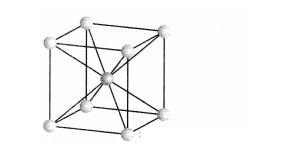
1. In a body centered cubic unit cell, each corner is occupied by an identical particle and in addition to that one atom occupied the body centre.
2. Those atoms which occupy the corners do not touch each other, however they all touch the one that occupies the body centre.
3. Hence each atom is surrounded by eight nearest neighbours and coordination number is 8. An atom present at the body centre belongs to only a particular unit cell i.e., unshared by other cell.
$\therefore$ number of atoms in a bcc unit cell $=\frac{N_c}{8}+\frac{N_b}{1}+\frac{8}{8}=\frac{1}{1}=1+1=2Image
View full question & answer
Question 183 Marks
Calculate the number of atoms belong to one unit cell of simple cubic unit cell(sc).
Answer
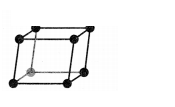
1. In the simple cubic unit cell, each corner is occupied by an identical atoms (or) ions (or) molecules and they touch along the edges of cube, do not touch diagonally. The coordination number of each atom is 6 .
2. Each atom in the comer of the cubic unit cell is shared by 8 neighbouring unit cells and therefore atoms per unit cell is equal to $\frac{N_c}{8}$. where Nc is the number of atoms at the corners.
3. no of atoms in a Sc unit cell $=\left(\frac{N_c}{8}\right)=\left(\frac{8}{8}\right)=1
Image
View full question & answer
Question 223 Marks
What are type of unit cells? Give their names.
Answer
  1. There are two types of unit cells, a) primitive b) Non – primitive.
  2. A unit cell that contains only one lattice point is called a primitive unit cell, which is made up from the lattice points at each of the comers.
  3. In the case of non-primitive unit cells, there are additional lattice points, either on a face of the unit cell or with in the unit cell.
View full question & answer
Question 233 Marks
What are characteristic parameters of a unit cell?
Answer
1. A basic repeating structural unit of a crystalline solid is called a unit cell.
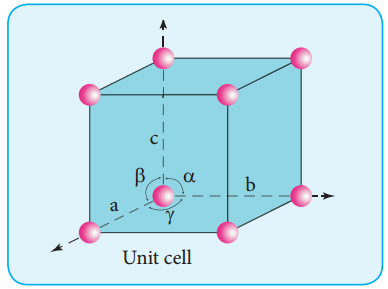
2. A unit cell is characterised by the three edge lengths or lattice constants a,b and c and the angle between the edges a,P and y.
3.
Image
View full question & answer
Question 243 Marks
Write a note about metallic solids.
Answer
  1. In metallic solids, the lattice points are occupied by positive metal ions and a cloud of electrons pervades the space.
  2. They are hard and have high melting point.
  3. Metallic solids possess excellent electrical and thermal conductivity. They possess bright lustre.
  4. Examples – Metals and metal alloys Cu, Fe, Zn, Ag, Ay, Cu – Zn etc.
View full question & answer
Question 253 Marks
What are polar molecular solids? Give example.
Answer
1. The constituents are molecules formed by polar covalent bonds.
2. They are held together by relatively strong dipole-dipole interactions.
3. They have higher melting points than the non-polar molecular solids. Eg., Solid $CO _2$, Solid $NH _3$.
View full question & answer
Question 263 Marks
Distinguish between isotropy and anisotropy?
Answer
Isotropy :
  1. Isotropy means uniformity in all directions.
  2. Isotropy means having identical values of physical properties such as refractive index, electrical conductance in all directions.
  3. Isotropy is the property of amorphous solids.
Anisotropy :
  1. Anisotropy means non-uniformity in all directions.
  2. Anisotropy is the property which depends on the direction of measurement. They show different values of physical properties when measured along different directions.
  3. Anisotropy is the properly of crystalline solids.
View full question & answer
[ 3 Marks Questions ] - Chemistry STD 12 Questions - Vidyadip