Question 15 Marks
Explain briefly seven types of unit cells.
Answer
Seven types of unit cells:
Cubic
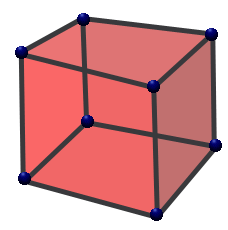
$a=b=c$
$\alpha=\beta=\gamma=90^{\circ}$
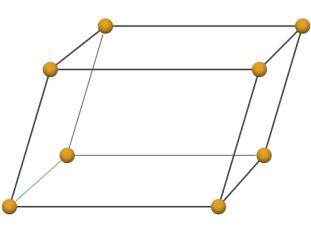
Rhombohedral
$a=b=c$
$\alpha=\beta=\gamma \neq 90^{\circ}$
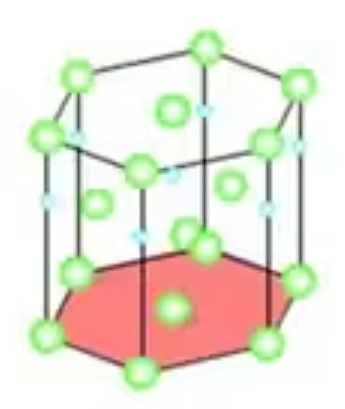
Hexagonal
$a=b \neq c$
$\alpha=\beta=90^{\circ}, \gamma=120^{\circ}$
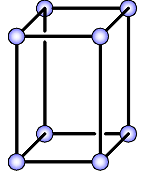
Tetragonal
$a=b \neq c$
$\alpha=\beta=\gamma=90^{\circ}$
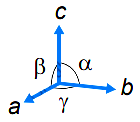
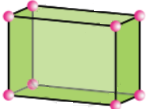
Orthorhombic
$a \neq b \neq c$
$\alpha=\beta=\gamma=90^{\circ}$
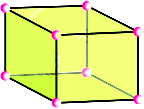
Monoclinic
$a \neq b \neq c$
$\alpha=\gamma=90^{\circ}, \beta \neq 90^{\circ}$
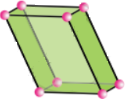
Triclinic
$a \neq b \neq c$
$\alpha \neq \beta \neq \gamma \neq 90^{\circ}$
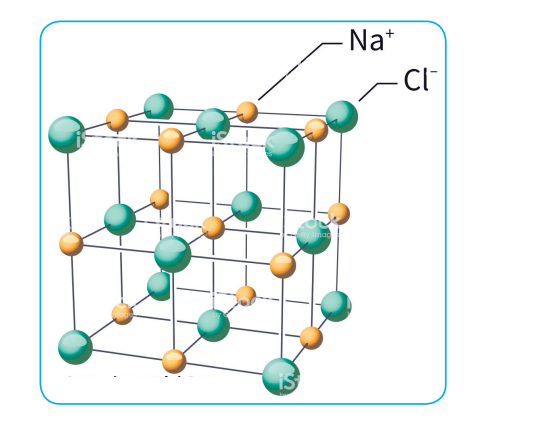
$\text { 1. } \text { Cubic }-NaCl$
$\text { 2. Rhombohedral - Cinnabar Cubic }$
$\text { 3. Hexagonal }-ZnO$
$\text { 4. Tetragonal }-TiO_2$
$\text { 5. Orthorhombic }-BaSO_4$
$\text { 6. Monoclinic }-PbCrO_4$
$\text { 7. Triclinic }-H_3 BO_3$
They differ in the arrangements of their crystallographic axes and angles.
Corresponding to the above seven, Bravis defined 14 possible crystal systems as shown in the figure.
View full question & answer→Seven types of unit cells:
Cubic
$a=b=c$
$\alpha=\beta=\gamma=90^{\circ}$
Rhombohedral
$a=b=c$
$\alpha=\beta=\gamma \neq 90^{\circ}$
Hexagonal
$a=b \neq c$
$\alpha=\beta=90^{\circ}, \gamma=120^{\circ}$
Tetragonal
$a=b \neq c$
$\alpha=\beta=\gamma=90^{\circ}$
Orthorhombic
$a \neq b \neq c$
$\alpha=\beta=\gamma=90^{\circ}$
Monoclinic
$a \neq b \neq c$
$\alpha=\gamma=90^{\circ}, \beta \neq 90^{\circ}$
Triclinic
$a \neq b \neq c$
$\alpha \neq \beta \neq \gamma \neq 90^{\circ}$
$\text { 1. } \text { Cubic }-NaCl$
$\text { 2. Rhombohedral - Cinnabar Cubic }$
$\text { 3. Hexagonal }-ZnO$
$\text { 4. Tetragonal }-TiO_2$
$\text { 5. Orthorhombic }-BaSO_4$
$\text { 6. Monoclinic }-PbCrO_4$
$\text { 7. Triclinic }-H_3 BO_3$
They differ in the arrangements of their crystallographic axes and angles.
Corresponding to the above seven, Bravis defined 14 possible crystal systems as shown in the figure.