Questions

Numerical Problems

🎯

Test yourself on this topic

6 questions · timed · auto-graded

Question 15 Marks
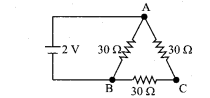
Find the value of current I in the circuit shown in figure.
Answer
Image
In the circuit, the resistance of arm ACB $(30+30=60 \Omega)$ is the parallel with the resistance of $\operatorname{arm} AB (=30 \Omega)$.
Hence, the effective resistance of the circuit is
$
R =\frac{30 \times 60}{30+60}=20 \Omega
$
Current, $I =\frac{V}{R}=\frac{2}{20}=0.1 A$.
Common Errors and Its Rectifications:
Common Errors:
1. Sometimes students think that charge and current are same.
2. In doing calculation part students can't give the importance to mention the units.
3. They may confuse the parallel and series network of the resistance.
Rectifications:
1.Charge q = ne Current I = q/t
2.Unit is very importance to the every physical quantities.
3.If the resistors are series, their resultant is sum of the all the reciprocal of individual resistance. If the resistors are parallel their resultant is sum of the individual resistance.
View full question & answer
Question 25 Marks
(i) At what temperature would the resistance of a copper conductor be double its resistance at $0^{\circ} C$.(ii) Does this temperature hold for all copper conductors regardless of shape and size? Given a for $Cu =3.9 \times 10^{-3}{ }^{\circ} C ^{-1}$.
Answer
(i) $\alpha=\frac{ R _2- R _1}{ R _1\left(t_2-t_1\right)}=\frac{2 R _0- R _0}{ R _0(t-0)}=\frac{1}{t}$$t=\frac{1}{\alpha}=\frac{1}}{3.9 \times 10^{-3}}=256^{\circ} C$Thus the resistance of copper conductor becomes double at $256^{\circ} C$.(ii) Since a does not depend on size and shape of the conductor. So the above result holds for all copper conductors.
View full question & answer
Question 35 Marks
 A copper wire has a resistance of $10 \Omega$. and an area of cross-section $1 mm^2$. A potential difference of 10 V exists across the wire. Calculate the drift speed of electrons if the number of electrons per cubic metre in copper is $8 \times 10^{28}$ electrons.
Answer
Here, $R=10 \Omega, A=1 mm ^2=10^{-6} m ^2, V =10 V , n =8 \times 10^{28}$ electrons $/ m ^3$
Now,
$
\begin{aligned}
& I = enAv _{ d } \\
& \therefore \frac{V}{R}= enAv _{ d } \text { (or) } v _{ d }=\frac{V}{e n A R} \\
& =\frac{10}{1.6 \times 10^{-19} \times 8 \times 10^{28} \times 10^{-6} \times 10}=0.078 \times 10^{-3} ms ^{-1} \\
& =0.078 \times ms ^{-1}
\end{aligned}
$
View full question & answer
Question 45 Marks
A wire of $10 ohm$ resistance is stretched to thrice its original length.What will be its (i) new resistivity and (ii) new resistance?
Answer
Here, $R=10 \Omega, A=1 mm ^2=10^{-6} m ^2, V =10 V , n =8 \times 10^{28}$
electrons $/ m ^3$
Now,
$I = enAv _{ d }$
$\therefore \frac{V}{R}= enAv _{ d } \text { (or) } v _{ d }=\frac{V}{e n A R}$
$=\frac{10}{1.6 \times 10^{-19} \times 8 \times 10^{28} \times 10^{-6} \times 10}=0.078 \times 10^{-3} ms ^{-1}$
$=0.078 \times ms ^{-1}$
View full question & answer
Question 55 Marks
Calculate the resistivity of a material of a wire $10 m$ long. $0.4 mm$ in diameter and having a resistance of $2.0 \Omega$.
Answer
Here I $=10 cm , r =0.2 mm =0.2 \times 10^{-3} m , R =2 \Omega$$\left[r=\frac{d}{2}\right]$Resistivity, $l=\frac{ RA }{l}=\frac{ R \times \pi r^2}{l \text 10}=\frac{2 \times 3.14 \times\left(0.2 \times 10^{-3}\right)^2}{10}$ $=2.513 \times 10^{-8} \Omega$.
View full question & answer
Question 65 Marks
Show that one ampere is equivalent to a flow of $6.25 \times 10^{18}$ elementary charges per second.
Answer
Here $I =1 A , t =1 s , e =1.6 \times 10^{-19} C$As $I =\frac{q}{t}=\frac{n e}{t}$Number of electrons, $n =\frac{I t}{e}=\frac{1 \times 1}{1.6 \times 10^{19}}=6.25 \times 10^{18}$
View full question & answer
Numerical Problems - Physics STD 12 Questions - Vidyadip