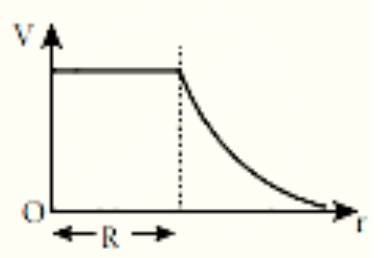
- Azero, $\frac{Q}{4 \pi \varepsilon_0 R^2}$
- B$\frac{Q}{4 \pi \varepsilon_0 R}$
- ✓$\frac{Q}{4 \pi \varepsilon_0 R}$, zero
- Dzero,zero
Answer: C.
View full solution →114 questions across 7 question groups — pick any mix to generate a Physics paper with step-by-step answer keys.
Choose the most appropriate answer from the given alternatives and write the option code and the corresponding answer.
56 Q→02Fill In The Blanks.
34 Q→03[ 2 Marks Questions ]
8 Q→04Assertion and reason type
5 Q→05Match the following.
4 Q→06Numerical Problems
5 Q→07[ 5 Marks Questions ]
2 Q→One sample from each question group in this chapter. Select any group above to see the full set with answer keys.
Answer: C.
View full solution →
Answer: B.
View full solution →Answer: C.
View full solution →Answer: D.
View full solution →Answer: B.
View full solution →| (i) Electric charge | (a) $Cm$ |
| (ii) Dipole moment | (b) $Nm ^2 C ^{-1}$ |
| (iii) Electric field | (c) coulomb |
| (iv) Electric flux | (d) $NC ^{-1}$ |
| (i) Electric dipole | (a) Ebonite |
| (ii) Dielectric | (b) $H _2$ |
| (iii) Polar molecules | (c) Ammonia |
| (iv) Non-polar molecules | (d) $H _2 O$ |
| (i) Positive and negative | (a) Michael Faraday |
| (ii) Electrostatic force | (b) Gauss |
| (iii) Concept of field ${ } | (c) Benjamin Franklin |
| (iv) $q$ in arbitrary closed surface | (d) coulomb |
| (i) Quantisation of charges | (a) $\int_{\infty}^{ P }-\overrightarrow{ E } \cdot d \vec{r}$ |
| (ii) Electric field | (b) ne |
| (iii) Electric dipole moment | (c) $\frac{ F }{q}$ |
| (iv) Electric potential | (d) $2 q a$ |
Pick question groups from the list above, set marks and difficulty, and export a branded PDF with step-by-step answer keys. First 3 chapters free — no signup.