Questions

[ 2 Marks Questions ]

🎯

Test yourself on this topic

25 questions · timed · auto-graded

Question 12 Marks
What are the conditions for total internal reflection?
Answer
i) Light must travel from denser to rarer medium.
ii) Angle of incidence in the denser medium must be greater than critical angle $\left(i>i_c\right)$
View full question & answer
Question 22 Marks
A lens of glass is immersed in water what will be its effect on the power of the lens?
Answer
Power of a lens, $\rho \alpha(\mu-1)$. As $w_{\mu g}
View full question & answer
Question 32 Marks
Give the methods of producing polarised light.
Answer
i) Polarisation by selective absorption
ii) Polarisation by reflection
iii) Polarisation by double refraction
iv) Polarisation by scattering
View full question & answer
Question 42 Marks
What is meant by double refraction or birefringence?
Answer
When a ray of unpolarised light is incident on a calcite crystal, two refracted rays are produced. Hence, two images of a single object are formed. This phenomenon is called double refraction or birefringence.
View full question & answer
Question 52 Marks
What is the reason for reddish appearance of sun during sunrise and sunset?
Answer
  1. During sunrise or sunset, the light has to pass through a greater distance in the atmosphere.
  2. Blue light is scattered most while the red colour is less scattered and reaches the observer.
  3. This is the reason for reddish appearence of sun during sunrise and sunset.
View full question & answer
Question 62 Marks
What is meant by secondary focus?
Answer
The secondary focus F2 is defined as a point where all the parallel rays travelling close to the principal axis converge to form an image on the principal axis.
View full question & answer
Question 72 Marks
What is meant by Primary focus?
Answer
The primary focus F1 is defined as a point where an object should be placed to give parallel emergent rays to the principal axis.
View full question & answer
Question 82 Marks
Define acceptance angle in optical fiber.
Answer
To ensure the critical angle incidence in the core-cladding boundary inside the optical fiber, the light should be incident at a certain angle at the end of an optical fiber while entering it. This is called an acceptance angle.
View full question & answer
Question 92 Marks
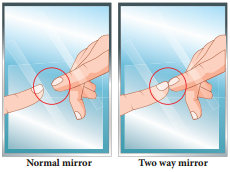
How do you identify a normal mirror and two-way mirror?
Answer
Image
There is a method to test the two-way mirror. Place the fingernail against the mirror surface. If there is a gap between the nail and its image, then it is a regular mirror. If the fingernail directly touches its image then it is a two-way mirror.

View full question & answer
Question 102 Marks
What is meant by simultaneous reflection or refraction?
Answer
The phenomenon in which a part of the light from a source undergoing reflection and the other part of the light from the same source undergoing refraction at the same surface is called simultaneous reflection or simultaneous refraction.
View full question & answer
Question 112 Marks
What is meant by refractive index?
Answer
Refractive index of a transparent medium is defined as the ratio of the speed of light in vacuum (or air) to the speed of light in that medium.
View full question & answer
Question 122 Marks
Define Optical path?
Answer
Optical path of a medium is defined as the distance d’ light travels in vacuum in the same time it travels a distance d in the medium.
View full question & answer
Question 132 Marks
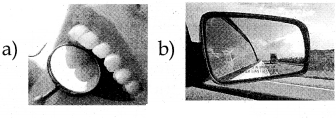
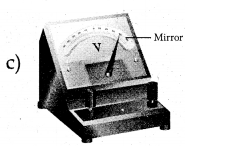
Identify the type of mirror used in each of the application shown below.

Image

Image
Answer
a) Concave mirror
b) Convex mirror
c) Plane mirror
View full question & answer
Question 142 Marks
Define marginal rays.
Answer
The rays travelling far away from the principal axis and fall on the mirror far away from the pole are called as marginal rays.
View full question & answer
Question 152 Marks
Define Centre of curvature.
Answer
Centre of curvature:
The centre of the sphere of which the mirror is a part is called the center of curvature (C) of the mirror.
View full question & answer
Question 162 Marks
Define principal axis.
Answer
Principal axis:
The line joining the pole and the centre of curvature is called the principal axis of the mirror. The light ray travelling along the principal axis towards the mirror after reflection travels back along the same principal axis. It is also called optical axis.
View full question & answer
Question 172 Marks
Define focal length.
Answer
Focal length:
The distance between the pole and the focus is called the focal length (f) of the mirror.
View full question & answer
Question 182 Marks
Define focal plane.
Answer
Focal plane:
The plane through the focus and perpendicular to the principal axis is called the focal plane of the mirror.
View full question & answer
Question 192 Marks
Define Focus or focal point.
Answer
Focus (or) Focal point:
Light rays travelling parallel and close to the principal axis when incident on a spherical mirror, converge at a point for concave mirror or appear to diverge from a point for convex mirror on the principal axis. This point is called the focus or focal point (F) of the mirror.
View full question & answer
Question 202 Marks
Define radius of curvature?
Answer
Radius of curvature:
The radius of the sphere of which the spherical mirror is a part is called the radius of curvature (R) of the mirror.
View full question & answer
Question 212 Marks
Define pole of a mirror?
Answer
The middle point on the spherical surface of the mirror (or) the geometrical center of the mirror is called pole (P) of the mirror.
View full question & answer
Question 222 Marks
Give the condition for nature of objects and images.
Answer
Nature of object/ imageCondition
Real ImageRays actually converge at the image
Virtual ImageRays appear to diverge from the image.
Real ObjectRays actually diverge from the object
Virtual ObjectRays appear to converge at the object
View full question & answer
Question 232 Marks
Two light sources of equal amplitudes interfere with each other. Calculate the ratio of maximum and minimum intensities.
Answer
Let the amplitude by a The intensity is, I $\alpha 4 a ^2 \cos ^2 2(\Phi / 2)$ or $I =4 I _0 \cos ^2 2(\Phi / 2)$
Resultant intensity is maximum when, $ \Phi=0, \cos 0=1, I_{\max } \alpha 4 a^2 $
Resultant amplitude is minimum when
$ \Phi=\pi \cos (\pi / 2)=0, I_{\min }=0$
$I_{\max }: I_{\min }=4 a^2: 0 $
View full question & answer
Question 242 Marks
Differentiate between real and virtual images.
Answer
Real imageVirtual image
i. Image can be formed on the screen.

ii. The image is formed infront of the mirror
The image is formed behind the mirror
iii. Rays actually coverage at the image.

iv. Example:
Rays appear to diverge from the image.
Image formed on a cinema screen.Example :
View full question & answer
Question 252 Marks
What is the reflection of light?
Answer
The bouncing back of light into the same medium when it encounters a reflecting surface is called reflection of light.
View full question & answer
[ 2 Marks Questions ] - Physics STD 12 Questions - Vidyadip