Question 15 Marks
What is astigmatism? How is it caused? How is it corrected?
Answer
View full question & answer→Astigmatism:
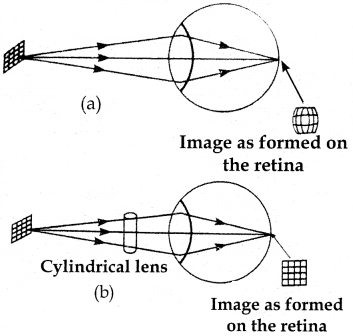
It is the defect of vision in which a person cannot simultaneously see both the horizontal and vertical views of an object with the same clarity. This defect can occur along with myopia or hypermetropia.Cause of astigmatism:
1. This defect occurs when the cornea is not perfectly spherical in shape. It may have a large curvature in the vertical plane than in the horizontal plane or vice versa.
2. If one looks at a wire mesh with such a defect in the evelens, focusing in the vertical plane may not be as sharp as in the horizontal plane or vice versa.
3. Astigmatism results in lines in one direction well focused while those in perpendicular direction will be distorted or curved.
Correction of Astigmatism:
Astigmatism can be corrected by a lens whose one surface is cylindrical. Such a surface focuses rays in one plane but not in the perpendicular plane. By suitably choosing the radius of curvature and axis direction of the cylindrical surface astigmatism can be corrected.
Question 8.
How can we determine the focal length and power of the convex lens required to correct a hypermetropic eye?
Answer:
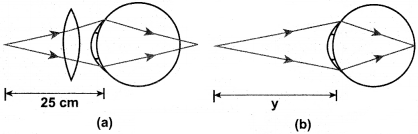
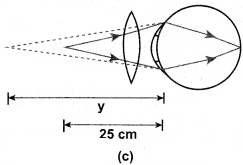
Calculation of focal length and power of correcting lens in hypermetropia.
Let $y =$ distance of the near point $N ^{\prime}$ from the defective eye. Now the near point $N$ of the normal eye is at distance $D =25 cm$. The object placed at $N$ forms its virtual image at $N ^{\prime}$ due to the convex lens.
$
\therefore u =- D , v =- y , f =\text { ? }
$
By lens formula
$
\frac{1}{f}=\frac{1}{v}-\frac{1}{u}=\frac{1}{-y}-\frac{1}{-D}=\frac{y-D}{y D}
$
$\therefore$ Required focal length
$
f =\frac{y D}{y-D}
$
Required power $P =\frac{1}{f}=\frac{y-D}{y D}$
As $y>D$, so both $f$ and $D$ are positive. That is the correcting lens must be a convex lens.
It is the defect of vision in which a person cannot simultaneously see both the horizontal and vertical views of an object with the same clarity. This defect can occur along with myopia or hypermetropia.Cause of astigmatism:
1. This defect occurs when the cornea is not perfectly spherical in shape. It may have a large curvature in the vertical plane than in the horizontal plane or vice versa.
2. If one looks at a wire mesh with such a defect in the evelens, focusing in the vertical plane may not be as sharp as in the horizontal plane or vice versa.
3. Astigmatism results in lines in one direction well focused while those in perpendicular direction will be distorted or curved.
Correction of Astigmatism:
Astigmatism can be corrected by a lens whose one surface is cylindrical. Such a surface focuses rays in one plane but not in the perpendicular plane. By suitably choosing the radius of curvature and axis direction of the cylindrical surface astigmatism can be corrected.
Question 8.
How can we determine the focal length and power of the convex lens required to correct a hypermetropic eye?
Answer:
Calculation of focal length and power of correcting lens in hypermetropia.
Let $y =$ distance of the near point $N ^{\prime}$ from the defective eye. Now the near point $N$ of the normal eye is at distance $D =25 cm$. The object placed at $N$ forms its virtual image at $N ^{\prime}$ due to the convex lens.
$
\therefore u =- D , v =- y , f =\text { ? }
$
By lens formula
$
\frac{1}{f}=\frac{1}{v}-\frac{1}{u}=\frac{1}{-y}-\frac{1}{-D}=\frac{y-D}{y D}
$
$\therefore$ Required focal length
$
f =\frac{y D}{y-D}
$
Required power $P =\frac{1}{f}=\frac{y-D}{y D}$
As $y>D$, so both $f$ and $D$ are positive. That is the correcting lens must be a convex lens.