Questions

Choose the most appropriate answer from the given alternatives and write the option code and the corresponding answer.

🎯

Test yourself on this topic

50 questions · timed · auto-graded

MCQ 11 Mark
When a ray of light enters a glass slab, then
  • A
     its frequency and velocity change
  • B
     only frequency changes
  • C
    its frequency and wavelength change
  • its frequency does not change
Answer
Correct option: D.
its frequency does not change
Hint:
When a ray of light enters a glass slab, its velocity, and wavelength change while frequency does not change.
View full question & answer
MCQ 21 Mark
The light-gathering power of a camera lens depends on
  • its diameter only
  • B
    the ratio of diameter and focal length
  • C
    product of focal length and diameter
  • D
    the wavelength of the light used
Answer
Correct option: A.
its diameter only
its diameter only
Hint:
The light-gathering power of a camera lens is proportional to its area or to the square of its diameter.
View full question & answer
MCQ 31 Mark
Rainbow is formed by _______ of light by droplets of water.
  • dispersion
  • B
    partial polarisation
  • C
    plane polarisation
  • D
    interference
Answer
Correct option: A.
dispersion
dispersion
View full question & answer
MCQ 41 Mark
In the propagation of electromagnetic waves, the angle between the direction of propagation and plane of polarisation is
  •  0°
  • B
    45°
  • C
  • D
    180°
Answer
Correct option: A.
 0°
 0°
View full question & answer
MCQ 51 Mark
In the propagation of light waves, the angle between the plane of vibration and plane of polarisation is
  • A
    10°
  • 90°
  • C
    40°
  • D
    70°
Answer
Correct option: B.
90°
90°
View full question & answer
MCQ 61 Mark
Polaroid glass is used in sunglasses because
  •  it reduces the light intensity to half on account of polarisation
  • B
    it is fashionable
  • C
     it has good colour
  • D
    it is cheaper
Answer
Correct option: A.
 it reduces the light intensity to half on account of polarisation
 it reduces the light intensity to half on account of polarisation
View full question & answer
MCQ 71 Mark
$F_1$ and $F_2$ are focal length of objective and eyepiece respectively of the telescope. The angular magnification for the given telescope is equal to
  • $\frac{F_1}{F_2}$
  • B
    $\frac{F_2}{F_1}$
  • C
    $\frac{F_1 F_2}{F_1+F_2}$
  • D
    $\frac{F_1+F_2}{F_1 F_2}$
Answer
Correct option: A.
$\frac{F_1}{F_2}$
$\frac{F_1}{F_2}$
Hint:
In normal adjustment of the telescope, $|m|=\frac{f_0}{f_e}=\frac{F_1}{F_2}$
View full question & answer
MCQ 81 Mark
Light transmitted by Nicol prism is
  • A
    unpolarised
  •  plane polarised
  • C
    circularly polarised
  • D
    elliptically polarised
Answer
Correct option: B.
 plane polarised
 plane polarised
View full question & answer
MCQ 91 Mark
Light waves can be polarised because they
  • A
    have high frequencies
  • B
    have a short wavelength
  • are transverse
  • D
    can be reflected
Answer
Correct option: C.
are transverse
 are transverse
View full question & answer
MCQ 101 Mark
The angular magnification of a simple microscope can be increased by increasing
  • A
    focal length of lens
  • size of object
  • C
    aperture of lens
  • D
    power of lens
Answer
Correct option: B.
size of object
size of object
View full question & answer
MCQ 111 Mark
When ordinary light is made incident on a quarter-wave plate, the emergent light is
  • A
     linearly polished
  • B
    circularly polarised
  • C
    unpolarised
  • elliptically polarised
Answer
Correct option: D.
elliptically polarised
View full question & answer
MCQ 121 Mark
What is the Brewster angle for air to glass transition? $\left(\mu_{ ag }=1.5\right)$
  • A
    $\tan (1.5)$
  • B
    $\sin (1.5)$
  • C
    $\sin ^{-1}(1.5)$
  • $\tan ^{-1}(1.5)$
Answer
Correct option: D.
$\tan ^{-1}(1.5)$
$\tan ^{-1}(1.5)$
View full question & answer
MCQ 131 Mark
Two light waves from S1 and S2 on reaching points P and Q on a screen in young’s double slit experiment have a path, difference zero and λ /4 respectively. The ratio of light intensities at P and Q will be
  • A
    $4: 1$
  • B
    $3: 2$
  • C
    $\sqrt{ } 2$
  • $2: 1$
Answer
Correct option: D.
$2: 1$
$2: 1$
View full question & answer
MCQ 141 Mark
Which colour of light has the highest speed
  • violet
  • B
    Red
  • C
    green
  • D
    All the same speed
Answer
Correct option: A.
violet
violet
View full question & answer
MCQ 151 Mark
The condition for observing Fraunhofer diffraction from a single slit is that the light wavefront incident on the slit should be
  • A
    Spherical
  • B
    cylindrical
  • plane
  • D
    elliptical
Answer
Correct option: C.
plane
plane
View full question & answer
MCQ 161 Mark
Dispersion of light is caused due to
  • Wavelength
  • B
    intensity of light
  • C
    density of medium
  • D
     none of these
Answer
Correct option: A.
Wavelength
Wavelength
Hint:
Dispersion is due to the dependence of the speed of a wave on its wavelength in any medium.
View full question & answer
MCQ 171 Mark
In which of the following the final image is erect?
  • Simple microscope
  • B
    Compound microscope
  • C
    Astronomical telescope
  • D
    None of these
Answer
Correct option: A.
Simple microscope
Simple microscope
View full question & answer
MCQ 181 Mark
To increase the angular magnification of a simple microscope, one should increase
  • A
    the focal length of the lens
  • the power of the lens
  • C
     the aperture of the lens
  • D
     the object size
Answer
Correct option: B.
the power of the lens
View full question & answer
MCQ 191 Mark
Two lenses of power $3D$ and $-1D$ are kept in contact. What is the focal length and nature of the combined lens?
  • $50 cm$, convex
  • B
    $200 cm$, convex
  • C
    $50 cm$, concave
  • D
    $200 cm$, concave
Answer
Correct option: A.
$50 cm$, convex
$50 cm$, convex
Hint: $ P = P _1+ P _2=3-1=2 D$
$ F =\frac{1}{P}=\frac{1}{2} m =50 cm $
View full question & answer
MCQ 201 Mark
The image formed by an objective of a compound microscope is
  • A
     real and diminished
  • real and enlarged
  • C
    virtual and enlarged
  • D
     virtual and diminished
Answer
Correct option: B.
real and enlarged
real and enlarged
View full question & answer
MCQ 211 Mark
The focal length of a normal eye-lens is about
  • A
    1 mm
  •  2 cm
  • C
    25 cm
  • D
     1 m
Answer
Correct option: B.
 2 cm
 2 cm
View full question & answer
MCQ 221 Mark
Astigmatism is corrected using
  • Cylindrical lens
  • B
     plano-convex lens
  • C
     Plano-concave lens
  • D
    convex lens
Answer
Correct option: A.
Cylindrical lens
Cylindrical lens
View full question & answer
MCQ 231 Mark
In secondary rainbow what is the order of colours observed from earth?
  • A
    Violet innermost, red outermost.
  •  Red innermost, violet outermost.
  • C
    Random.
  • D
    White and dark alternatively.
Answer
Correct option: B.
 Red innermost, violet outermost.
 Red innermost, violet outermost.
View full question & answer
MCQ 241 Mark
A point source of light is placed 4 m below the surface of water of refractive index 5/3. The minimum diameter of a disc which should be placed over the source, on the surface of water to cut-off all light coming out of water is
  • A
     infinite
  • 6 cm
  • C
    4 cm
  • D
    3 cm
Answer
Correct option: B.
6 cm
$6 cm$Hint:$r=\frac{h}{\sqrt{\mu^2-1}}=\frac{4}{\sqrt{\left(\frac{5}{3}\right)^2-1}}=3 cm$
View full question & answer
MCQ 251 Mark
In primary rainbow what is the order of colors observed from earth?
  • Violet innermost, red outermost
  • B
    Red innermost, violet outermost
  • C
    Random
  • D
    White and dark alternatively
Answer
Correct option: A.
Violet innermost, red outermost
View full question & answer
MCQ 261 Mark
The angle of prism is 60° and angle of deviation is 30°. In the position of minimum deviation, the values of angle of incidence and angle of emergence are:
  • A
    i = 45°; e = 50°
  • B
    i = 30°; e = 45°
  • i = 45°; e = 45°
  • D
    i = 30°; e = 30°
Answer
Correct option: C.
i = 45°; e = 45°
i = 45°; e = 45°
View full question & answer
MCQ 271 Mark
The dispersive power of a prism depends on its
  • A
    shape
  • B
    size
  • C
    angle of the prism
  • refractive index of the monitorial of the prism
Answer
Correct option: D.
refractive index of the monitorial of the prism
View full question & answer
MCQ 281 Mark
The wavelength of sodium light in air is $5890 \mathring A$. The velocity of light in air is $3 \times 10^8 ms ^{-1}$. The wavelength of light in a glass of refractive index 1.6 would be close to
  • A
    $5890 \mathring A$
  • $3681 \mathring A$
  • C
    $9424 \mathring A$
  • D
    $15078 \mathring A$
Answer
Correct option: B.
$3681 \mathring A$
$3681 \mathring A$
Hint:
$\mu=\frac{\lambda_a}{\lambda_g} \Rightarrow \lambda_{ g }=\frac{\lambda_a}{\mu}=\frac{5890 \mathring A}{1.6}=3681 \mathring A$
View full question & answer
MCQ 291 Mark
Yellow light is refracted through a prism producing minimum deviation. If i1 and i2 denote the angle of incidence and emergence for this prism, then
  •  i1 = i2
  • B
    i1 > i2
  • C
    i1 < i2
  • D
    i1 + i2 = 90°
Answer
Correct option: A.
 i1 = i2
 i1 = i2
View full question & answer
MCQ 301 Mark
When white light enters a prism, it gets split into its constituent colours, This is due to
  • A
    high density of prism material
  •  because μ is different for different wavelength
  • C
    diffraction of light
  • D
    velocity changes for different frequency
Answer
Correct option: B.
 because μ is different for different wavelength
 because μ is different for different wavelength
View full question & answer
MCQ 311 Mark
If D is the deviation of a normally falling light beam on a thin prism of angle A and δ is the dispersive power of the same prism then
  • A
    D is independent of A
  • B
    D is independent of refractive Index
  • C
    δ is independent of refractive Index
  • δ is independent of A
Answer
Correct option: D.
δ is independent of A
View full question & answer
MCQ 321 Mark
If a glass prism is dipped in water, its dispersive power
  • A
     increases
  • decreases
  • C
    does not change
  • D
     may increase or decrease depending on whether the angle of the prism is less than or greater than 60°
Answer
Correct option: B.
decreases
decreases
View full question & answer
MCQ 331 Mark
A pencil of light rays falls on a plane mirror and forms a real image, so the incident rays are
  • A
    parallel
  • B
    diverging
  • converging
  • D
     statement is false
Answer
Correct option: C.
converging
converging
Hint:
When converging rays fall on a plane mirror, they get reflected a point d in front of the mirror forming a real image.
View full question & answer
MCQ 341 Mark
The focal length of a converging lens are fv and fR for violet and red light respectively. Then
  • A
     fv > fR
  • B
    fv = fR
  •  fv < fR
  • D
    any of the three is possible depending on the value of the average refraction index m
Answer
Correct option: C.
 fv < fR
fv < fR
View full question & answer
MCQ 351 Mark
What causes chromatic aberration?
  • A
    Marginal rays
  • B
    Central rays
  • C
    Difference in radii of curvature of its surfaces
  • Variation of focal length of lens with colour
Answer
Correct option: D.
Variation of focal length of lens with colour
View full question & answer
MCQ 361 Mark
The rays of different colours fail to converge at a point after going through a converging lens. This defect is called
  • A
    spherical aberration
  • B
    distortion
  • C
    coma
  • chromatic aberration
Answer
Correct option: D.
chromatic aberration
View full question & answer
MCQ 371 Mark
Time image formed by an objective of a compound microscope is
  • A
    virtual and diminished
  • B
    real and diminished
  • real and enlarged
  • D
    virtual and enlarged
Answer
Correct option: C.
real and enlarged
real and enlarged
Hint:
The image formed by the objective of a compound microscope is real and enlarged.
View full question & answer
MCQ 381 Mark
The speed of light in an isotropic medium depends on
  • A
    the nature of the source
  •  its wavelength
  • C
    its direction of propagation
  • D
    its intensity
Answer
Correct option: B.
 its wavelength
 its wavelength
View full question & answer
MCQ 391 Mark
The apparent flattening of the sun at sunset and sunrise is due
  • refraction
  • B
    diffraction
  • C
     total internal reflection
  • D
    Interference
Answer
Correct option: A.
refraction
refraction
View full question & answer
MCQ 401 Mark
Which of the following is used in optical fibres?
  • Total internal reflection
  • B
     Diffraction
  • C
    Refraction
  • D
    Scattering
Answer
Correct option: A.
Total internal reflection
Hint:
The working of optical fibres is based on total internal reflection.
View full question & answer
MCQ 411 Mark
When the angle of incidence of a light ray is greater than the critical angle it gets
  • A
    critically refracted
  • B
    totally reflected
  •  total internally reflected
  • D
     totally refracted
Answer
Correct option: C.
 total internally reflected
 total internally reflected
View full question & answer
MCQ 421 Mark
The difference between reflection and total internal reflection is that
  • A
    the laws of reflection hold true for reflection but not for total internal reflection
  • B
    total internal reflection can take place only when light travels from a rarer medium to a denser medium while reflection can take place vice-versa also.
  • reflection can take place when light. travels from rarer medium to denser medium and vice-versa but total internal reflection can take place only when it travels from an optically denser to an optically rarer medium
  • D
    reflection is a natural phenomenon while total internal reflection is man-made.
Answer
Correct option: C.
reflection can take place when light. travels from rarer medium to denser medium and vice-versa but total internal reflection can take place only when it travels from an optically denser to an optically rarer medium
c) reflection can take place when light travels from rarer medium to denser medium and vice-versa but total internal reflection can take place only when it travels from an optically denser to an optically rarer medium
View full question & answer
MCQ 431 Mark
If the light moving in a straight line bends but a small in fixed angle, it may be a case of
  • A
    reflection
  • B
    Frequency
  • C
    Velocity
  • Amplitude
Answer
Correct option: D.
Amplitude
Amplitude
View full question & answer
MCQ 441 Mark
When a ray of light enters a glass slab from air
  • its wavelength decreases
  • B
    its wavelength increases
  • C
    its frequency increases
  • D
    neither its wavelength nor its frequency changes
Answer
Correct option: A.
its wavelength decreases
(a) its wavelength decreases
Hint:
Wavelength, $\lambda=\frac{\text { Velocity }}{\text { Frequency }}=\frac{u}{v}$
When light travels from air to glass, frequency $v$ remains unchanged, velocity $u$ decreases and hence wavelength $X$ also decreases.
View full question & answer
MCQ 451 Mark
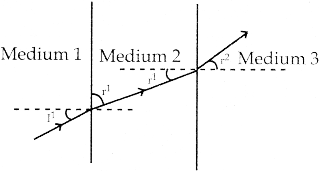
The following figure shows refraction of light at the interface of three media
Image

Correct the order of optical density (d) of the media is
  • A
    $d 1>d 2>d 3$
  • B
    $d 2>d 1>d 3$
  • C
    $d 3>d 1>d 2$
  • $d 2>d 3>d 1$
Answer
Correct option: D.
$d 2>d 3>d 1$
(d) $d_2>d_3>d_1$
As $r_2<i$ incident ray bend towards normal.
$\Rightarrow$ medium 2 is denser (or) $r _2< i _1$
$\Rightarrow$ medium 3 is denser than medium 1, Also $r_2>r_1$
$\Rightarrow$ medium 2 is denser than medium 3
View full question & answer
MCQ 461 Mark
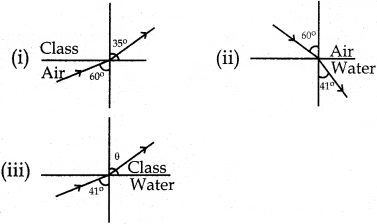
Refraction of light from air to glass and from air to water is shown in figure (i) and figure (ii) below. The value of the angle – in the case of refraction as shown

Image
  • A
    $30°$
  • $35°$
  • C
    $60°$
  • D
     $41°$
Answer
Correct option: B.
$35°$
(b) $35^{\circ}$
Solution:
${ }_a \mu_g=\frac{\sin 60^{\circ}}{\sin 35^{\circ}} $
${ }_{ a } \mu_{ w }=\frac{\sin 60^{\circ}}{\sin 41^{\circ}} $
${ }_w{ }^\mu g =\frac{\sin 41^{\circ}}{\sin \theta} $
${ }_a \mu_g \times{ }_w \mu_g={ }_a \mu_g $
$\frac{\sin 60^{\circ}}{\sin 41^{\circ}} \times \frac{\sin 41^{\circ}}{\sin \theta}=\frac{\sin 60^{\circ}}{\sin 35^{\circ}} $
$\sin \theta=\sin 35^{\circ} $
$\theta=35^{\circ} $
View full question & answer
MCQ 471 Mark
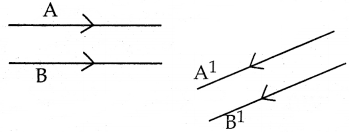
Figures shows two rays A and B being reflected by a mirror and going as A and B. The mirror

Image
  •  is plane
  • B
    is convex
  • C
    is concave
  • D
    maybe any spherical mirror
Answer
Correct option: A.
 is plane
(a) is plane
View full question & answer
Question 481 Mark
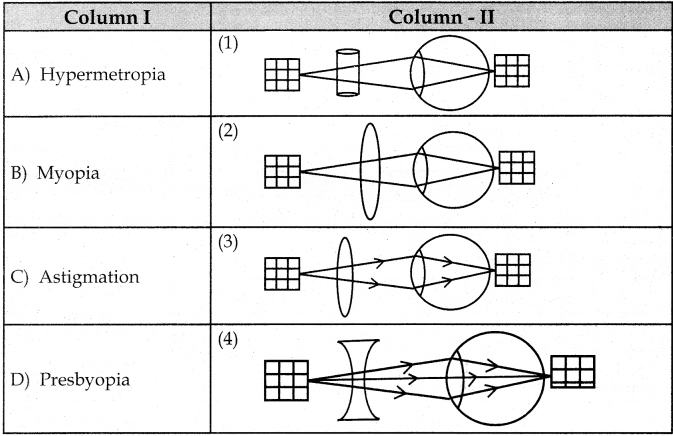
Match the column – I and column – II:
Image

a) (A) → (3); (B) →(1); (C) → (2); (D) →(4)
b) (A) → (4); (B)→ (3); (C) →(2); (D) → (1)
c) (A) →(1); (B) → (2); (C) → (3); (D) → (4)
d) (A) → (3); (B)→ (4); (C) → (1); (D) → (2)
Answer
 (A) → (3); (B)→ (4); (C) → (1); (D) → (2)
View full question & answer
Question 491 Mark
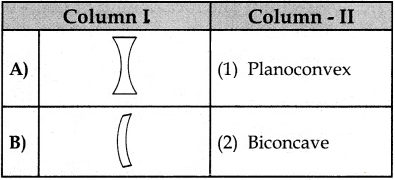
Match the column – I and column – II:
Image

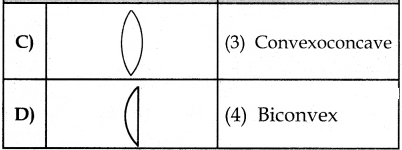
Image

a) (A) → (3); (B) → (1); (C) → (2); (D) → (4)
b) (A) → (2); (B) → (3); (C) → (4); (D) → (1)
c) (A) → (2); (B) → (4); (C) → (3); (D) → (1)
d) (A) → (3); (B) → (2); (C) → (1); (D) → (4)

Answer
b) (A) → (2); (B) → (3); (C) → (4); (D) → (1)
View full question & answer
Question 501 Mark
Match the column – I and column – II:
Column IColumn - II
A) An object is placed at focus before a convex mirrorMagnification is -oo
B) An object is placed at centre of curvature before a concave mirrorMagnification is 0.5
C) An object is placed at focus before a concave mirrorMagnification is +1
D) An object is placed at centre of curvature before a convex mirrorMagnification is 0.33

a) (A) → (2); (B) → (3); (C) → (4); (D) → (1)
b) (A) → (2); (B) → (4); (C) → (3); (D) → (1)
c) (A) → (2); (B) → (4); (C) → (1); (D) → (3)
d) (A) → (3); (B) → (1); (C) → (2); (D) → (4)

Answer
c) (A) → (2); (B) → (4); (C) → (1); (D) → (3)
View full question & answer
Choose the most appropriate answer from the given alternativ - Physics STD 12 Questions - Vidyadip