Question types

T1 CH1 Measurements question types

104 questions across 9 question groups — pick any mix to generate a Science paper with step-by-step answer keys.

104
Questions
9
Question groups
5
Question types
Sample Questions

T1 CH1 Measurements questions

One sample from each question group in this chapter. Select any group above to see the full set with answer keys.

Q 2MCQ1 Mark
Two spheres have mass and volume in the ratio 2:1. The ratio of their density is ______.
  • A
    1:2
  • 2:1
  • C
    4:1
  • D
    1:4

Answer: B.

View full solution
Assertion: Iron ball sinks in water.
Reason: Water is denser than iron.
  • A
    Both assertion and reason are true and reason is the correct explanation of assertion.
  • Both assertion and reason are true, but reason is not the correct explanation of assertion.
  • C
    Assertion is true but reason is false.
  • D
    Assertion is false but reason is true.

Answer: B.

View full solution
Assertion: Wood floats in water.
Reason: Water is a transparent liquid.
  • A
    Both assertion and reason are true and reason is the correct explanation of assertion.
  • Both assertion and reason are true, but reason is not the correct explanation of assertion.
  • C
    Assertion is true but reason is false.
  • D
    Assertion is false but reason is true.

Answer: B.

View full solution
Assertion: Volume of a stone is found using a measuring cylinder.
Reason: Stone is an irregularly shaped object.
  • Both assertion and reason are true and reason is the correct explanation of assertion.
  • B
    Both assertion and reason are true, but reason is not the correct explanation of assertion.
  • C
    Assertion is true but reason is false.
  • D
    Assertion is false but reason is true.

Answer: A.

View full solution
Assertion (A): It is easier to swim in sea water than in river water.
Reason (R) : Density of sea water is more than that of river water
  • A
    Both A and R are true but R is not the correct reason.
  • Both A and R are true and R is the correct reason.
  • C
    A is true but R is false.
  • D
    A is false but R is true

Answer: B.

View full solution
Assertion (A): The distance between two celestial bodies is measured by the unit of light year.
Reason (R) : The distance travelled by the light in one year in vacuum is called one light year.
  • Both A and R are true but R is not the correct reason.
  • B
    Both A and R are true and R is the correct reason.
  • C
    A is true but R is false.
  • D
    A is false but R is true

Answer: A.

View full solution
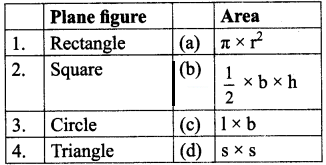
Match the following items.
Column 1 Column 2
1. Area a. g/cm$^3$
2. Length b. measuring jar
3. Density c. amount of a substance
4. Volume d. rope
5. Mass e. plane figures
View full solution
Questions based on Higher Order Thinking Skills:
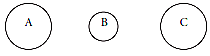
There are three spheres A, B, C as shown below.
Sphere A and B are made of same material. Sphere C is made of a different material. Spheres A and C have equal radii. The radius of sphere B is half that of A. Density of A is double that of C.

Now answer the following questions.
  1. Find the ratio of masses of spheres A and B.
  2. Find the ratio of volumes of spheres A and B.
  3. Find the ratio of masses of spheres A and C.
View full solution
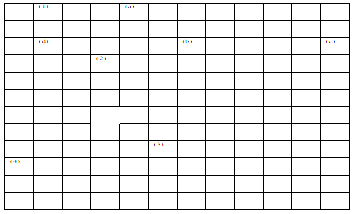
Cross word puzzle.

Clues – Across
  1. SI unit of temperature;
  2. A derived quantity;
  3. Mass per unit volume;
  4. Maximum volume of liquid a container can hold
    Clues – Down
  1. A derived quantity
  2. SI unit of volume
  3. A liquid denser than iron
  4. A unit of length used to measure very long distances
View full solution
Two spheres of same size are made from copper and iron respectively. Find the ratio between their masses (Density of copper is $8,900 kg / m$ and iron is $7,800 kg / m ^3$ ).
View full solution

Generate a T1 CH1 Measurements paper free

Pick question groups from the list above, set marks and difficulty, and export a branded PDF with step-by-step answer keys. First 3 chapters free — no signup.

Download App