Question 15 Marks
Estimate the fraction of molecular volume to the actual volume occupied by oxygen gas at STP. Take the diameter of an oxygen molecule to be $3\mathring{\text{A}}$
AnswerDiameter of an oxygen molecule, $d = 3A = 3 \times 10^{-10}m$. Consider one mole of oxygen gas at STP, which contain total $NA = 6.023 \times 10^{23}$ molecules. Actual molecular volume of $6.023 \times 10^{23}$ oxygen molecules $\text{V}_\text{actual}=\frac{4}{3}\pi\text{r}^3\text{N}\text{A}$
$=\frac{4}{3}\times3.14\times(1.5)^3\times10^{-3}\times6.02\times10^{23}\text{m}^3$
$=8.51\times10^{-6}\text{m}^3$
$=8.15\times10^{-3}\text{litre}$
$\big[\because1\text{m}^3=10^3\text{litre}\big]$
$\therefore$ Molecular volumn of one mole of oxygen $\text{V}_\text{actual}=8.51\times10^{-3}\text{litre}$ At STP, the volume of one mole of oxygen $\text{V}_\text{molar}=22.4\text{ litre}$
$\frac{\text{V}_{\text{actual}}}{\text{V}_\text{molar}}=\frac{8.51\times10^{-3}}{22.4}$
$=3.8\times10^{-1}\approx4\times10^{-4}$
View full question & answer→Question 25 Marks
Estimate the average thermal energy of a helium atom at:
- Room temperature $(27°C)$
- The temperature on the surface of the Sun(6000K)
- The temperature of 10 million kelvin (the typical core temperature in the case of a star).
Answer
- At room temperature, T = 27°C = 300K
Average thermal energy $=\Big(\frac{3}{2}\Big)\text{KT}$
Where k is Boltzmann constant = $1.38 \times 10^{-23}m^2kg s^{-2}K^{-1}$
$\therefore\ \Big(\frac{3}{2}\Big)\text{KT}=\Big(\frac{3}{2}\Big)\times1.38\times10^{-38}\times300$
$=6.21\times10^{-21}\text{J}$
Hence, the average thermal energy of a helium atom at room temperature $(27^\circ C)$ is $6.21 \times 10^{-21}J$
- On the surface of the sun, T = 6000K
$=\Big(\frac{3}{2}\Big)\times1.38\times10^{-38}\times6000$
$=1.241\times10^{-19}\text{J}$
Hence, the average thermal energy of a helium atom on the surface of the sun is $1.241 \times 10^{-19}J$.
- At temperature, $T = 10^7K$
Average thermal energy $=\Big(\frac{3}{2}\Big)\text{KT}$
$=\Big(\frac{3}{2}\Big)\times1.38\times10^{-23}\times10^{7}$
$=2.07\times10^{-16}\text{J}$
Hence, the average thermal energy of a helium atom at the core of a star is $2.07 \times 10^{-16}J$. View full question & answer→Question 35 Marks
Given below are densities of some solids and liquids. Give rough estimates of the size of their atoms:
|
Substance
|
Atomic Mass(u)
|
Density $(10^3kgm^{-3})$
|
|
Carbon (diamond)
Gold
Nitrogen (liquid)
Lithium
Fluorine (liquid)
|
12.01
197.00
14.01
6.94
19.00
|
2.22
19.32
1.00
0.53
1.14
|
$\big[$Hint: Assume the atoms to be ‘tightly packed’ in a solid or liquid phase, and use the known value of Avogadro’s number. You should, however, not take the actual numbers you obtain for various atomic sizes too literally. Because of the crudeness of the tight packing approximation, the results only indicate that atomic sizes are in the range of a few $\mathring{\text{A}}\big].$ AnswerIf r is the radius of the atom, then volume of each atom $=\frac{4}{3}\pi\text{r}^3$ Volume of all atoms in one mole of substance $=\frac{4}{3}\pi\text{r}^3\times\text{N}=\frac{\text{M}}{\rho}$
$\therefore\ \text{r}=\Big[\frac{3\text{M}}{4\pi\rho\text{N}}\Big]^{\frac{1}{3}}$ For Carbon, $\text{M}=12.01\times10^{-3}\text{kg}$
$\rho=2.22\times10^{3}\text{kg}\text{m}^{-3}$
$\text{r}=\frac{3\times12.01\times10^{-3}}{4\times\frac{22}{7}\times(2.2\times10^{23})\times(6.023\times10^{23})}$
$=1.29\times10^{-10}\text{m}$
$=1.29\mathring{\text{A}}$ Similarly, for gold, $\text{r}=1.59\mathring{\text{A}}$ for liquid nitrogen, $\text{r}=1.77\mathring{\text{A}}$for lithium, $\text{r}=1.73\mathring{\text{A}}$
for liquid fluorine, $\text{r}=1.88\mathring{\text{A}}$
View full question & answer→Question 45 Marks
From a certain apparatus, the diffusion rate of hydrogen has an average value of $28.7 \mathrm{~cm}^3 \mathrm{~s}^{-1}$. The diffusion of another gas under the same conditions is measured to have an average rate of $7.2 \mathrm{~cm}^3 \mathrm{~s}^{-1}$. Identify the gas. [Hint: Use Graham's law of diffusion $\frac{\mathrm{R}_1}{\mathrm{R}_2}=\left(\frac{\mathrm{M}_2}{\mathrm{M}_1}\right)^{\frac{1}{2}}$, where $\mathrm{R}_1, \mathrm{R}_2$ are diffusion rates of gases 1 and 2 , and $\mathrm{M}_1$ and $\mathrm{M}_2$ their respective molecular masses. The law is a simple consequence of kinetic theory]
AnswerRate of diffusion of hydrogen, $R_1= 28.7cm^3 s^{-1}$ Rate of diffusion of another gas, $R_2 = 7.2cm^3 s^{-1}$ According to Graham’s Law of diffusion, we have $\frac{\text{R}_1}{\text{R}_2}=\sqrt{\frac{\text{M}_2}{\text{M}_1}}$ where, $M_1$ is the molecular mass of hydrogen = $2.020g\ M_2$ is the molecular mass of the unknown gas $\therefore\text{ M}_2=\text{M}_1\Big(\frac{\text{R}_1}{\text{R}_2}\Big)^2$
$=2.02\Big(\frac{28.7}{7.2}\Big)^2=32.09\text{g}$ 32g is the molecular mass of oxygen. Hence, the unknown gas is oxygen.
View full question & answer→Question 55 Marks
Shows plot of $\frac{\text{PV}}{\text{T}}$ versus P for $1.00 \times 10^{-3}kg$ of oxygen gas at two different temperatures: If we obtained similar plots for $1.00 \times 10^{-3}kg$ of hydrogen, would we get the same value of $\frac{\text{PV}}{\text{T}}$ at the point where the curves meet on the y-axis? If not, what mass of hydrogen yields the same value of $\frac{\text{PV}}{\text{T}}$ (for low pressure high temperature region of the plot)? (Molecular mass of $H_2 = 2.02u, of O_2 = 32.0u, R = 8.31J mo1^{-1}K^{-1}$).
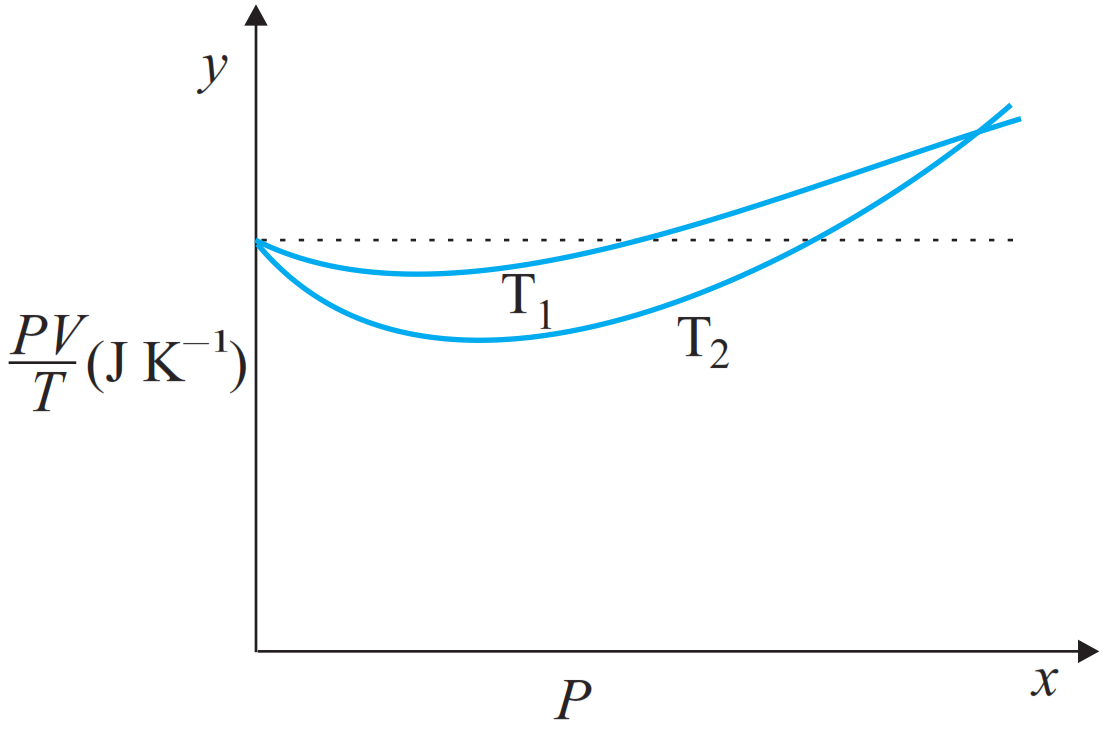
AnswerIf we obtain similar plots for $1.00 \times 10^{-3}kg$ of hydrogen, then we will not get the same value of $\frac{\text{PV}}{\text{T}}$ at th point where the curves meet the y-axis. This is because the molecular mass of hydrogen (2.02u) is different from that of oxygen (32.0u). We have, $\frac{\text{PV}}{\text{T}}=0.26\text{Jk}^{-1}$
$\text{R} = 8.314\text{J mole}^{-1}\text{K}^{-1}$ Molecular mass (M) of $H_2 = 2.02u$ $\frac{\text{PV}}{\text{T}}=\mu\text{R}$ at constant temperature Where, $\mu=\frac{\text{m}}{\text{M}}$ m = Mass of $H_2$
$\therefore\text{ m}=\Big(\frac{\text{PV}}{\text{T}}\Big)\times\Big(\frac{\text{M}}{\text{R}}\Big)$
$=\frac{0.26\times2.02}{8.31}$
$=6.3\times10^{-2}\text{g}=6.3\times10^{-5}\text{kg}$ Hence, $6.3 \times 10^{-5}kg of H_2$ will yield the same value of $\frac{\text{PV}}{\text{T}}$
View full question & answer→Question 65 Marks
Shows plot of $\frac{\text{PV}}{\text{T}}$ versus P for $1.00 \times 10^{-3}kg$ of oxygen gas at two different temperatures: What is the value of $\frac{\text{PV}}{\text{T}}$ where the curves meet on the y-axis?
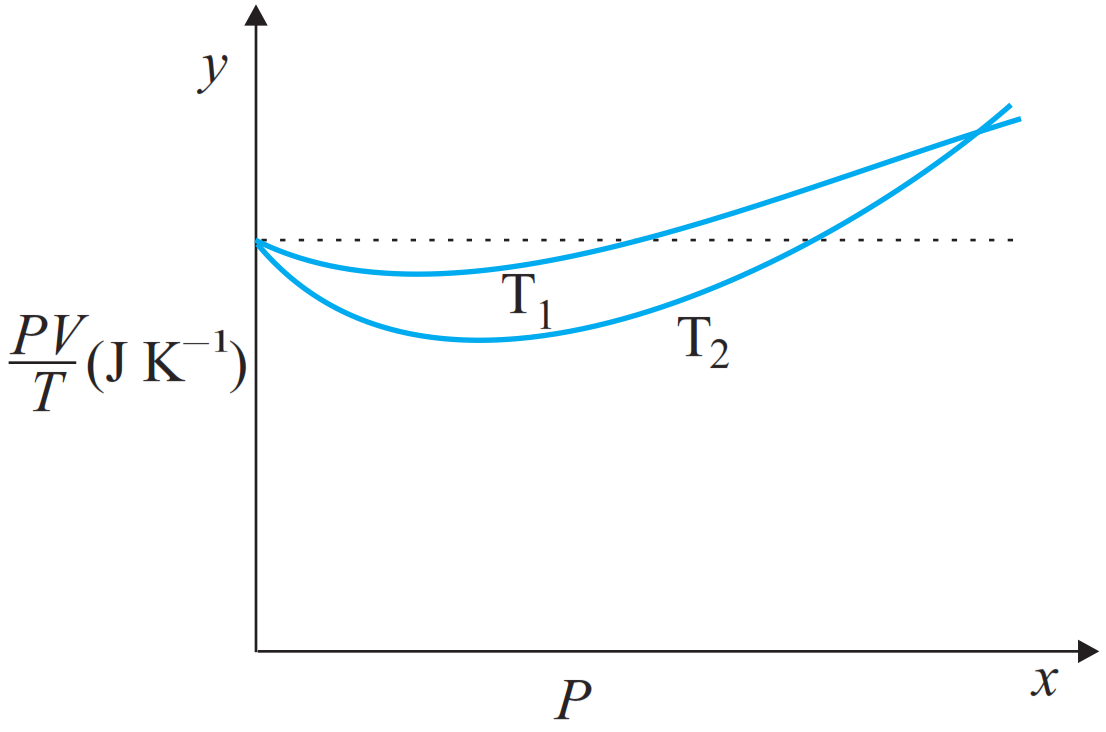
AnswerThe value of the ratio $\frac{\text{PV}}{\text{T}},$ where the two curves meet, is $\mu\text{R}.$ This is because the ideal gas equation is given as, $\text{PV}=\mu\text{RT}$
$\frac{\text{PV}}{\text{T}}=\mu\text{R}$ Where, P is the pressure. T is the temperature. V is the volume. $\mu$ is the number of moles. R is the universal constant. Molecular mass of oxygen = 32.0g Mass of oxygen = $1 \times 10^{-3}kg = 1g R = 8.314J mole^{-1}K^{-1}$
$\therefore\ \frac{\text{PV}}{\text{T}}=\Big(\frac{1}{32}\Big)\times8.314$
$=0.26\text{Jk}^{-1}$ Therefore, the value of the ratio $\frac{\text{PV}}{\text{T}},$ where the curve meet on the y-axis, is $0.26JK^{-1}$
View full question & answer→Question 75 Marks
An air bubble of volume $1.0cm^3$ rises from the bottom of a lake 40m deep at a temperature of 12°C. To what volume does it grow when it reaches the surface, which is at a temperature of 35°C?
AnswerVolume of the air bubble, $V_1 = 1.0cm^3 = 1.0 \times 10^{-6}m^3$ Bubble rises to height, d = 40m Temperature at a depth of 40 m, $T_1 = 12^\circ C = 285K$ Temperature at the surface of the lake, $T_2 = 35^\circ C = 308K$ The pressure on the surface of the lake, $P_2 = 1 atm = 1 \times 1.013 \times 10^5Pa$
The pressure at the depth of 40m $P_1 = 1$ atm + dpg Where, p is the density of water = $10^3kg/m^3$ g is the acceleration due to gravity = $9.8m/s^2 $
$\therefore P_1 = 1.013 \times 10^5 + 40 \times 10^3 \times 9.8 = 493300Pa$
We have, $\frac{\text{P}_1\text{V}_1}{\text{T}_1}=\frac{\text{P}_2\text{V}_2}{\text{T}_2}$ Where, $V_2$ is the volume of the air bubble when it reaches the surface $\text{V}_2=\frac{\text{P}_1\text{V}_1\text{T}_2}{\text{T}_1\text{P}_2}$
$=\frac{493300\times(1.0\times10^{-6})308}{285\times1.013\times10^{5}} = 5.263 \times 10^{-6}m^3$ or $5.263cm^3$ Therefore, when the air bubble reaches the surface, its volume becomes 5.263cm^3.
View full question & answer→Question 85 Marks
A gas in equilibrium has uniform density and pressure throughout its volume. This is strictly true only if there are no external influences. A gas column under gravity, for example, does not have uniform density (and pressure). As you might expect, its density decreases with height. The precise dependence is given by the so-called law of atmospheres: $\text{n}_2=\text{n}_1\text{exp}\Big[\frac{-\text{mg}}{\text{k}_\text{B}\text{T}}(\text{h}_2-\text{h}_1)\Big]$ where $n_2, n_1$ refer to number density at heights $h_2$ and $h_1$respectively. Use this relation to derive the equation for sedimentation equilibrium of a suspension in a liquid column: $\text{n}_2=\text{n}_1\text{exp}\Big[\frac{-\text{mgN}_\text{A}(\rho-\rho')(\text{h}_2-\text{h}_1)}{(\rho\text{RT})}\Big]$ where $\rho$ is the density of the suspended particle, and $\rho'$ that of surrounding medium. [NA is Avogadro’s number, and R the universal gas constant] [Hint: Use Archimedes principle to find the apparent weight of the suspended particle]
AnswerConsidering the particles and molecules to be spherical, the weight of the particle is $\text{W}=\text{mg}=\frac{4}{3}\pi\text{r}^3\rho\text{g}\ ...(\text{i})$ Where r = radius of the particle and $\rho=$ density of the particle. Its motion under gravity causes buoyant force to act upward which is equal to B = Volume of particle × fensity of the surrounding medium × g $=\frac{4}{3}\pi\text{r}^3\rho'\text{g}\ ...(\text{ii})$ If F be the downward force acting on the particle, then $\text{F}=\text{W}-\text{B}=\frac{4}{3}\pi\text{r}^3(\rho-\rho')\text{g}\ ...(\text{iii})$ Also $\text{n}_2=\text{n}_1\text{exp}\Big[\frac{-\text{mg}}{\text{k}_\text{B}\text{T}}(\text{h}_2-\text{h}_1)\Big]\ ...(\text{iv})$ Where KB = Boltzman constant $n_1$ and $n_2$ are number densities at heights $h_1$ and $h_2$ respectively. Here, mg can be replaced by effective force F given by equation (iii) $\therefore$ From (iii) and (iv) we get $\text{n}_2=\text{n}_1\text{exp}\Big[-\frac{4\pi}{3}\text{r}^3\frac{(\rho-\rho')}{\text{k}_\text{B}\text{T}}\text{g}(\text{h}_2-\text{h}_1)\Big]$ $\text{n}_2=\text{n}_1\text{exp}\Bigg[-\frac{4\pi}{3}\text{r}^3\frac{\rho\text{g}\big(1-\frac{\rho'}{\rho}\big)(\text{h}_2-\text{h}_1)}{\big(\frac{\text{RT}}{\text{N}_\text{A}}\big)}\Bigg]$ $\Big[\because\text{ k}_\text{B}=\frac{\text{R}}{\text{N}_\text{A}}\Big]$ $\text{n}_2=\text{n}_1\text{exp}\Bigg[-\frac{\text{mgN}_\text{A}\big(1-\frac{\rho'}{\rho}\big)(\text{h}_2-\text{h}_1)}{\text{RT}}\Bigg]$ Which is required relation where, $\frac{4}{3}\pi\text{r}^3\rho\text{g}=$ mass of the particle × g = mg
View full question & answer→Question 95 Marks
Estimate the mean free path and collision frequency of a nitrogen molecule in a cylinder containing nitrogen at 2.0 atm and temperature 17°C. Take the radius of a nitrogen molecule to be roughly $1.0\mathring{\text{A}}$ Compare the collision time with the time the molecule moves freely between two successive collisions (Molecular mass of $N^2 = 28.0u$).
AnswerMean free path $= 1.11 \times 10^{-7}m$
Collision frequency $= 4.58 \times 10^9s^{-1}$
Successive collision time $= 500 \times ($Collision time$)$
Pressure inside the cylinder containing nitrogen, $P = 2.0$
atm $= 2.026 \times 10^5Pa$
Temperature inside the cylinder, $T = 17^\circ C =290K$
Radius of a nitrogen molecule,
$\text{r}=1.0\mathring{\text{A}}=1\times10^{10}\text{m}$
Diameter, $d = 2 \times 1 \times 10^{10} = 2 \times 10^{10}m$
Molecular mass of nitrogen,$ M = 28.0g = 28 \times 10^{-3}kg$
The root mean square speed of nitrogen is given by the relation,
$\text{v}_\text{rms}=\sqrt{\frac{3\text{RT}}{\text{M}}}$
where, R is the universal gas constant $= 8.314J\ mole^{-1}k^{-1}$
$\therefore\text{ v}_\text{rms}=\frac{3\times8.314\times290}{28\times10^{-3}}=508.26\text{m/s}$
The mean free part (L) is given by relation,
$\text{l}=\frac{\text{KT}}{\sqrt{2}\times\text{d}^2\times\text{P}}$
where, K is the boltzmann constant $= 1.38 \times 10^{-23}kgm^2s^{-2}k^{-1}$
$\therefore\text{ l}=\frac{1.38\times10^{-23}\times290}{\sqrt{2}\times3.14\times(2\times10^{-10})^2\times2.026\times10^{5}}$
$=1.11\times10^{-7}\text{m}$
Collision frequency $=\frac{\text{v}_\text{rms}}{\text{l}}$
$=\frac{508.26}{(1.11\times10^{-7})}=4.58 \times 10^9\text{s}^{-1}$ Collision time is given as, $\text{T}=\frac{\text{d}}{\text{v}_\text{rms}}$
$=\frac{2\times10^{-10}}{508.26}=3.93\times10^{-13}\text{s}$ Time taken between successive collisions, $\text{T}'=\frac{\text{l}}{\text{V}_\text{rms}}$
$=\frac{1.11\times10^{-7}}{508.26}=2.18\times10^{-10}\text{s}$
$\therefore\ \frac{\text{T}'}{\text{T}}=\frac{2.18\times10^{-10}}{(3.93\times10^{-13})}=500$
Hence, the time taken between successive collisions is 500 times the time taken for a collision.
View full question & answer→Question 105 Marks
A metre long narrow bore held horizontally (and closed at one end) contains a $76cm$ long mercury thread, which traps a $15cm$ column of air. What happens if the tube is held vertically with the open end at the bottom?
AnswerLength of the narrow bore, $\mathrm{L}=1 \mathrm{~m}=100 \mathrm{~cm}$ Length of the mercury thread, $\mathrm{I}=76 \mathrm{~cm}$ Length of the air column between mercury and the closed end, $\mathrm{I}_{\mathrm{a}}=15 \mathrm{~cm}$ Since the boreis held vertically in air with the open end at the bottom, the mercury length that occupies the air space is, $100-(76+15)=9 \mathrm{~cm}$ Hence, the total length of the air column $=15+9=24 \mathrm{~cm}$ Let h cm of mercury flow out as a result of atmospheric pressure. $\therefore$. Length of the air column in the bore $=24+\mathrm{h} \mathrm{cm}$ And, length of the mercury column $=76-\mathrm{h} \mathrm{cm}$ Initial pressure, $\mathrm{P}_1=76 \mathrm{~cm}$ of mercury Initial volume, $\mathrm{V}_1=15 \mathrm{~cm}^3$ Final pressure, $\mathrm{P}_2=76-(76-\mathrm{h})=\mathrm{hcm}$ of mercury Final volume, $\mathrm{V}_2=(24+$ h) $\mathrm{cm}^3$ Temperature remains constant throughout the process. $\therefore \mathrm{P}_1 \mathrm{~V}_1=\mathrm{P}_2 \mathrm{~V}_2=76 \times 15=\mathrm{h}(24+\mathrm{h}) \mathrm{h}^2+24 \mathrm{~h}-1140$ $=0 \therefore h=-24+$ underroot $\left[(24)^2+4 \times 1 \times 1140\right] / 2 \times 1=23.8 \mathrm{~cm}$ or -47.8 cm Height cannot be negative. Hence, 23.8 cm of mercurywill flow out from the boreand 52.2 cm of mercury will remain in it. The length of the air column will be $24+23.8=47.8 \mathrm{~cm}$
View full question & answer→Question 115 Marks
An oxygen cylinder of volume 30 litres has an initial gauge pressure of 15 atm and a temperature of 27°C. After some oxygen is withdrawn from the cylinder, the gauge pressure drops to 11 atm and its temperature drops to 17°C. Estimate the mass of oxygen taken out of the cylinder $(R = 8.31J\ mol^{-1}K^{-1},$ molecular mass of $O_2 = 32u).$
AnswerVolume of oxygen, $V_1 = 30$ litres $= 30 \times 10^{-3}m^3$
Gauge pressure, $P_1 = 15$ atm $= 15 \times 1.013 \times 10^5Pa$
Temperature, $T_1 = 27^\circ C = 300K$
Universal gas constant, $R = 8.314\ J\ mole^{-1}K^{-1}$
Let the initial number of moles of oxygen gas in the cylinder be $n_1.$
The gas equation is given as,
$P_1V_1 = n_1RT_1 \text{n}_1 = \frac{\text{P}_1\text{V}_1}{\text{RT}_1}$
$=\frac{(15.195\times10^5 \times 30 \times 10^{-3})}{(8.314 \times 300)}=18.276$
But $\text{n}_1=\frac{\text{m}_1}{\text{M}}$
Where, $m_1 =$ Initial mass of oxygen
$M = $ Molecular mass of oxygen $= 32g $
$m_1 = n_1M = 18.276 \times 32 = 584.84g$
After some oxygen is withdrawn from the cylinder, the pressure and temperature reduces.
Volume, $V_2 = 30$ litres $= 30 \times 10^{-3}m^3$
Gauge pressure, $P_2 = 11\ atm = 11 \times 1.013 \times 10^5Pa$
Temperature, $T_2 = 17^\circ C = 290K$
Let $n_2 $ be the number of moles of oxygen left in the cylinder.
The gas equation is given as, $P_2V_2 = n_2RT_2$
$\therefore\ \text{n}_2=\frac{\text{P}_2\text{V}_2}{\text{RT}_2}$
$=\frac{11.143\times10^{5}\times30\times10^{-3}}{8.314\times290}=13.86$
But $\text{n}_2=\frac{\text{m}_2}{\text{M}}$
Where, $m_2$ is the mass of oxygen remaining in the cylinder $m_2 = n_2M = 13.86 \times 32 = 453.1g$
The mass of oxygen taken out of the cylinder is given by the relation, Initial mass of oxygen in the cylinder - Final mass of oxygen in the cylinder
$= m_1 - m_2 = 584.84 g - 453.1g = 131.74g = 0.131kg$
Therefore, 0.131kg of oxygen is taken out of the cylinder.
View full question & answer→Question 125 Marks
Three vessels of equal capacity have gases at the same temperature and pressure. The first vessel contains neon (monatomic), the second contains chlorine (diatomic), and the third contains uranium hexafluoride (polyatomic). Do the vessels contain equal number of respective molecules? Is the root mean square speed of molecules the same in the three cases? If not, in which case is vrms the largest?
AnswerAll contain the same number of the respective molecules. No. The root mean square speed of neon is the largest. Since the three vessels have the same capacity, they have the same volume. Hence, each gas has the same pressure, volume, and temperature. According to Avogadro's law, the three vessels will contain an equal number of the respective molecules. This number is equal to Avogadro's number, $N = 6.023 \times 10^{23}$. The root mean square speed $(V_{rms})$ of a gas of mass m, and temperature T, is given by the relation, $V_{rms}$= underroot 3kT/m Where, k is Boltzmann constant For the given gases, k and T are constants. Hence $V_{rms}$ depends only on the mass of the atoms, i.e., $\text{V}_{\text{rms}}\alpha$ underroot1/m Therefore, the root mean square speed of the molecules in the three cases is not the same. Among neon, chlorine, and uranium hexafluoride, the mass of neon is the smallest. Hence, neon has the largest root mean square speed among the given gases.
View full question & answer→Question 135 Marks
At what temperature is the root mean square speed of an atom in an argon gas cylinder equal to the rms speed of a helium gas atom at$-20°C$? (atomic mass of $Ar = 39.9u,$ of $He = 4.0u$).
AnswerTemperature of the helium atom, $T_{He} = -20^\circ C= 253K$ Atomic mass of argon, $M_{Ar}= 39.9u$ Atomic mass of helium, $M_{He} = 4.0u$ Let, $(v_{rms})_{Ar}$ be the rms speed of argon. Let $(v_{rms})_{He}$ be the rms speed of helium. The rms speed of argon is given by $(\text{v}_{\text{rms}})_\text{Ar}=\sqrt{\frac{3\text{RT}_{\text{Ar}}}{\text{M}_\text{Ar}}}\ ...(\text{i})$ where, R is the universal gas constant TAr is temperature of argon gas The rms speed of helium is given by, $(\text{v}_{\text{rms}})_\text{He}=\sqrt{\frac{3\text{RT}_{\text{He}}}{\text{M}_\text{He}}}\ ....(\text{ii})$ It is given that, $(\text{v}_{\text{rms}})_\text{Ar}=(\text{v}_{\text{rms}})_\text{He}$ $\sqrt{\frac{3\text{RT}_{\text{Ar}}}{\text{M}_\text{Ar}}}=\sqrt{\frac{3\text{RT}_{\text{He}}}{\text{M}_\text{He}}}$ $\frac{\text{T}_\text{Ar}}{\text{M}_\text{Ar}}=\frac{\text{T}_\text{He}}{\text{M}_\text{He}}$ $\text{T}_\text{Ar}=\frac{\text{T}_\text{He}}{\text{M}_\text{He}}\times\text{M}_\text{Ar}$ $=\frac{253}{4}\times39.9$ $= 2523.675 = 2.52 × 10³\text{K}$ Therefore, the temperature of the argon atom is $2.52 \times 10^3K$.
View full question & answer→Question 145 Marks
A gas mixture consists of $2.0$ moles of oxygen and $4.0$ moles of neon at temperature T. Neglecting all vibrational modes, calculate the total internal energy of the system. (Oxygen has two rotational modes.)
AnswerTo find total energy of a given molecule of a gas we must find its degree of freedom. In molecule of oxygen it has 2 atom. So it has degree of freedom 3T + 2R = 5, so total internal energy $=\frac{5}{2}\text{RT}$ per mole as gas $O_2$ is 2 mole So total internal energy of 2 mole oxygen $=\frac{2\times5}{2}\text{RT}=5\text{RT}$ Neon gas is mono atomic so its degree of freedom is only 3 hence total internal energy $=\frac{3}{2}\text{RT}$ per mole. So, total internal energy of 4 mole Ne $=\frac{4\times3}{2}\text{RT}=6\text{RT}$ Total internal energy of 2 mole oxygen and 4 mole Ne = 5RT + 6RT = 11RT
View full question & answer→Question 155 Marks
A gaseous mixture contains $16g$ of helium and $16g$ of oxygen, then calculate the ratio of $\frac{\text{C}_{\text{p}}}{\text{C}_{\text{V}}}$ of the mixture.
AnswerMoles of helium $(\mu_{\text{He}})=\frac{16}{4}=4$ Moles of oxygen $(\mu_{\text{O}_2})=\frac{16}{32}=\frac{1}{2}$As helium is monoatomic, so degrees of freedom of helium, f = 3, so $\text{C}_{\text{V}_{\text{He}}}=\frac{\text{f}}{2}\text{R}=\frac{3}{2}\text{R}$
As oxygen is diatomic, so degrees of freedom of oxygen f = 5, so$\text{C}_{\text{V}_{\text{O}_2}}=\frac{\text{f}}{2}\text{R}=\frac{5}{2}\text{R}$
$\therefore\text{C}_{\text{V mixture}}=\frac{\mu_{\text{He}}\text{C}_{\text{V}_{\text{He}}}+\mu_{\text{O}_2}\text{C}_{\text{V}_{\text{O}_2}}}{\mu_{\text{He}}+\mu\text{O}_2}$
$=\frac{4\times\frac{3}{2}\text{R}+\frac{1}{2}\times\frac{5}{2}\text{R}}{4+\frac{1}{2}}=\frac{29}{18}\text{R}$
$\gamma=\frac{\text{C}_{\text{P}}}{\text{C}_{\text{V}}}$ [of mixture]
$\gamma_{\text{mixture}}=1+\frac{\text{R}}{\text{C}_{\text{V}_{\text{mixture}}}}$
$=1+\frac{\text{R}}{\frac{29}{18}\text{R}}=1.62$ [as $C_P - C_V = R$]
View full question & answer→Question 165 Marks
Estimate the fraction of molecular volume to the actual volume occupied by oxygen gas at STP. Take the diameter of an oxygen molecule to be $3\mathring{\text{A}}$
AnswerDiameter of an oxygen molecule, $d = 3A = 3 \times 10^{-10}m$. Consider one mole of oxygen gas at STP, which contain total NA = $6.023 \times 10^{23}$ molecules. Actual molecular volume of $6.023 \times 10^{23}$ oxygen molecules$\text{V}_\text{actual}=\frac{4}{3}\pi\text{r}^3\text{N}\text{A}$
$=\frac{4}{3}\times3.14\times(1.5)^3\times10^{-3}\times6.02\times10^{23}\text{m}^3$
$=8.51\times10^{-6}\text{m}^3$
$=8.15\times10^{-3}\text{litre}$ $\big[\because1\text{m}^3=10^3\text{litre}\big]$
$\therefore$ Molecular volumn of one mole of oxygen
$\text{V}_\text{actual}=8.51\times10^{-3}\text{litre}$
At STP, the volume of one mole of oxygen$\text{V}_\text{molar}=22.4\text{ litre}$
$\frac{\text{V}_{\text{actual}}}{\text{V}_\text{molar}}=\frac{8.51\times10^{-3}}{22.4}$
$=3.8\times10^{-1}\approx4\times10^{-4}$
View full question & answer→Question 175 Marks
Figure. shows two vessels A and B with rigid walls containing ideal gases. The pressure, temperature and the volume are $p_A, T_A, V$ in the vessel A and $p_B, T_B$, V in the vessel B. The vessels are now connected through a small tube. Show that the pressure p and the temperature T satisfy $\frac{\text{p}}{\text{T}}=\frac{1}{2}\Big(\frac{\text{P}_\text{A}}{\text{T}_\text{A}}+\frac{\text{p}_\text{B}}{\text{T}_\text{B}}\Big)$ when equilibrium is achieved.
Answer
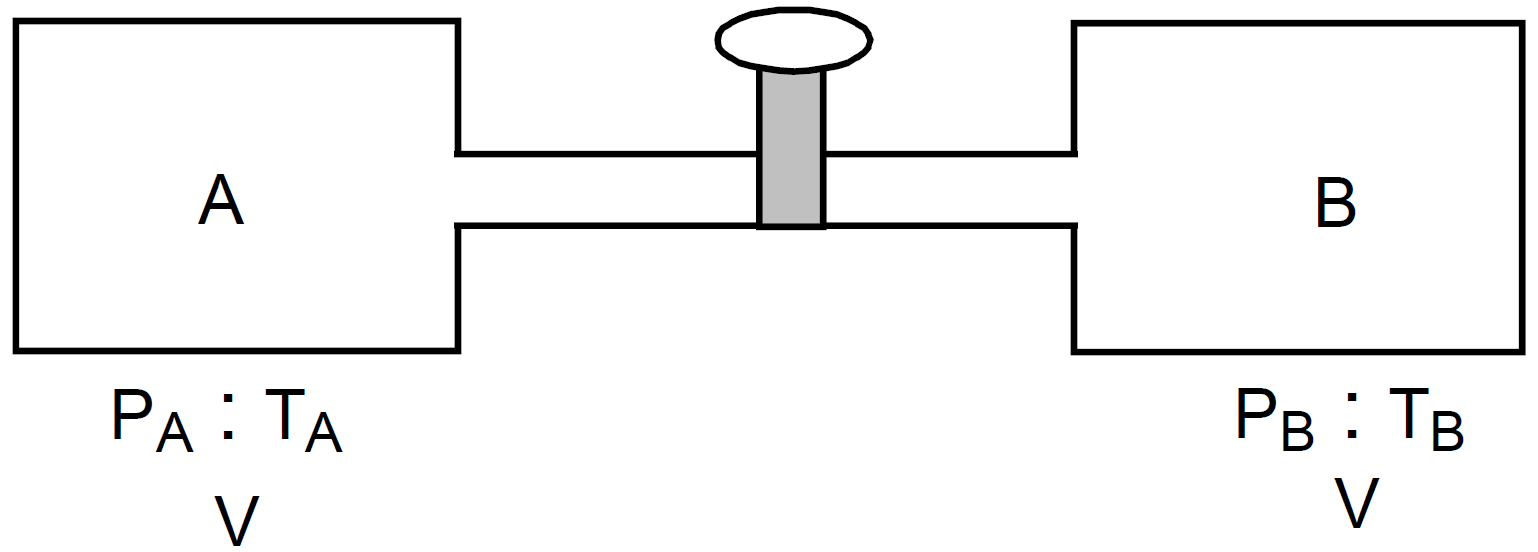
Now, Let the final pressure; Volume & Temp be
After connection = $P_A' \rightarrow$ Partial pressure of A
$P_B' \rightarrow$ Partial pressure of B
Now, $\frac{\text{P}_\text{A}'\times2\text{V}}{\text{T}}=\frac{\text{P}_\text{A}\times\text{V}}{\text{T}_\text{A}}$
Or $\frac{\text{P}_\text{A}'}{\text{T}}=\frac{\text{P}_\text{A}}{2\text{T}_\text{A}}\ ...(1)$
Similarly, $\frac{\text{P}_\text{B}'}{\text{T}}=\frac{\text{P}_\text{B}}{2\text{T}_\text{B}}\ ...(2)$
Adding (1) & (2)
$\frac{\text{P}_\text{A}'}{\text{T}}+\frac{\text{P}_\text{B}'}{\text{T}}=\frac{\text{P}_\text{A}}{2\text{T}_\text{A}}+\frac{\text{P}_\text{B}}{2\text{T}_\text{B}}=\frac{1}{2}\Big(\frac{\text{P}_\text{A}}{\text{T}_\text{A}}+\frac{\text{P}_\text{B}}{\text{T}_\text{B}}\Big)$
$\Rightarrow\frac{\text{P}}{\text{T}}=\frac{1}{2}\Big(\frac{\text{P}_\text{A}}{\text{T}_\text{A}}+\frac{\text{P}_\text{B}}{\text{T}_\text{B}}\Big)$ $\big[\therefore\text{P}_\text{A}'+\text{P}_\text{B}'=\text{P}\big]$ View full question & answer→Question 185 Marks
A ballon has $5.0g$ mole of helium at $7°C$. Calculate.
- The number of atoms of helium in the balloon,
- The total internal energy of the system.
AnswerFor gas helium n = 5 mole T = 7 + 273 = 280k
- Number of atoms of he is 5 mole = $5 \times 6.023 \times 10^{23}$ atoms
= $30.115 \times 10^{23}$ atoms
= $30.115 \times 10^{24}$ atoms.
- He atoms is mono atomic so degree of freedom is 3 So average kinetic energy
$=\frac{3}{2}\text{K}_\text{B}\text{T}$ per molecule
$=\frac{3}{2}\text{K}_\text{B}\text{T}\times$ Number of He Atom
$=\frac{3}{2}\times1.38\times10^{-23}\times280\times3.0115\times10^{24}$
Total E of 15 mole of He = $1.74 \times 10^4J$ View full question & answer→Question 195 Marks
Two molecules of a gas have speeds of $9 \times 10^{16} ms^{-1}$ and $1 \times I0^6ms^{-1}$ respectively. What is the root mean square speed of these molecules?
Answerrms speed for w-molecules is defined as:$\text{v}_{\text{rms}}=\sqrt{\frac{\text{v}_1^2+\text{v}_2^2+\text{v}_3^2+.....+\text{v}_\text{n}^2}{\text{n}}}$ [$v_{rms}$ = root mean square velocity]
Where $v_1, v_2, v_1, ......vn$ are individual velocities of n-molecules of the gas. For two molecules, According to the problem, $v_1 = 9 \times 10^6m/s$ and $v_2 = 1 \times 10^6m/s$
$\therefore\text{v}_\text{rms}=\sqrt{\frac{(9\times10^6)^2+(1\times10^6)}{2}}$
$=\sqrt{\frac{81\times10^{12}+1\times10^{12}}{2}}$
$=10^6\sqrt{\frac{81+1}{2}}=\sqrt{41}\times10^6\text{ms}^{-1}$
View full question & answer→Question 205 Marks
An ideal gas is kept in a long cylindrical vessel fitted with a frictionless piston of cross-sectional area $10cm^2$ and weight $1kg$. The length of the gas column in the vessel is $20cm$. The atmospheric pressure is $100kPa$. The vessel is now taken into a spaceship revolving round the earth as a satellite. The air pressure in the spaceship is maintained at $100kPa$. Find the length of the gas column in the cylinder.
Answer$\text{P}_1\text{V}_1=\text{P}_2\text{V}_2$$\Rightarrow\Big(\frac{\text{mg}}{\text{A}}+\text{P}_0\Big)\text{A}\ell\ \text{ P}_0\text{A}\ell$
$\Rightarrow\Big(\frac{1\times9.8}{10\times10^{-4}}+10^5\Big)0.2=10^5\ell'$
$\Rightarrow(9.8\times10^3+10^5)\times0.2=10^5\ell'$
$\Rightarrow109.8\times10^3\times0.2=10^5\ell'$
$\Rightarrow\ell'=\frac{109.8\times0.2}{10^2}=0.2196\approx0.22\text{m}\approx22\text{cm}$
View full question & answer→Question 215 Marks
Estimate the average thermal energy of a helium atom at:
- Room temperature $(27°C)$
- The temperature on the surface of the Sun$(6000K)$
- The temperature of $10$ million kelvin (the typical core temperature in the case of a star).
Answer
- At room temperature, T = 27°C = 300K
Average thermal energy $=\Big(\frac{3}{2}\Big)\text{KT}$
Where k is Boltzmann constant $= 1.38 \times 10^{-23}m^2kg s^{-2}K^{-1}$
$\therefore\ \Big(\frac{3}{2}\Big)\text{KT}=\Big(\frac{3}{2}\Big)\times1.38\times10^{-38}\times300$
$=6.21\times10^{-21}\text{J}$
Hence, the average thermal energy of a helium atom at room temperature $(27^\circ C)$ is $6.21 \times 10^{-21}J$
- On the surface of the sun, T = 6000K
$=\Big(\frac{3}{2}\Big)\times1.38\times10^{-38}\times6000$
$=1.241\times10^{-19}\text{J}$
Hence, the average thermal energy of a helium atom on the surface of the sun is $1.241 \times 10^{-19}J$.
- At temperature, $T = 10^7K$
Average thermal energy $=\Big(\frac{3}{2}\Big)\text{KT}$
$=\Big(\frac{3}{2}\Big)\times1.38\times10^{-23}\times10^{7}$
$=2.07\times10^{-16}\text{J}$
Hence, the average thermal energy of a helium atom at the core of a star is $2.07 \times 10^{-16}J$. View full question & answer→Question 225 Marks
Find the rms speed of hydrogen molecules in a sample of hydrogen gas at $300K$. Find the temperature at which the rms speed is double the speed calculated in the previous part.
Answerr.m.s. velocity of hydrogen molecules = ? $T = 300K, R = 8.3, M = 2g = 2 \times 10^{-3}Kg$$\text{C}=\sqrt{\frac{3\text{RT}}{\text{M}}}\Rightarrow\sqrt{\frac{3\times8.3\times300}{2\times10^{-3}}}=1932.6\text{m/s}\approx1930\text{m/s}$
Let the temp. at which the C = 2 × 1932.6 is T'$2\times1932.6=\sqrt{\frac{3\times8.3\times\text{T}'}{2\times10^{-3}}}\Rightarrow(2\times1932.6)^2=\frac{3\times8.3\times\text{T}'}{2\times10^{-3}}$
$\Rightarrow\frac{(2\times1932.6)^2\times2\times10^{-3}}{3\times8.3}=\text{T}'$
$\Rightarrow\text{T}'=1199.98\approx1200\text{K}.$
View full question & answer→Question 235 Marks
An ideal gas is trapped between a mercury column and the closed-end of a narrow vertical tube of uniform base containing the column. The upper end of the tube is open to the atmosphere. The atmospheric pressure equals 76cm of mercury. The lengths of the mercury column and the trapped air column are 20cm and 43cm respectively. What will be the length of the air column when the tube is tilted slowly in a vertical plane through an angle of 60°? Assume the temperature to remain constant.
Answer
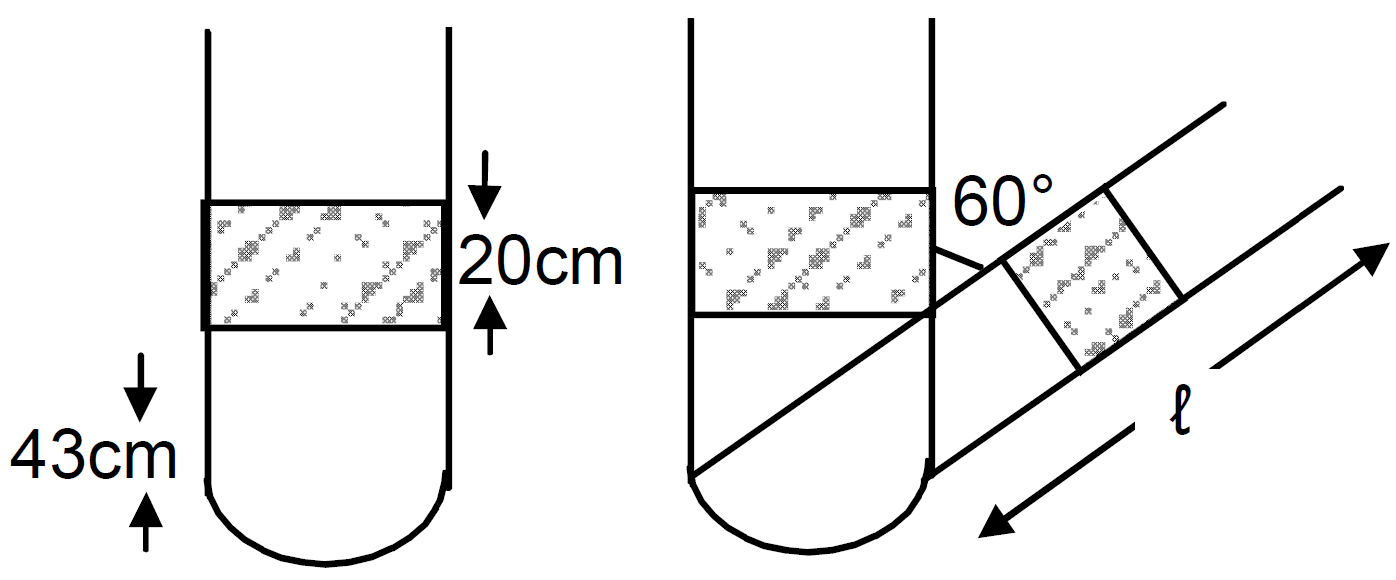 Case I- Atmospheric pressure + pressure due to mercury column.
Case II- Atmospheric pressure + Component of the pressure due to mercury column
$\text{P}_1\text{V}_1=\text{P}_2\text{V}_2$
$\Rightarrow(76\times\text{f}_\text{Hg}\times\text{g}+\text{f}_\text{Hg}\times\text{g}\times20)\times\text{A}\times43$
$=(76\times\text{f}_\text{Hg}\times\text{g}+\text{f}_\text{Hg}\times\text{g}\times20\times\cos60^\circ)\text{A}\times\ell$
$\Rightarrow96\times43=86\times\ell$
$\ell=\frac{96\times43}{86}=48\text{cm}$ View full question & answer→Question 245 Marks
Calculate the number of degrees of freedom of molecules of hydrogen in $1cc$ of hydrogen gas at NTP.
AnswerKey concept: Total number of degrees of freedom in a thermodynamical system = Number of degrees of freedom associated per molecule x number of molecules. At NPT, Volume occupied by $6.023 \times 10^{23}$ molecules of gas = 22400cc$\therefore$ Number of molecules in I cc of hydrogen $=\frac{6.023\times10^{23}}{22400}=2.688\times10^{19}$
$H_2$ is a diatomic gas, having a total of 5 degree of freedom. (3 translational + 2 rotational)
$\therefore$ Total degrees of freedom possessed by all the molecules
$= 5 \times 2.688 \times 10^{19} = 1.344 \times 10^{20}$
View full question & answer→Question 255 Marks
A vessel of volume $V_0$ contains an ideal gas at pressure $P_0$ and temperature T. Gas is continuously pumped out of this vessel at a constant volume-rate dV I dt = r keeping the temperature constant. The pressure of the gas being taken out equals the pressure inside the vessel. Find, (1) the pressure of the gas as a function of time. (2) the time taken before half the original gas is pumped out.
Answer$\frac{\text{dV}}{\text{dt}}=\text{r}\Rightarrow\text{dV}=\text{r dt}$Let the pumped out gas pressure dp
Volume of container = $V_0$ At a pump dv amount of gas has been pumped out.
$Pdv = -V_0df \Rightarrow PV df = –V_0dp$
$\Rightarrow\int\limits^\text{P}_\text{P}\frac{\text{dp}}{\text{p}}=-\int\limits^\text{t}_0\frac{\text{dtr}}{\text{V}_0}\Rightarrow\text{P}=\text{p e}^{\frac{-\text{rt}}{\text{V}_0}}$
Half of the gas has been pump out, Pressure will be half $=\frac{1}{2}\text{e}^{\frac{-\text{vt}}{\text{V}_0}}$
$\Rightarrow\text{In }2=\frac{\text{rt}}{\text{V}_0}$
$\Rightarrow\text{t}=\text{In }2\frac{\gamma_0}{\text{r}}$
View full question & answer→Question 265 Marks
A faulty barometer contains certain amount of air and saturated water vapour. It reads 74.0cm when the atmospheric pressure is 76.0cm of mercury and reads 72.10cm when the atmospheric pressure is 74.0cm of mercury. Saturation vapour pressure at the air temperature = 1.0cm of mercury. Find the length of the barometer tube above the mercury level in the reservoir
AnswerLet the barometer has a length = x Height of air above the mercury column = (x - 74 - 1) = (x - 73) Pressure of air = 76 - 74 - 1 = 1cm For 2nd case height of air above = (x - 72.1 - 1 - 1) = (x - 71.1) Pressure of air = (74 - 72.1 - 1) = 0.99$(\text{x}-73)(1)=\frac{9}{10}(\text{x}-71.1)$
⇒ 10(x - 73) = 9 (x - 71.1) ⇒ x = 10 × 73 - 9 × 71.1 = 730 - 639.9 = 90.1 Height of air = 90.1 Height of barometer tube above the mercury column = 90.1 + 1 = 91.1mm.
View full question & answer→Question 275 Marks
Air is pumped into an automobile tyre's tube up to a pressure of 200kPa in the morning when the air temperature is 20°C. During the day the temperature rises to 40°C and the tube expands by 2%. Calculate the pressure of the air in the tube at this temperature.
Answer$\frac{\text{P}_1\text{V}_1}{\text{T}_1}=\frac{\text{P}_2\text{V}_2}{\text{T}_2}$$\text{P}_1 \rightarrow 200\text{KPa} = 2 × 10^5\text{pa, P}^2 = ?$
$\text{T}_1 = 20^\circ\text{C} = 293\text{K, T}_2 = 40^\circ\text{C} = 313\text{K}$
$\text{V}_2=\text{V}_1+2\%\text{V}_1=\frac{102\times\text{V}_1}{100}$
$\Rightarrow\frac{2\times10^5\times\text{V}_1}{293}=\frac{\text{P}_2\times102\times\text{V}_1}{100\times313}$
$\Rightarrow\text{P}_2=\frac{2\times10^7\times313}{102\times293}=209462\text{Pa}=209.462\text{KPa}$
View full question & answer→Question 285 Marks
Given below are densities of some solids and liquids. Give rough estimates of the size of their atoms:
|
Substance
|
Atomic Mass(u)
|
Density $(10^3kgm^{-3})$
|
|
Carbon (diamond)
Gold
Nitrogen (liquid)
Lithium
Fluorine (liquid)
|
12.01
197.00
14.01
6.94
19.00
|
2.22
19.32
1.00
0.53
1.14
|
$\big[$Hint: Assume the atoms to be ‘tightly packed’ in a solid or liquid phase, and use the known value of Avogadro’s number. You should, however, not take the actual numbers you obtain for various atomic sizes too literally. Because of the crudeness of the tight packing approximation, the results only indicate that atomic sizes are in the range of a few $\mathring{\text{A}}\big].$ AnswerIf r is the radius of the atom, then volume of each atom $=\frac{4}{3}\pi\text{r}^3$ Volume of all atoms in one mole of substance $=\frac{4}{3}\pi\text{r}^3\times\text{N}=\frac{\text{M}}{\rho}$$\therefore\ \text{r}=\Big[\frac{3\text{M}}{4\pi\rho\text{N}}\Big]^{\frac{1}{3}}$
For Carbon,$\text{M}=12.01\times10^{-3}\text{kg}$
$\rho=2.22\times10^{3}\text{kg}\text{m}^{-3}$
$\text{r}=\frac{3\times12.01\times10^{-3}}{4\times\frac{22}{7}\times(2.2\times10^{23})\times(6.023\times10^{23})}$
$=1.29\times10^{-10}\text{m}$
$=1.29\mathring{\text{A}}$
Similarly, for gold, $\text{r}=1.59\mathring{\text{A}}$ for liquid nitrogen, $\text{r}=1.77\mathring{\text{A}}$for lithium, $\text{r}=1.73\mathring{\text{A}}$
for liquid fluorine, $\text{r}=1.88\mathring{\text{A}}$
View full question & answer→Question 295 Marks
Consider an ideal gas with following distribution of speeds.
|
Speed m/s
|
200
|
400
|
600
|
800
|
1000
|
|
% of molecules
|
10
|
20
|
40
|
20
|
10
|
Calculate $V_{rms}$ and hence T. $(m = 3.0 \times 10^{-26}kg)$ Answer$\text{v}_\text{rms}^2=\frac{\text{n}_1\text{v}_1^2+\text{n}_2\text{v}_2^2...\text{n}_\text{n}\text{v}_\text{n}^2}{\text{n}_1+\text{n}_2+\text{n}_3...\text{n}_\text{n}}$$\text{v}_\text{rms}^2=\frac{10\times(200)^2+20(400)^2+40(600)^2+20\times(800)^2+10(1000)^2}{10+20+40+20+10}$
$\text{v}_\text{rms}^2=\frac{10^5[1\times2^1+2\times(4)^2+4\times6^2+2\times8^2+1\times10^2]}{100}$
$\text{v}^2_\text{rms}=\frac{10^5[4+32+144+128+100}{100}=10^3[408]$
$\text{v}_\text{rms}^2=\sqrt{10^4\times40.8}=10^2\times6.39\text{m\s}$
$\frac{1}{2}\text{m v}_\text{rms}^2=\frac{3}{2}\text{K}_\text{B}\text{T}$
$\text{T}=\frac{\text{ms}^2_\text{rms}}{3\text{k}_\text{B}}=\frac{3\times10^{-26}\times10^5\times4.08}{3\times1.38\times10^{-23}}$
$=\frac{204\times10^{-23}\times10^2}{68\times10^{-23}}$
$\text{T}=2.96\times10^2=296\text{K}$
View full question & answer→Question 305 Marks
From a certain apparatus, the diffusion rate of hydrogen has an average value of $28.7cm^3 s^{-1}$. The diffusion of another gas under the same conditions is measured to have an average rate of $7.2cm^3 s^{-1}$. Identify the gas. [Hint: Use Graham’s law of diffusion $\frac{\text{R}_1}{\text{R}_2}=\Big(\frac{\text{M}_2}{\text{M}_1}\Big)^{\frac{1}{2}},$ where $R_1 , R_2$ are diffusion rates of gases 1 and 2, and $M_1$ and $M_2$ their respective molecular masses. The law is a simple consequence of kinetic theory]
AnswerRate of diffusion of hydrogen, $R_1= 28.7cm^3 s^{-1}$ Rate of diffusion of another gas, $R_2 = 7.2cm^3 s^{-1}$ According to Graham’s Law of diffusion, we have$\frac{\text{R}_1}{\text{R}_2}=\sqrt{\frac{\text{M}_2}{\text{M}_1}}$
where, $M_1$ is the molecular mass of hydrogen $= 2.020g\ M_2$ is the molecular mass of the unknown gas$\therefore\text{ M}_2=\text{M}_1\Big(\frac{\text{R}_1}{\text{R}_2}\Big)^2$
$=2.02\Big(\frac{28.7}{7.2}\Big)^2=32.09\text{g}$
32g is the molecular mass of oxygen. Hence, the unknown gas is oxygen.
View full question & answer→Question 315 Marks
Explain why. There is no atmosphere on moon.
AnswerAs acceleration due to gravity on moon is 1/6th of g on earth. So the escape velocity on moon $\text{V}_{\text{es}}=\sqrt{2\text{gR}}=2.38\text{km}/\text{s}$ M = Mass of hydrogen, As $H_2$ is lightest gas $m = 1.67 \times 10^{-24}kg$$\text{v}_\text{rms}=\sqrt{\frac{3\text{K}_\text{B}\text{T}}{\text{m}}}=\sqrt{\frac{3\times1.38\times10^{-23}\times300}{1.67\times10^{-24}}}$
= 2.72 km/s Due to small gravitational force and $v_{rms}$ is greater than escape velocity so molecule of air can escape out. As the distance of moon from sun is approximately equal to that of earth so the intensity of energy of sun reaches to moon is larger due to lower density of atmosphere, distance become smaller than earth when moon is towards sun during its rotation around earth. Due to this (sun light), rms speed of molecule increase and some of them can speed up more than escape velocity and so probability of escaping out increased. Hence over a long time moon has lost most of its atmosphere.
View full question & answer→Question 325 Marks
Shows plot of $\frac{\text{PV}}{\text{T}}$ versus P for $1.00 \times 10^{-3}kg$ of oxygen gas at two different temperatures: If we obtained similar plots for $1.00 \times 10^{-3}$kg of hydrogen, would we get the same value of $\frac{\text{PV}}{\text{T}}$ at the point where the curves meet on the y-axis? If not, what mass of hydrogen yields the same value of $\frac{\text{PV}}{\text{T}}$ (for low pressure high temperature region of the plot)? (Molecular mass of $H_2 = 2.02u, of O_2 = 32.0u, R = 8.31J mo1^{-1}K^{-1}$).
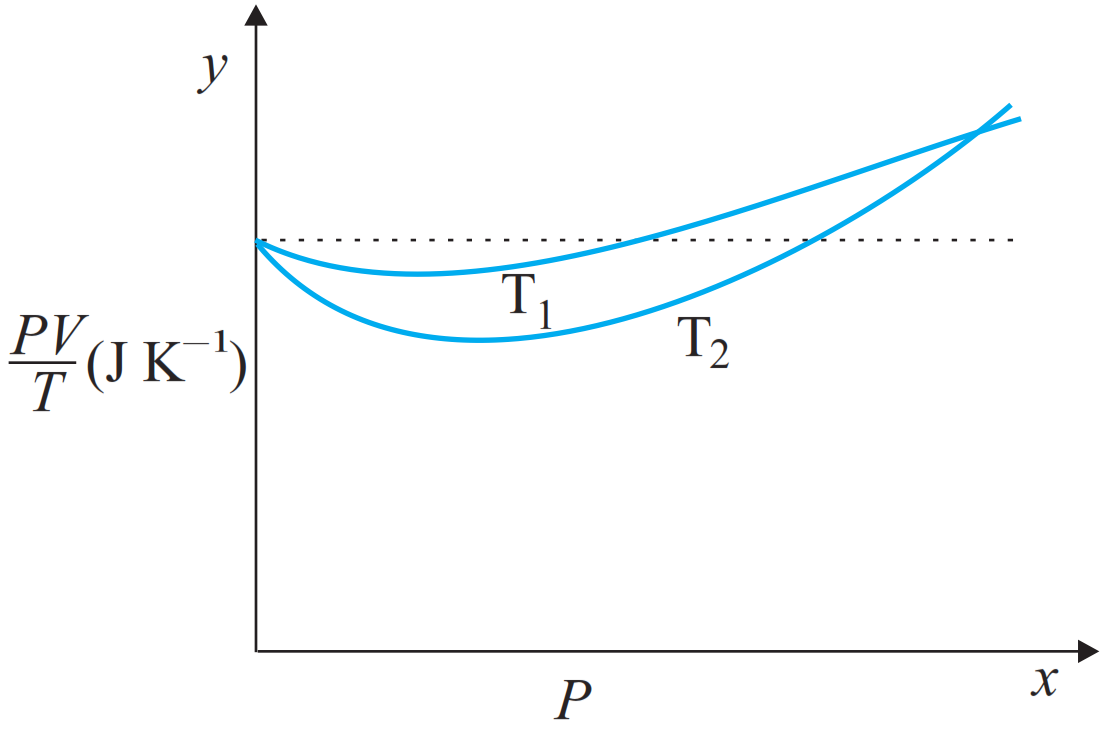
AnswerIf we obtain similar plots for $1.00 \times 10^{-3}kg$ of hydrogen, then we will not get the same value of $\frac{\text{PV}}{\text{T}}$ at th point where the curves meet the y-axis. This is because the molecular mass of hydrogen (2.02u) is different from that of oxygen (32.0u). We have,$\frac{\text{PV}}{\text{T}}=0.26\text{Jk}^{-1}$
$\text{R} = 8.314\text{J mole}^{-1}\text{K}^{-1}$
Molecular mass (M) of $H_2 = 2.02u \frac{\text{PV}}{\text{T}}=\mu\text{R}$ at constant temperature
Where, $\mu=\frac{\text{m}}{\text{M}}$ m = Mass of $H_2$
$\therefore\text{ m}=\Big(\frac{\text{PV}}{\text{T}}\Big)\times\Big(\frac{\text{M}}{\text{R}}\Big)$
$=\frac{0.26\times2.02}{8.31}$
$=6.3\times10^{-2}\text{g}=6.3\times10^{-5}\text{kg}$
Hence, $6.3 \times 10^{-5}kg$ of $H_2$ will yield the same value of $\frac{\text{PV}}{\text{T}}$
View full question & answer→Question 335 Marks
The temperature and humidity of air are 27°C and 50% on a particular day. Calculate the amount of vapour that should be added to 1 cubic metre of air to saturate it. The saturation vapour pressure at 27°C = 3600Pa.
Answer$\text{RH}=\frac{\text{VP}}{\text{SVP}}$Given, $0.50=\frac{\text{VP}}{3600}$
$\Rightarrow\text{VP}=3600\times0.5$
Let the Extra pressure needed be P
So, $\text{P}=\frac{\text{m}}{\text{M}}\times\frac{\text{RT}}{\text{V}}=\frac{\text{m}}{18}\times\frac{8.3\times300}{1}$
Now, $\frac{\text{m}}{18}\times8.3\times300+3600\times0.50=3600$ [air is saturated i.e. RH = 100% = 1 or VP = SVP]
$\Rightarrow\text{m}=\Big(\frac{36-18}{8.3}\Big)\times6=13\text{g}$
View full question & answer→Question 345 Marks
One mole of an ideal gas undergoes a process $\text{p}=\frac{\text{p}_0}{1+\Big(\frac{\text{V}}{\text{V}_0}\Big)^2}$ where $P_0$ and $V_0$ are constants. Find the temperature of the gas when $V = V_0$.
Answer$\text{P}=\frac{\text{P}_0}{1+\Big(\frac{\text{V}}{\text{V}_0}\Big)^2}$$\Rightarrow\frac{\text{nRT}}{\text{V}}=\frac{\text{P}_0}{1+\Big(\frac{\text{V}}{\text{V}_0}\Big)^2}$ [PV = nRT according to ideal gas equation]
$\Rightarrow\frac{\text{RT}}{\text{V}}=\frac{\text{P}_0}{1+\Big(\frac{\text{V}}{\text{V}_0}\Big)^2}$ [Since n = 1 mole]
$\Rightarrow\frac{\text{RT}}{\text{V}_0}=\frac{\text{P}_0}{1+\Big(\frac{\text{V}}{\text{V}_0}\Big)^2}\ [\text{At V}=\text{V}_0]$
$\Rightarrow\text{P}_0\text{V}_0=\text{RT}(1+1)$
$\Rightarrow\text{P}_0\text{V}_0=2\text{RT}\Rightarrow\text{T}=\frac{\text{P}_0\text{V}_0}{2\text{R}}$
View full question & answer→Question 355 Marks
The molecules of a given mass of a gas have root mean square speeds of $1100 \mathrm{~ms}-$ at $27 \mathrm{C}^{\circ}$ and $1.00$ atmospheric pressure. What will be the root mean square speeds of the molecules of the gas at $127^{\circ} \mathrm{C}$ and $2.0$ atmospheric pressure?
Answer$V_{ms} = 100m/ s T_1 = 27 + 273 = 300K V_{2rms} = ? T_2 = 127 + 273 = 400K$
$\text{v}_{\text{ms}}=\sqrt{\frac{3\text{RT}}{\text{M}}}$
M = Molar mass of gas for a gas M is constant.$\therefore\text{v}_\text{ms}\infty\sqrt{\text{T}}$
$\frac{\text{v}_{1\text{ms}}}{\text{v}_{2\text{ms}}}=\sqrt{\frac{\text{T}_1}{\text{T}_2}}$
$\frac{100}{\text{v}_{2\text{ms}}}=\sqrt{\frac{300}{400}}$
$\text{V}_{2\text{ms}}=\frac{100\times\sqrt{400}}{\sqrt{300}}$
$=\frac{100\times2\times10}{10\sqrt{3}}\times\frac{\sqrt{3}}{\sqrt{3}}$
$=\frac{200\times\sqrt{3}}{3}=\frac{200\times1.732}{3}$
$\text{v}_{2\text{rms}}=115.\text{ms}^{-1}$
View full question & answer→Question 365 Marks
Shows plot of $\frac{\text{PV}}{\text{T}}$ versus P for $1.00 \times 10^{-3}kg$ of oxygen gas at two different temperatures: What is the value of $\frac{\text{PV}}{\text{T}}$ where the curves meet on the y-axis?
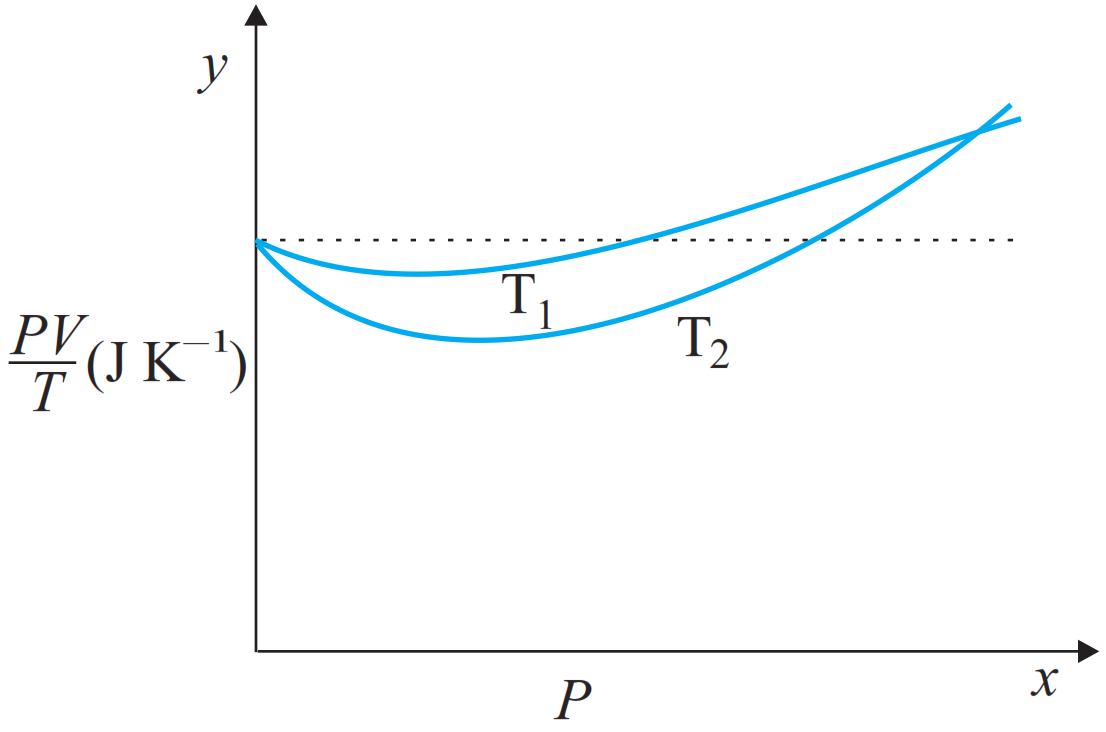
AnswerThe value of the ratio $\frac{\text{PV}}{\text{T}},$ where the two curves meet, is $\mu\text{R}.$ This is because the ideal gas equation is given as,$\text{PV}=\mu\text{RT}$
$\frac{\text{PV}}{\text{T}}=\mu\text{R}$
Where, P is the pressure. T is the temperature. V is the volume.$\mu$ is the number of moles.
R is the universal constant. Molecular mass of oxygen = 32.0g Mass of oxygen = $1 \times 10^{-3}kg = 1g R = 8.314J mole^{-1}K^{-1}$
$\therefore\ \frac{\text{PV}}{\text{T}}=\Big(\frac{1}{32}\Big)\times8.314$
$=0.26\text{Jk}^{-1}$
Therefore, the value of the ratio $\frac{\text{PV}}{\text{T}},$ where the curve meet on the y-axis, is $0.26JK^{-1}$
View full question & answer→Question 375 Marks
State the law of equipartition of energy of a dynamic system and use it to find the values of internal energy and the ratio of the specific heats of (a) monoatomic, (b) diatomic, (c) triatomic gas molecules.
AnswerLaw of equipartition of energy: For any dynamical system in thermal equilibrium, the total energy is distributed equally amongst all degrees of freedom and the energy associated with each molecule per degree of freedom is $\frac{1}{2}\text{K}_{\text{B}}\text{T},$ where $K_B$ is Boltzmann's constant and T is the temperature of the system.
- For monoatomic gas there are only three degrees of freedom. For a gas in thermal equilibrium at temperature T, the average value of translation energy of molecule is
$(\text{E}_1)=\Big(\frac{1}{2}\text{mv}^2_{\text{x}}\Big)+\Big(\frac{1}{2}\text{mv}^2_{\text{y}}\Big)+\Big(\frac{1}{2}\text{mv}^2_{\text{z}}\Big)$
Therefore, energy associated with monoatomic molecule is $\frac{3}{2}\text{K}_{\text{B}}\text{T}.$
Ratio of specific heat $\gamma=\frac{\text{C}_{\text{P}}}{\text{C}_{\text{V}}}=\frac{5}{3}=5:3$
- In case of diatomic gases, each molecule has two rotational degrees of freedom in addition to three translation degrees of freedom. Therefore, total energy of a diatomic gas molecule is sum of translation energy $E_t$ and rotational energy $E_r$, i.e., $\text{E}_{\text{t}}+\text{E}_{\text{r}}=\Big(\frac{1}{2}\text{mv}^2_{\text{x}}+\frac{1}{2}\text{mv}^2_{\text{y}}+\frac{1}{2}\text{mv}^2_{\text{z}}\Big)\\+\Big(\frac{1}{2}\text{I}_1\omega^2_1+\frac{1}{2}\text{I}_2\omega^2_2\big)$
$\omega_1,\omega_2$ and $\text{I}_1,\text{I}_2$ are angular speed about the axes and corresponding moments of inertia.
Ratio of specific heat $\gamma=\frac{\text{C}_{\text{P}}}{\text{C}_{\text{V}}}=7:5$
- Triatomic gas: Tri - atomic gas molecule has seven degrees of freedom.
Atoms oscillates along the interatomic axis contributing a vibrational energy, term $E_v$ to the total energy,
where $\text{E}_{\text{v}}=\frac{1}2{}\text{m}\Big(\frac{\text{dy}}{\text{dt}}\Big)^2+\frac{1}{2}\text{ky}^2$
The total energy of the gas molecule
$\text{E}=\text{E}_{\text{t}}+\text{E}_{\text{r}}+\text{E}_{\text{v}}$
each vibrational mode contributes two squared terms, one of K.E. and the other for P.E. of the molecule.
Accordingly, each vibrational mode contribute $2\times\frac{1}{2}$
$\text{K}_{\text{B}}\text{T = K}_{\text{B}}\text{T}$ to the total energy.
Specific heat ratio $\gamma=\frac{\text{C}_{\text{P}}}{\text{C}_{\text{V}}}=9:7.$ View full question & answer→Question 385 Marks
Three vessels of equal capacity have gases at the same temperature and pressure. The first vessel contains neon (monatomic), the second contains chlorine (diatomic), and the third contains uranium hexafluoride (polyatomic). Do the vessels contain equal number of respective molecules? Is the root mean square speed of molecules the same in the three cases? If not, in which case is vrms the largest?
AnswerAll contain the same number of the respective molecules. No. The root mean square speed of neon is the largest. Since the three vessels have the same capacity, they have the same volume. Hence, each gas has the same pressure, volume, and temperature. According to Avogadro's law, the three vessels will contain an equal number of the respective molecules. This number is equal to Avogadro's number, $N = 6.023 \times 10^{23}$. The root mean square speed $(V_{rms})$ of a gas of mass m, and temperature T, is given by the relation, $V_{rms}$= underroot 3kT/m Where, k is Boltzmann constant For the given gases, k and T are constants. Hence $V_{rms}$ depends only on the mass of the atoms, i.e.,$\text{V}_{\text{rms}}\alpha$ underroot1/m
Therefore, the root mean square speed of the molecules in the three cases is not the same. Among neon, chlorine, and uranium hexafluoride, the mass of neon is the smallest. Hence, neon has the largest root mean square speed among the given gases.
View full question & answer→Question 395 Marks
On the basis of equipartion law of energy find expressions for two principal molar specific heat of a gas as well as for y (the ratio of two specific heats) for a gas having P degrees of freedom per molecule.
AnswerWe know that in a state of thermal equilibrium, in accordance with the equipartition law of energy, the average energy associated with each degree of freedom is $\frac{1}{2}\text{k}_{\text{B}}\text{T}.$ If a gas molecule has P degrees of freedom in all, then the average energy per molecule of gas$=\text{P}\times\frac{1}{2}\text{k}_{\text{B}}\text{T}=\frac{\text{P}}{2}\text{k}_{\text{B}}\text{T}$
As one mole of a gas consists of $N_A$ molecules, hence total internal energy of one mole of given gas will be given by$\text{u}=\text{N}_{\text{A}}\times\frac{\text{P}}{2}\text{k}_{\text{B}}\text{T}=\frac{\text{P}}{2}\text{RT}$
where $R = N_A.k_B$ (universal gas constant).
$\therefore$ Molar specific heat of given gas under constant volume condition will be given by
$\text{C}_{\text{v}}=\frac{\text{d}\text{U}}{\text{dt}}=\frac{\text{d}}{\text{dT}}\Big[\frac{\text{P}}{2}\text{RT}\Big]=\frac{\text{P}}{2}\text{R}$
For an ideal gas $C_p - C_v = R$
$\therefore$ Molar specific heat of given gas under constant pressure constant
$\text{C}_{\text{p}}=\text{C}_{\text{v}}+\text{R}=\frac{\text{P}}{2}\text{R + R}(\text{P + 2})\frac{\text{R}}{2}$
$\gamma=\frac{\text{C}_{\text{P}}}{\text{C}_{\text{v}}}=\frac{(\text{P}+2)\frac{\text{R}}{2}}{\text{P}\frac{\text{R}}{2}}=\frac{\text{P}+2}{\text{P}}=\Big(1+\frac{2}{\text{P}}\Big)$
Thus, it is clear that values of principal specific heats of a gas as well as their ratio depends on the number of degrees of freedom per molecule of the given gas.
View full question & answer→Question 405 Marks
Give the postulates of kinetic theory of gases. Derive the expression for pressure exerted by gas molecules in a container. Use it to relate kinetic energy with pressure.
AnswerThe kinetic theory of gases is based on the following assumptions:
- A gas consists of a very large number of molecules which are perfect elastic spheres and identical in all respects for a given gas. These are different for different gases.
- The molecules of a gas are in a state of continuous, rapid and random motion in all directions with different speeds, ranging from zero to infinity and obey Newton's laws of motion.
- The size of the gas molecules is very small as compared to the distance between them. Hence, the volume occupied by the molecules, is negligible in comparison to the volume of the gas.
- The molecules do not exert any force of attraction or repulsion on each other, except during collision.
- The collisions of the molecules with themselves and with the walls of the vessels are perfectly elastic, i.e. the momentum and the kinetic energy of the molecules are conserved during collisions.
Expression for pressure due to an ideal gas:
Consider an ideal gas contained in a cubical container OPQRSTKL of each side a and having a volume V.
Clearly, volume of the gas, V = volume of the container = $a^3$, i.e. $V = a^3$.
Let there be n molecules of the gas in the container each of mass m. Then, the total mass of the gas in the container is given by
$M = m \times n$
Let the random velocities of the gas molecules $A_1, A_2, .... A_n,$ be $c_1, c_2, ..... c_n$ respectively. Let $(x_1, y_1, z_1), (x_2, y_2, z_2), ..... (x_n, y_n, z_n)$ be the rectangular components of the velocities $c_1, c_2, ... c_n$, respectively, along three mutually perpendicular directions Ox, OY and Oz.
$\begin{matrix}\text{x}^2_1+\text{y}^2_1+\text{z}^2_1=\text{c}^2_1\\\text{x}^2_2+\text{y}^2_2+\text{z}^2_2=\text{c}^2_2\\.................\\\text{x}^2_\text{n}+\text{y}^2_\text{n}+\text{z}^2_\text{n}=\text{c}^2_\text{n}\end{matrix}$
The change in momentum of $A_1$, along OX after one collision = $-mx_1 - mx_1 --2mx_1$
According to law of conservation of linear momentum, in one collision, the momentum transferred to the wall QRSL by the molecule $A_1$ will be = $+2mx_1$
The molecule $A_1$ returned from face QRSL, collides against the wall OPKT, rebounds and again collides with QRSL. Thus, the molecule $A_1$ covers a distance 2a between two successive collisions with the wall QRSL.
$\therefore$ Time between two successive collisions, $\text{t}=\frac{\text{distance}}{\text{speed}}=\frac{2\text{a}}{\text{x}_1}$
It means the molecule $A_1$ will collide with wall QRSL after every $\frac{2\text{a}}{\text{x}_1}$ seconds.
Therefore, number of collisions per second with wall QRSL $=\frac{1}{\text{t}}=\frac{\text{x}_1}{2\text{a}}$
$\therefore$ Momentum transferred to the wall QRSL in one second by molecule $A_1$ = momentum transferred in one collision × no. of collisions in 1s.
$=2\text{mx}_1\times\frac{\text{x}_1}{2\text{a}}=\frac{\text{mx}^2_1}{\text{a}}$
According to Newton's 2nd law of motion, the rate of change of momentum of a body is equal to the force exerted on it. Hence, the force exerted by the molecule A, on the wall QRSL will be.
$\text{f}_1=\frac{\text{mx}^2_1}{\text{a}}$
$\text{f}_2=\frac{\text{mx}^2_2}{\text{a}},...\text{f}_\text{n}=\frac{\text{mx}^2_{\text{n}}}{\text{a}}$
Total force exerted by all the molecules on wall QRSL will be
$\text{F}_{\text{x}}=\frac{\text{mx}^2_1}{\text{a}}+\frac{\text{mx}^2_2}{\text{a}}+...+\frac{\text{mx}^2_\text{n}}{\text{a}}=\frac{\text{m}}{\text{a}}\big(\text{x}^2_1+\text{x}^2_2+\text{x}^2_{\text{n}}\big)$
$\therefore$ Pressure exerted on the wall QRSL is
$\text{P}_{\text{x}}=\frac{\text{force}}{\text{area of wall QRSL}}=\frac{\text{F}_{\text{x}}}{\text{a}^2}=\frac{\text{m}}{\text{a}^3}\big(\text{x}^2_1+\text{x}^2_2+...+\text{x}^2_\text{n}\big)$
Similarly, the pressure exerted by the gas molecules perpendicular to OY and OZ respectively are given by
$\text{P}_{\text{y}}=\frac{\text{m}}{\text{a}^3}\big(\text{y}^2_1+\text{y}^2_2+...+\text{y}^2_{\text{n}}\big)$
and $\text{P}_{\text{z}}=\frac{\text{m}}{\text{a}^3}\big(\text{z}^2_1+\text{z}^2_2+...+\text{z}^2_{\text{n}}\big)$
Since the molecular density is uniform throughout the gas, therefore the pressure exerted by the molecules is the same in all directions. Hence,
$\text{P}_{\text{x}}=\text{P}_{\text{y}}=\text{P}_{\text{z}}=\text{p}$ (say)
$\therefore\text{P}_{\text{x}}+\text{P}_{\text{y}}+\text{P}_{\text{z}}=3\text{P}$
or $\text{P}=\frac{\text{P}_{\text{x}}+\text{P}_{\text{y}}+\text{P}_{\text{z}}}{3}$
$\text{P}=\frac{1}{3}\Big[\frac{\text{m}}{\text{a}^3}\big(\text{x}^2_1+\text{x}^2_2+...+\text{x}^2_\text{n}\big)+\frac{\text{m}}{\text{a}^3}\big(\text{y}^2_1+\text{y}^2_2+...+\text{y}^2_{\text{n}}\big)\\+\frac{\text{m}}{\text{a}^3}\big(\text{z}^2_1+\text{z}^2_2+...+\text{z}^2_{\text{n}}\big)\Big]$
$=\frac{\text{m}}{3\text{a}^3}\Big[\big(\text{x}^2_1+\text{x}^2_2+...+\text{x}^2_{\text{n}}\big)+\big(\text{y}^2_1+\text{y}^2_2+...+\text{y}^2_{\text{n}}\big)\\+\big(\text{z}^2_1+\text{z}^2_2+...+\text{z}^2_{\text{n}}\big)\Big]$
$\text{P}=\frac{\text{m}}{3\text{a}^3}\Big[\big(\text{x}^2_1+\text{y}^2_1+\text{z}^2_1\big)+\big(\text{x}^2_2+\text{y}^2_2+\text{z}^2_2\big)\\+...+\big(\text{x}^2_\text{n}+\text{y}^2_\text{n}+\text{z}^2_\text{n}\big)\Big]$
$=\frac{\text{m}}{3\text{V}}\big[\text{c}^2_1+\text{c}^2_2+...+\text{c}^2_\text{n}\big]=\frac{1}{3}\frac{\text{mv}}{\text{V}}\Big[\frac{\text{c}^2_1+\text{c}^2_2+...+\text{c}^2_\text{n}}{\text{n}}\Big]$
$\text{P}=\frac{\text{M}}{3\text{V}}\text{c}^2$
where $\text{c}=\sqrt{\frac{\text{c}^2_1+\text{c}^2_2+...+\text{c}^2_\text{n}}{\text{n}}}$ is called the root mean square (r.m.s.) velocity of the gas molecules.
Relation of K.E. with pressure:
Pressure $\text{P}=\frac{1}{3}\frac{\text{nmc}^2}{\text{V}}=\frac{1}{3}\frac{\text{M}}{\text{V}}\text{c}^2$
$\Rightarrow\text{P}=\frac{1}{3}\rho\text{c}^2$ $\Big[\because\frac{\text{M}}{\text{V}}=\rho\Big]$
Mean K.E. of translation per unit volume of gas is E $=\frac{1}2{}\rho\text{c}^2$
$\therefore\frac{\text{P}}{\text{E}}=\frac{\frac{1}{3}\rho\text{c}^2}{\frac{1}{2}\rho\text{c}^2}=\frac{2}{3}$
$\text{P}=\frac{2}{3}\text{E}$ View full question & answer→Question 415 Marks
If one mole of a monoatomic gas is mixed with three moles of a diatomic gas. What is the molar specific heat of mixture at constant value? [Take, $R = 8.31 Jmol^{-1}K^{-1}$]
AnswerGiven, for monoatomic gas, $\mu_1=1,\text{C}_{\text{V}_{1}}=\frac{3}{2}\text{R}$ and for a diatomic gas, $\mu_2=3$ and $\text{C}_{\text{V}_2}=\frac{5}{2}\text{R}$$\therefore$ Total heat energy required to raise the temperature of mixture by $\Delta\text{T}.$
$\Delta\text{U}=\mu_1\text{C}_{\text{V}_{1}}\Delta\text{T}+\mu_2\text{C}_{\text{V}_2}\Delta\text{T}$
$\Delta\text{U}=1\times\frac{3}{2}\text{R}\Delta\text{T}+3\times\frac{5}{2}\text{R}\Delta\text{T}=9\text{R}\Delta \ ...(\text{i})$
Let $\text{C}_{\text{V}_{\text{m}}}$ be the molar specific heat of the mixture at constant volume and as total number of moles of mixture.$\mu_{\text{m}}=1+3=4$
$\therefore$ Heat energy required
$\Delta\text{U}=\mu_{\text{m}}\text{C}_{\text{V}_{\text{m}}}\Delta\text{T}$
$\Rightarrow\Delta\text{U}=4\text{C}_{\text{V}_{\text{m}}}\Delta\text{T} \ ...(\text{ii})$
From Eqs. (i) and (ii), we have$9\text{R}\Delta\text{T}=4\text{C}_{\text{V}_{\text{m}}}\Delta\text{T}$
$\Rightarrow\Delta\text{C}_{\text{V}_{\text{m}}}=\frac{9}{4}\text{R}=2.25\text{R}$
View full question & answer→Question 425 Marks
Derive an expression for pressure of a gas in a container. Using it, relate K.E. with pressure.
AnswerThe kinetic theory of gases is based on the following assumptions :
- A gas consists of a very large number of molecules which are perfect elastic spheres are identical in all respects for a given gas and are different for different gases.
- The molecules of a gas are in a state of continuous, rapid and random motion in all directions with different speeds, ranging from zero to infinity and obey Newton's laws of motion.
- The size of the gas molecules is very small as compared to the distance between them. Hence volume occupied by the molecules is negligible in comparison to the volume of the gas.
- The molecules do not exert any force of attraction or repulsion on each other, except during collision.
- The collisions of the molecules with themselves and with the walls of the vessels are perfectly elastic. i.e., the momentum and the kinetic energy of the molecules are conserved during collisions.
Expression for pressure due to an ideal gas: Consider an ideal gas contained in a cubical container OPQRSTKL of each side a and having a volume V. Clearly, volume of the gas, V = volume of the container = $a^3$ i.e., V = $a^3$ Let there be n molecules of the gas in the container each of mass m. Then total mass of the gas in the container is M = m \times n Let the random velocities of the gas molecules $A_1, A_2, ... A_n$ be $c_1, c_2, ... c_n$, respectively. Let $(x_1, y_1, z_1), (x_2, y_2, z_2), ...... (x_n, y_n, z_n)$ be the rectangular components of the velocities $c_1, c_2, .... c_n$ respectively, along three mutually perpendicular directions OX, OY and OZ.$\begin{matrix}\text{x}^2_1+\text{y}^2_1+\text{z}^2_1=\text{c}^2_1\\\text{x}^2_2+\text{y}^2_2+\text{z}^2_2=\text{c}^2_2\\.................\\\text{x}^2_\text{n}+\text{y}^2_\text{n}+\text{z}^2_\text{n}=\text{c}^2_\text{n}\end{matrix}$
Change in momentum of $A_1$ along OX after one collision $-mx_1 - mx_1 = -2mx_1$
According to law of conservation of linear momentum, in one collision, the momentum transferred to the wall QRSL by the molecule $A_1$ will be = $+2mx_1$
The molecule $A_1$ returned from face QRSL, collides against the wall OPKT, rebounds and again collides with QRSL. Thus the molecule $A_1$ covers a distance 2a between two successive collisions with the wall QRSL.
$\therefore$ Time between two successive collisions,
$\text{t}=\frac{\text{distance}}{\text{speed}}=\frac{2\text{a}}{\text{x}_1}$
It means the molecule A, will collide with wall QRSL after every $\frac{2\text{a}}{\text{x}_1}$ seconds. Therefore, number of collisions per second with wall QRSL $=\frac{1}{\text{t}}=\frac{\text{x}_1}{2\text{a}}$
$\therefore$ Momentum transferred to the wall QRSL in one second by molecule $A_1$ = momentum transferred in one collision no. of collisions in 1 sec.
$=2\text{mx}_1\times\frac{\text{x}_1}{2\text{a}}=\frac{\text{mx}^2_1}{\text{a}}$
According to Newton's 2nd law of motion, the rate of change of momentum of a body is equal to the force exerted on it. Hence the force exerted by the molecule A on the wall QRSL will be,
$\text{f}_1=\frac{\text{mx}^2_1}{\text{a}}$
$\text{f}_2=\frac{\text{mx}^2_2}{\text{a}},...\text{f}_\text{n}=\frac{\text{mx}^2_{\text{n}}}{\text{a}}$
Total force exerted by all the molecules on wall QRSL will be
$\text{F}_{\text{x}}=\frac{\text{mx}^2_1}{\text{a}}+\frac{\text{mx}^2_2}{\text{a}}+...+\frac{\text{mx}^2_\text{n}}{\text{a}}$
$=\frac{\text{m}}{\text{a}}\big(\text{x}^2_1+\text{x}^2_2+\text{x}^2_\text{n}\big)$
$\therefore$ Pressure exerted on the wall QRSL is
$\text{P}_{\text{x}}=\frac{\text{force}}{\text{area of wall QRSL}}$
$=\frac{\text{F}_{\text{x}}}{\text{a}^2}$
$=\frac{\text{m}}{\text{a}^3}\big(\text{x}^2_1+\text{x}^2_2+...+\text{x}^2_\text{n}\big)$
Similarly, the pressure exerted by the gas molecules perpendicular to OY and OZ respectivety are given by
$\text{P}_{\text{y}}=\frac{\text{m}}{\text{a}^3}\big(\text{y}^2_1+\text{y}^2_2+...+\text{y}^2_\text{n}\big)$
and $\text{P}_{\text{z}}=\frac{\text{m}}{\text{a}^3}\big(\text{z}^2_1+\text{z}^2_2+...+\text{z}^2_\text{n}\big)$
Since the molecular density is uniform throughout the gas, therefore the pressure exerted by the molecules is the same in all directions. Hence,
$\text{P}_{\text{x}}=\text{P}_{\text{y}}=\text{P}_{\text{z}}=\text{P}$ (say)
$\therefore\text{P}_{\text{x}}+\text{P}_{\text{y}}+\text{P}_{\text{z}}=3\text{P}$
or $\text{P}=\frac{\text{P}_{\text{x}}+\text{P}_{\text{y}}+\text{P}_{\text{z}}}{3}$
$\text{P}=\frac{1}{3}\Big[\frac{\text{m}}{\text{a}^3}\big(\text{x}^2_1+\text{x}^2_2+...+\text{x}^2_\text{n}\big)+\frac{\text{m}}{\text{a}^3}\big(\text{y}^2_1+\text{y}^2_2+...+\text{y}^2_\text{n}\big)\\+\frac{\text{m}}{\text{a}^3}\big(\text{z}^2_1+\text{z}^2_2+...+\text{z}^2_\text{n}\big)\Big]$
$=\frac{\text{m}}{3\text{a}^3}\Big[\big(\text{x}^2_1+\text{x}^2_2+...+\text{x}^2_\text{n}\big)+\big(\text{y}^2_1+\text{y}^2_2+...+\text{y}^2_\text{n}\big)\\+\big(\text{z}^2_1+\text{z}^2_2+...+\text{z}^2_\text{n}\big)\Big]$
$\text{P}=\frac{\text{m}}{3\text{a}^2}\Big[\big(\text{x}^2_1+\text{y}^2_1+\text{z}^2_2\big)+\big(\text{x}^2_1+\text{y}^2_2+\text{z}^2_2\big)\\+...+\big(\text{x}^2_\text{n}+\text{y}^2_\text{n}+\text{z}^2_\text{n}\big)\Big]$
$=\frac{\text{m}}{3\text{V}}\big[\text{c}^2_1+\text{c}^2_2+...+\text{c}^2_\text{n}\big]$
$=\frac{1}{3}\frac{\text{mn}}{\text{V}}\Big[\frac{\text{c}^2_1+\text{c}^2_2+...+\text{c}^2_\text{n}}{\text{n}}\Big]$
$\text{P}=\frac{\text{M}}{3\text{V}}\text{c}^2$
where $\text{c}=\sqrt{\frac{\text{c}^2_1+\text{c}^2_2+...+\text{c}^2_\text{n}}{\text{n}}}$ is called the root mean square (r.ar.s.) velocity of the gas molecules.
Relation of K.E. with pressure:
Pressure $\text{P}=\frac{1}{3}\frac{\text{nmc}^2}{\text{V}}$
$\Rightarrow\text{P}=\frac{1}{3}\rho\text{c}^2$ $\Big[\because\frac{\text{m}}{\text{v}}=\rho\Big]$
Mean K.E. of translation per unit volume of gas is E $=\frac{1}{2}\rho\text{c}^2$
$\therefore\frac{\text{P}}{\text{E}}=\frac{\frac{1}{3}\rho\text{c}^2}{\frac{1}{2}\rho\text{c}^2}=\frac{2}{3}$
$\text{P}=\frac{2}{3}\text{E}$ View full question & answer→Question 435 Marks
When air is pumped into a cycle tyre the volume and pressure of the air in the tyre both are increased. What about Boyle’s law in this case?
AnswerHere, according to the question, when air is pumped, more molecules are pumped and Boyle’s law is stated for situation where, mass of molecules remains constant.$\text{PV}=\text{P}\Big(\frac{\text{m}}{\rho}\Big)=\text{constant}$
$\Rightarrow\frac{\text{P}}{\rho}=\text{constant or}\frac{\text{P}_1}{\rho_1}=\frac{\text{P}_2}{\rho_2}$
$\Big(\text{As volume}=\frac{\text{m}}{\rho(\text{Density of the gas})}\text{and m}=\text{constant}\Big)$
In this case, when air is pumped into a cycle tyre, mass of air in it increases as the number of air molecules keep increasing. Hence, this is a case of variable mass, Boyle’s law (and even Charle’s law) is only applicable in situations, where mass of gas molecules remains fixed. Hence, Boyle’s law is not applicable in this case.
View full question & answer→Question 445 Marks
Two perfect gases at absolute temperatures $T_1$ and $T_2$ are mixed. There is no loss of energy. Find the temperature of the mixture if masses of molecules are $m_1$ and $m_2$ and the number of molecules in the gases are $\mu_1$ and $\mu_2$ respectively.
AnswerWe know, K.E. of one molecule of a perfect gas at temperature T is given by$\text{E}=\frac{3}{2}\text{kT} \ ...(1)$
$\therefore\text{K.E.}$ or $\mu_1$ molecules of a perfect gas at temperature $\text{T}_1,\text{E}_1=\Big(\frac{3}{2}\text{kT}_1\Big)\mu_1$
K.E. of $\mu_2$ molecules of a perfect gas at temperature $\text{T}_2,\text{E}_2=\Big(\frac{3}{2}\text{kT}_2\Big)\mu_2$ When both the gases are mixed, then the total K.E. of the mixture is$\text{E}=\frac{3}{2}\text{k}(\mu_1\text{T}_1+\mu_2\text{T}_2) \ ...(2)$
After mixing, the temperature of the mixture is T, therefore K.E. of the mixture is given by$\text{E}'=\frac{3}{2}\text{kT}(\mu_1)+\frac{3}{2}\text{kT}(\mu_2)$
$=\frac{3}{2}\text{kT}(\mu_1+\mu_2)$
Since there is no loss of energy$\therefore\text{E}'=\text{E}$ or $\frac{3}{2}\text{kT}(\mu_1+\mu_2)$
$=\frac{3}2{}\text{k}(\mu_1\text{T}_1+\mu_2\text{T}_2)$
$\therefore\text{T}=\frac{\mu_1\text{T}_1+\mu_2\text{T}_2}{\mu_1+\mu_2}$
View full question & answer→Question 455 Marks
$36$. You are given, the following data about a group of particles, where n represents the number of molecules with speed $v_i$
|
$n_i$
|
2
|
4
|
8
|
6
|
3
|
|
$v_i(ms^{-1})$
|
1.0
|
2.0
|
3.0
|
4.0
|
5.0
|
Calculate:
- Average speed.
- Rms speed.
- Most probable speed.
Answer
- Average speed:
$=\frac{\text{n}_1\text{v}_1+\text{n}_2\text{v}_2+\text{n}_3\text{v}_3+\text{n}_4\text{v}_4+\text{n}_5\text{v}_5}{\text{n}_1+\text{n}_2+\text{n}_3+\text{n}_4+\text{n}_5}$
$=\frac{2\times1+4\times2+8\times3+6\times4+3\times5}{2+4+8+6+3}$
$=3.17\text{m/s}$
- Root mean square speed:
$=\sqrt{\frac{\text{n}_1\text{v}^2_1+\text{n}_2\text{v}^2_2+\text{n}_3\text{v}^2_3+\text{n}_4\text{v}^2_4+\text{n}_5\text{v}^2_5}{\text{n}_1+\text{n}_2+\text{n}_3+\text{n}_4+\text{n}_5}}$
$=\sqrt{\frac{2\times1^2+4\times2^2+8\times3^3+6\times4^2+3\times5^2}{2+4+8+6+3}}$
$=3.36\text{m/s}$
- The most Probable speed is that speed which is possessed by maximum number of molecules.
Most probable speed $(v_{mp})$ $=\sqrt{\frac{2\text{k}_{\text{B}}\text{T}}{\text{m}}}=\sqrt{\frac{3\text{k}_{\text{B}}\text{T}}{\text{m}}\times}\frac{2}{3}$
$\text{v}_{\text{mp}}=\sqrt{\frac{2}{3}}\times\sqrt{\frac{3\text{k}_{\text{B}}\text{T}}{\text{m}}}$
$=\sqrt{\frac{2}{3}}\text{v}_{\text{rms}}=\sqrt{\frac{2}{3}}\times3.36\text{m/s}$
$=0.816\times3.36\text{m/s}=2.74\text{m/s}$ View full question & answer→Question 465 Marks
A gas mixture consists of molecules of $A, B$ and $C$ with masses $m_A > m_B > m_c$. Rank the three types of molecules in decreasing order of (a) average KE, (b) rms speeds.
AnswerWe know that the average KE of translation per molecule is$\text{KE}=\frac{3}{2}\text{k}_\text{B}\text{T}$
Now as, $\text{V}_\text{rms}=\sqrt{\frac{3\text{PV}}{\text{M}}}=\sqrt{\frac{3\text{RT}}{\text{M}}}$$=\sqrt{\frac{3\text{RT}}{\text{mN}}}=\sqrt{\frac{3\text{kT}}{\text{m}}}$
Where, M = molar mass of the gas m = mass of each molecular of the gas, R = gas constant Clearly, $\text{v}_\text{rms}\propto\sqrt{\frac{1}{\text{m}}}$ From above eqution (i) $\text{KE}\propto\sqrt{\text{T}}$ Which remains same for all the three types of molecules, as conditions of temperature and pressure are the same. As k = Boltzmann constant T = absolute temperature (same for all) But $\text{m}_\text{A}>\text{m}_\text{B}>\text{m}_\text{C}$$\therefore\ (\text{v}_\text{rms})_\text{A}<(\text{v}_\text{rms})_\text{B}<(\text{v}_\text{rms})_\text{C}$
Or $(\text{v}_\text{rms})_\text{C}>(\text{v}_\text{rms})_\text{B}>(\text{v}_\text{rms})_\text{A}$
View full question & answer→Question 475 Marks
Define degrees of freedom. How will you account for the five degrees of freedom in a diatomic molecule? Using the idea of equi-partition of energy, find the value of $\gamma$ for the same.
AnswerThe number ofdegrees offreedom ofa dynamical system is defined as total number of coordinates required to describe comiletely the position and configuration of the syslem. The diatomic molecules have two atoms in it. The molecule is capable of translatory motion of its centre of mass and also it can rotate about its cenfie of mass. Therefore it has three translational degrees of freedom and two rotational degrees of freedom. So diatomic molecule has in all five degrees of freedom.$\text{U}=5\times\Big(\frac{1}{2}\text{K}_{\text{B}}\text{T}\Big)\times\text{N}_{\text{A}}=\frac{5}{2}\text{RT}$
$\text{C}_{\text{v}}=\Big(\frac{\text{dU}}{\text{dT}}\Big)$
$\text{C}_{\text{v}}=\frac{\text{d}}{\text{dT}}\Big(\frac{5}{2}\text{RT}\Big)=\frac{5}{2}\text{R}$
$\text{C}_{\text{v}}=4.96\text{ cal mol}^{-1}\text{K}^{-1}$
also, $\text{C}_{\text{P}}=\text{C}_{\text{v}}+\text{R}=\frac{5}{2}\text{R + R}=\frac{7}{2}\text{R}$$\text{C}_{\text{P}}=\frac{7}{2}\times1.985$
$\text{C}_{\text{P}}=6.95\text{ cal mol}^{-1}\text{ K}^{-1}$
$\gamma=\frac{\text{C}_\text{P}}{\text{C}_{\text{v}}}=\frac{\frac{7}{2}\text{R}}{\frac{5}{2}\text{R}}=1.4$
View full question & answer→Question 485 Marks
An air bubble of radius $2.0mm$ is formed at the bottom of a $3.3m$ deep river. Calculate the radius of the bubble as it comes to the surface. Atmospheric pressure = $1.0 \times 10^5$ Pa and density of water = $1000kg/m^{-3}$.
Answer$\text{P}_1=10^5+\text{fgh}=10^5+1000\times10\times3.3=1.33\times10^5\text{pa}$$\text{P}_2=10^5,\ \text{T}_1=\text{T}_2=\text{T},\ \text{V}_1=\frac{4}{3}\pi(2\times10^{-3})^3$
$\text{V}_2=\frac{4}{3}\pi\text{r}^3,\text{r}=?$
$\frac{\text{P}_1\text{V}_1}{\text{T}_1}=\frac{\text{P}_2\text{V}_2}{\text{T}_2}$
$\Rightarrow\frac{1.33\times10^5\times\frac{4}{3}\times\pi\times(2\times10^{-3})^3}{\text{T}_1}$ $=\frac{10^5\times\frac{4}{3}\times\pi\text{r}^2}{\text{T}_2}$
$\Rightarrow1.33\times8\times10^5\times10^{-9}=10^5\times\text{r}^3$
$\Rightarrow\text{r}=3\sqrt{10.64\times10^{-3}}=2.19\times10^{-3}\approx2.2\text{mm}$
View full question & answer→Question 495 Marks
A balloon partially filled with Helium has a volume of $30m^3$, at the earth's surface, where pressure is $76cm$ of Hg and temperature is $27°C$. What will be the increase in volume of gas if balloon rises to a height, where pressure is $7.6cm$ of Hg and temperature is $-54°C$?
Answer$\frac{\text{P}_1\text{V}_1}{\text{T}_1}=\frac{\text{PV}}{\text{T}}$$\text{V}_1=\frac{\text{PVT}_1}{\text{TP}_1}$
$=\frac{76\times30\times(273-54)}{(273+27)\times7.6}$
$=219\text{m}^3$
Hence increase in volume
$=\text{V}_1-\text{V}$
$=219-30$
$=189\text{m}^3$
View full question & answer→Question 505 Marks
Given Avogadro number $=6.02 \times 10^{23}$ and Boltzmann's constant $=1.38 \times 10^{-23}$ joule/ (molecule-K). Calculate (a) the average kinetic energy of translation of an oxygen molecule at $27^{\circ} \mathrm{C}$, (b) the total kinetic energy of an oxygen molecule at $27^{\circ} \mathrm{C}$ (c) the total kinetic energy in joules of a gram-molecule of oxygen at $27^{\circ} \mathrm{C}$.
AnswerGiven, Avogadro number $N = 6.02 \times 10^{23}$ Boltzmann's constant $k = 1.38 \times 10^{-23}$ joule/ molecule K Kelvin temperature $T = 27 + 273 = 300K$.
- An oxygen molecule has three degrees of freedom with respect of translation. Hence the average kinetic energy of translation of molecule
$=3\times\frac{1}{2}\text{kT}=\frac{3}{2}\text{kT}$
$\Big(\because$ Average kinetic energy of a gas molecule per degree of freedom is $\frac{1}{2}\text{kT}.\Big)$
$=3\times\frac{1}{2}(1.38\times10^{-23})\times300$
$=6.21\times10^{-21}\text{joule/molecule}$
- The oxygen molecule has five degrees of freedom (three degrees of freedom with respect to translation and two degrees of freedom with respect to rotation as it is a diatomic molecule). Hence the total kinetic energy of the molecule
$=5\times\frac{1}{2}\text{kT}=\frac{5}{2}\text{kT}$
$=\frac{5}{2}(1.38\times10^{-23})\times300$
$=10.35\times10^{-21}\text{joule/molecule}$
- One gm molecule of oxygen contains N molecules. Hence the total kinetic energy of 1gm molecule of the gas
$=\text{N}\times\frac{5}{2}\text{kT}$
$=(6.02\times10^{23})\times10.35\times10^{-21}$
$=6231\text{joule/mole}$ View full question & answer→