Questions · Page 1 of 5

M.C.Q (1 Marks)

🎯

Test yourself on this topic

50 questions · timed · auto-graded

MCQ 11 Mark
The conductivity of a metal decreases with the increase in temperature on account of:
  • A
    Decrease in number density of electrons.
  • Decrease in resistivity.
  • C
    Decrease in relaxation time.
  • D
    Increase in mean free path.
Answer
Correct option: B.
Decrease in resistivity.
$\rho=\frac{1}{\sigma}=\frac{\text{m}}{\text{ne}^2\tau}$
As we increase temperature, average speed of the electrons, which act as the carriers of current, increases resulting in more frequent collisions. The average time of collisions $\tau,$ thus decreases with temperature.
View full question & answer
MCQ 21 Mark
Kirchhoff ’s first rule at a junction in an electrical network, deals with conservation of:
  • A
    Energy.
  • Charge.
  • C
    Momentum.
  • D
    Both energy and charge.
Answer
Correct option: B.
Charge.

The Kirchoff law is applied to find the charge/ current in the circuit by applying loop rule and junction rule.

View full question & answer
MCQ 31 Mark
A potentiometer can measure emf of a cell because:
  • A
    The sensitivity of potentiometer is large.
  • B
    No current is drawn from the cell at balance.
  • No current flows in the wire of potentiometer at balance.
  • D
    Internal resistance of cell is neglected.
Answer
Correct option: C.
No current flows in the wire of potentiometer at balance.

Potentiometer is preferred over voltmeter because it measures true emf of the cell. It uses null method so that no current is drawn from cell in balanced condition, as $E - Ir = V$ and $I = 0$ then $V = E.$
Hence emf measurement is more accurate.

View full question & answer
MCQ 41 Mark
Two resistors $R _1$ and $R _2$ of $4 \Omega$ and $6 \Omega$ are connected in parallel across a battery. The ratio of power dissipated in them, $P _1: P _2$ will be:
  • A
    $4 : 9$
  • $3 : 2$
  • C
    $9 : 4$
  • D
    $2 : 3$
Answer
Correct option: B.
$3 : 2$

$\text{P}=\frac{\text{V}^2}{\text{R}}$
As the resistors on connected in paralled to battorty, both have same patential,
$\text{p}=\frac{1}{\text{R}}$
$\frac{\text{P}_1}{\text{P}_2}=\frac{\text{R}_2}{\text{R}_1}$
$=\frac{6}{4}$
$=\frac{3}{2}$
$3:2$

View full question & answer
MCQ 51 Mark
Appliances based on heating effect of current work on:
  • A
    Only $a.c.$
  • B
    Only $d.c.$
  • Both $a.c.$ and $d.c.$
  • D
    None of these.
Answer
Correct option: C.
Both $a.c.$ and $d.c.$
View full question & answer
MCQ 61 Mark
Identify the factor which does not depend on the resistance of a conductor.
  • A
    Nature of material
  • B
    Area of cross$-$section
  • C
    Length
  • Viscosity
Answer
Correct option: D.
Viscosity

The resistance of a conductor is directly proportional to its length, inversely proportional to the area of cross$-$section, and nature of the material. The resistance of the conductor does not depend on viscosity.

View full question & answer
MCQ 71 Mark
The cold junction of a thermocouple is maintained at $10^\circ C$. No thermo $e.m.f.$ is developed when the hot junction is maintained at $530^\circ C.$ The neutral temperature is:
  • A
    $260^\circ C.$
  • B
    $265^\circ C.$
  • $270^\circ C.$
  • D
    $520^\circ C.$
Answer
Correct option: C.
$270^\circ C.$
View full question & answer
MCQ 81 Mark
An energy source will supply a constant current into the load if its internal resistance is:
  • A
    Very large as compared to the load resistance.
  • B
    Equal to the resistance of the load.
  • C
    Non-zero but less than the resistance of the load.
  • Zero.
Answer
Correct option: D.
Zero.
View full question & answer
MCQ 91 Mark
Unit of conductance is $......$
  • A
    Dyne
  • Siemen
  • C
    Ohm
  • D
    Volts
Answer
Correct option: B.
Siemen

Unit of conductance is siemen.

View full question & answer
MCQ 101 Mark
Two cells of emfs approximately $5V$ and $10V$ are to be accurately compared using a potentiometer of length $400\ cm.$
  • A
    The battery that runs the potentiometer should have voltage of $8V.$
  • The battery of potentiometer can have a voltage of $15V$ and $R$ adjusted so that the potential drop across the wire slightly exceeds $10V.$
  • C
    The first portion of $50\ cm$ of wire itself should have a potential drop of $10V.$
  • D
    Potentiometer is usually used for comparing resistances and not voltages.
Answer
Correct option: B.
The battery of potentiometer can have a voltage of $15V$ and $R$ adjusted so that the potential drop across the wire slightly exceeds $10V.$
View full question & answer
MCQ 111 Mark
In a current carrying conductor the net charge is:
  • A
    $1.6 \times 10^{-19}$ coulomb.
  • B
    $6.25 \times 10^{-18}$ coulomb.
  • Zero.
  • D
    Infinite.
Answer
Correct option: C.
Zero.
View full question & answer
MCQ 121 Mark
A current passes through a wire of non-uniform cross-section. Which of the following quantities are independent of the cross-section?
  • A
    The charge crossing in a given time interval.
  • B
    Drift speed.
  • C
    Free-electron density.
  • A and C both
Answer
Correct option: D.
A and C both
Explanation:
$\text{v}_\text{f}=\Big(\frac{\text{e}}{\text{qm}}\Big)\tau$
$\text{E}=\frac{\text{i}}{\text{A ne}}$
$\text{j}=\frac{\text{i}}{\text{A}}$
Vd → drift speed
j → current density
i → current
A → cross-section area.
View full question & answer
MCQ 131 Mark
Identify the combination which is not a series connection.
  • A
    Resistance box
  • B
    Decorative bulbs
  • C
    Fuses
  • Domestic appliances
Answer
Correct option: D.
Domestic appliances

Domestic appliances in a house are connected in parallel combinations, and not in series combinations. This arrangement is done so that each of the appliances can switched on and off independently, which is essential in a house’s wiring.

View full question & answer
MCQ 141 Mark
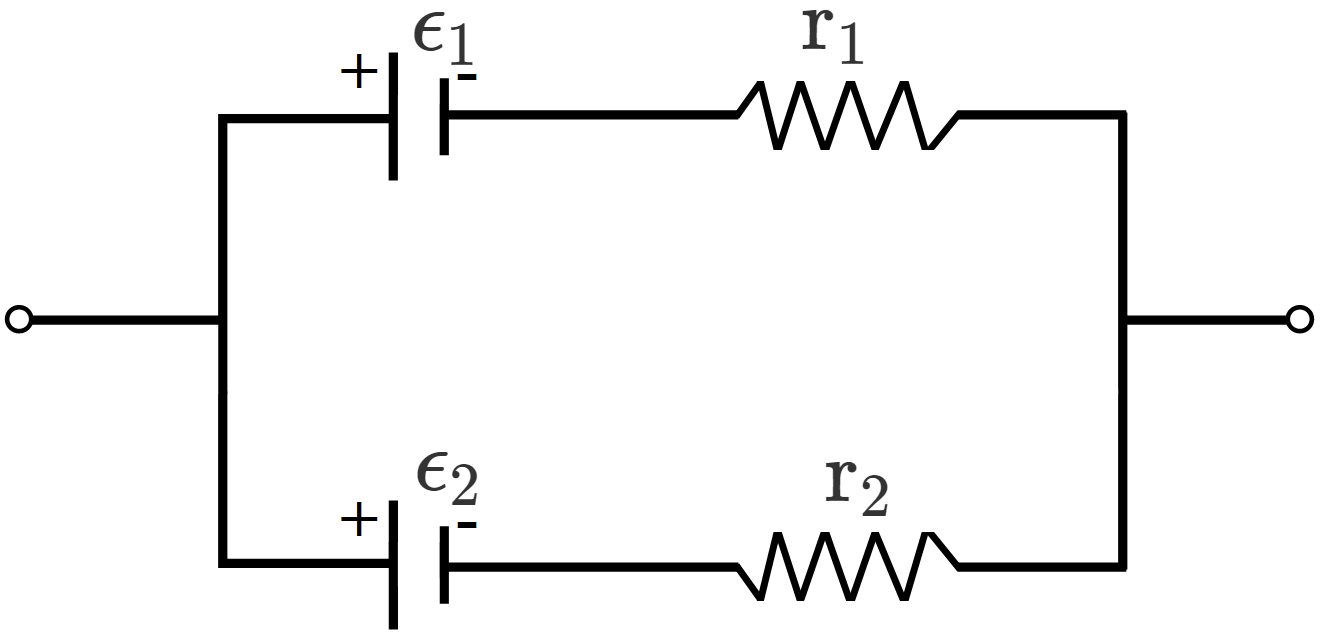
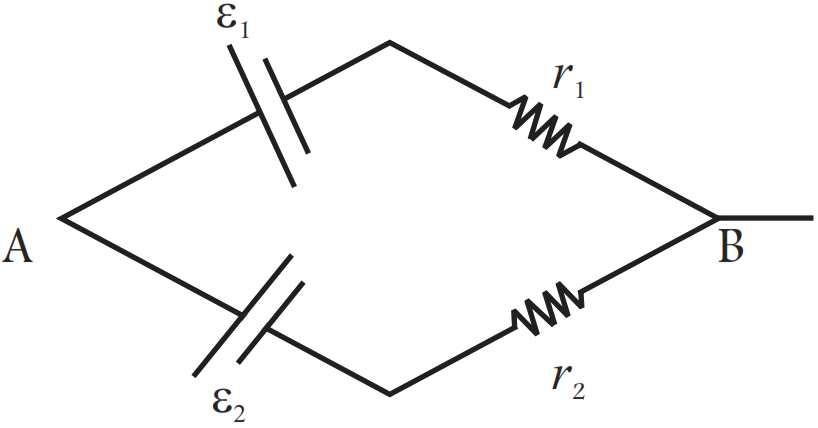
Two batteries of emf $\epsilon_1$ and $\epsilon_2\left(\epsilon_2 > \epsilon_1\right)$ and internal resistances $r_1$ and $r_2$ respectively are connected in parallel as shown in Fig.
  • The equivalent emf $\in_\text{eq}$ of the two cells is between $\in_1$ and $\in_2\text{ i.e., }\in_1<\in_\text{eq}<\in_2.$
  • B
    The equivalent emf $\in_\text{eq}$ is smaller than $\in_1$.
  • C
    The $\in_\text{eq}$ is given by $\in_\text{eq}=\in_1+\in_2$ always.
  • D
    $\in_\text{eq}$ is independent of internal resistances $r_1$ and $r_2$
Answer
Correct option: A.
The equivalent emf $\in_\text{eq}$ of the two cells is between $\in_1$ and $\in_2\text{ i.e., }\in_1<\in_\text{eq}<\in_2.$
a. The equivalent emf $\epsilon_{\text {eq }}$ of the two cells is between $\epsilon_1$ and $\epsilon_2$ i.e., $\epsilon_1 < \epsilon_{\text {eq }} < \epsilon_2$.
Solution:
In the above combination, the equivalent $\epsilon_{\text {eq }}$ is given by $\epsilon_{\text {eq }}=\frac{\left(\epsilon_1 r_1+\epsilon_2 r_2\right)}{\left(r_1+r_2\right)}$ The above equation shows that for any value of $r_1$ and $r_2 \in_{\text {eq }}$ will always lie between $\in_1$ and $\in_2$, In the given question, $\epsilon_2>\epsilon_1$, therefore, $\in_1<\epsilon_{\text {eq }}<\epsilon_2$.
View full question & answer
MCQ 151 Mark
When no current is passed through a conductor?
  • A
    The free electrons do not move.
  • B
    The average speed of a free electron over a large period of time is not zero.
  • C
    The average velocity of a free electron over a large period of time is zero.
  • The average of the velocities of all the free electrons at an instant is non zero.
Answer
Correct option: D.
The average of the velocities of all the free electrons at an instant is non zero.
View full question & answer
MCQ 161 Mark
An electrical cable of copper has just one wire of radius $9\ mm$. Its resistance is $5 \ ohm$. This single copper wire of the cable is replaced by $6$ different well insulated copper wires each of radius $3\ mm$. The total resistance of the cable will now be equal to:
  • $7.5 \ ohm.$
  • B
    $45 \ ohm.$
  • C
    $90 \ ohm.$
  • D
    $270 \ ohm.$
Answer
Correct option: A.
$7.5 \ ohm.$
View full question & answer
MCQ 171 Mark
A resistor of resistance $R$ is connected to an ideal battery. If the value of $R$ is decreased, the power dissipated in the resistor will:
  • A
    Increase.
  • Decrease.
  • C
    Remain unchanged.
  • D
    $(A)$ or $(B) $
Answer
Correct option: B.
Decrease.

Power $=\frac{\text{V}^2}{\text{R}},\text{R}\downarrow\text{thanpower}\uparrow$
Because Power $\propto\frac{1}{\text{R}}.$

View full question & answer
MCQ 181 Mark
Identify the dimensional formula of electric current.
  • A
    $\left[M L T^{-2}\right]$
  • $\left[ M ^0 L^0 T^0 A^1\right]$
  • C
    $\left[ M L ^3 T^0\right]$
  • D
    $\left[ M L ^2 T^{-3}\right]$
Answer
Correct option: B.
$\left[ M ^0 L^0 T^0 A^1\right]$
The flow of charge per unit time is defined as current. The fundamental unit of current is Ampere $($named after Andre Marie Ampere$).$
View full question & answer
MCQ 191 Mark
What is the driving force in a working Electrical Circuit?
  • Voltage Difference.
  • B
    Current.
  • C
    Temperature difference.
  • D
    Chemical Imbalance.
Answer
Correct option: A.
Voltage Difference.

When a potential difference is applied across a resistor then randomly moving free electrons start to move towards positive terminal due to force applied by electric field generated due to voltage difference. thus a start to Current Flows from High Voltage to Low Voltage.
Voltage is cause and current is effect.

View full question & answer
MCQ 201 Mark
In meter bridge or Wheatstone bridge for measurement of resistance, the known and the unknown resistance are interchanged. The error so removed is:
  • End correction.
  • B
    Index error.
  • C
    Due to temperature effect.
  • D
    Random error.
Answer
Correct option: A.
End correction.
View full question & answer
MCQ 211 Mark
What is the reciprocal of resistance of a material called? Give its unit.
  • Conductance, $ohm { }^{-1}$
  • B
    Conductivity, $ohm { }^{-1} m^{-1}$
  • C
    Conductance, $ohm { }^{-1} m^{-1}$
  • D
    Conductivity, $ohm { }^{-1}$
Answer
Correct option: A.
Conductance, $ohm { }^{-1}$
The conductance of a material is the ease with which electric charges flow through it.
Conductance $=\frac{1}{\text{Resistance.}}$
SI unit of conductance $=\frac{1}{\text{ohm}}$
$= ohm { }^{-1}$
View full question & answer
MCQ 221 Mark
Identify the correct statement from the following about discharging of a cell.
  • A
    The direction of current in the cell is from positive to negative terminal.
  • B
    Terminal potential difference is greater than emf of the cell.
  • Terminal potential difference is lesser than emf of the cell.
  • D
    The current increases and decreases frequently.
Answer
Correct option: C.
Terminal potential difference is lesser than emf of the cell.

During discharging of a cell terminal potential difference, the terminal potential difference is lesser than the emf of the cell. The direction of current inside the cell is from negative terminal to positive terminal.

View full question & answer
MCQ 231 Mark
Which of the following is correct when one cell is wrongly connected in series circuit?
  • A
    The total emf reduces by e.
  • B
    The total emf increases by e.
  • The total emf increases by 2e.
  • D
    The total emf decreases by 2e.
Answer
Correct option: C.
The total emf increases by 2e.
c. The total emf increases by 2 e .
Explanation:
When one cell is wrongly connected in series of $n$ identical cells, each of emf $e$, it will reduce the total emf by $2$ e . So, effective emf is calculated as $e_{\text {EFF }}=n e-2 e$. This happens in case of mixed grouping.
View full question & answer
MCQ 241 Mark
Two non-ideal batteries are connected in parallel. Consider the following statements:
  1. The equivalent emf is smaller than either of the two emfs.
  2. The equivalent internal resistance is smaller than either of the two internal resistances.
  • A
    Both $A$ and $B$ are correct.
  • B
    $A$ is correct but $B$ is wrong.
  • $B$ is correct but $A$ is wrong.
  • D
    Both $A$ and $B$ are wrong.
Answer
Correct option: C.
$B$ is correct but $A$ is wrong.

Equivalent emf $\in_0=\frac{\in_1\text{r}_1+\in_2\text{r}_2}{\text{r}_1+\text{r}_2}$

Equivalent resistance $=\text{r}_0=\frac{\text{r}_1\text{r}_2}{\text{r}_1+\text{r}_2}$
$\phi$ The equivalent emf is smaller than either of the two emfs.
$\phi$ The equivalent internal resistance is smaller than either of the two internal resistances.

View full question & answer
MCQ 251 Mark
The resistivity of certain metals or alloys drops to zero when they are cooled below a certain temperature, this phenomenon is known as $......$.
  • A
    Conductivity
  • B
    Partial conductivity
  • Superconductivity
  • D
    Non$-$conductivity
Answer
Correct option: C.
Superconductivity
The resistivity of certain metals or alloys drops to zero when they are cooled below a certain temperature, this phenomenon is known as superconductivity.
View full question & answer
MCQ 261 Mark
Identify the correct options:
  • A
    An ammeter should have small resistance.
  • B
    An ammeter should have large resistance.
  • C
    A voltmeter should have large resistance.
  • A and C both
Answer
Correct option: D.
A and C both
Explanation:
Þ An ammeter should have small resistane. To measure the accurate reading of current in the circuit by Ammeter.
þ A voltmeter should have large resistance. To measure the accurate reading of voltage across voltmeter.
View full question & answer
MCQ 271 Mark
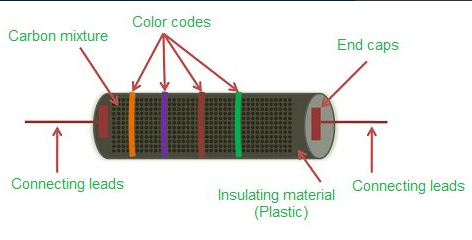
$......$ represents the most significant digits of the resistance value in finding the resistance of carbon resistor.
  • A
    Last two color bands
  • First two color bands
  • C
    Last color band only
  • D
    First color band only
Answer
Correct option: B.
First two color bands

Since first and second color bands has higher multiplier, they represents the most significant digits of the resistance value in finding the resistance of carbon resistor.

View full question & answer
MCQ 281 Mark
Potentiometer measures the potential difference more accurately than a voltmeter because:
  • A
    it has a wire of high resistance.
  • B
    it has a wire of low resistance.
  • it does not draw current from external circuit.
  • D
    it draws a heavy current from external circuit.
Answer
Correct option: C.
it does not draw current from external circuit.

When we measure the emf of a cell by the potentiometer then no current flows in the circuit in zero$-$deflection condition ie, cell is in open circuit. Thus, in this condition the actual value of a cell is found. In this way, potentiometer is equivalent to an ideal voltmeter of infinite resistance.
Note. The emf in the potentiometer is measured by null method in which zero deflection position is found on the wire.

View full question & answer
MCQ 291 Mark
A current passes through a resistor. If $K _1$ and $K _2$ represent the average kinetic energy of the conduction electrons and the metal ions respectively then:
  • A
    $K _1 < K _2$
  • B
    $K _1= K _2$
  • $K _1 > K _2$
  • D
    Any of these three may occur.
Answer
Correct option: C.
$K _1 > K _2$
View full question & answer
MCQ 301 Mark
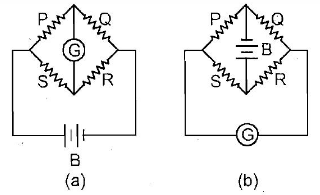
Figure $(a)$ below shows a Wheatstone bridge in which $\text{P, Q, R, S}$ are fixed resistances, $G$ is a galvanometer and $B$ is a battery. For this particular case the galvanometer shows zero deflection. Now, only the positions of $B$ and $G$ are interchanged,. as shown in figure $(b).$ The new deflection of the galvanometer.
  • A
    Is to the left.
  • B
    Is to the right.
  • Is zero.
  • D
    Depends on the values of $\text{P, Q, R, S.}$
Answer
Correct option: C.
Is zero.
This is one charactristic of a wheatstone bridge, that if we interchange the position of galvanometer and battery, there will no any change in the output.
View full question & answer
MCQ 311 Mark
Which resistor has color bands on it?
  • Carbon resistor.
  • B
    Rheostat.
  • C
    Wire wound resistor.
  • D
    None of these.
Answer
Correct option: A.
Carbon resistor.

The carbon composition resistor is a type of fixed resistor that reduces or restricts the electric current flow to a certain level.

View full question & answer
MCQ 321 Mark
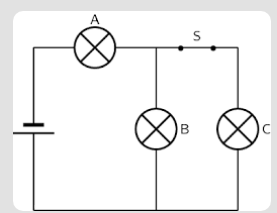
Which of the following is not a correct statement with respect to the given circuit?
  • A
    Switch $S$ is closed
  • B
    Current is flowing in the circuit
  • $B$ and $C$ are connected in series
  • D
    A is connected in series to $B$ and $C$
Answer
Correct option: C.
$B$ and $C$ are connected in series
View full question & answer
MCQ 331 Mark
In the series combination of two or more than two resistances:
  • The current through each resistance is same.
  • B
    The voltage through each resistance is same.
  • C
    Neither current nor voltage through each resistance is same.
  • D
    Both current and voltage through each resistance are same.
Answer
Correct option: A.
The current through each resistance is same.
View full question & answer
MCQ 341 Mark
Given a current carrying wire of non$-$uniform cross-section. Which one of the following is constant through out the length of wire ?
  • Current only.
  • B
    Current and drift speed.
  • C
    Drift speed only.
  • D
    Current, electric field and drift speed.
Answer
Correct option: A.
Current only.

Current is uniform throughout the wire even if it is of non$-$uniform thickness. This is because charge passing through every cross sectional area per unit time remains the same throughout the wire. So, current remains the same.

View full question & answer
MCQ 351 Mark
For small currents, $‘X’$ obeys Ohm’s law. But when large currents are passed through the same conductor, it deviates from ohmic behaviour. Identify $X.$
  • Metallic conductor.
  • B
    Gallium arsenide.
  • C
    Thyristor.
  • D
    $p-n$ junction diode.
Answer
Correct option: A.
Metallic conductor.

$‘X\ ’$ is a metallic conductor. For small currents, it obeys Ohms’s law and its $V-I$ graph is a straight line. But when large currents are passed through the same conductor, it gets heated up and its resistance increases. It no longer obeys Ohm’s law at higher currents.

View full question & answer
MCQ 361 Mark
The electric resistance of a certain wire of iron is R. If its length and radius are both doubled, then:
  • A
    The resistance and the specific resistance, will both remain unchanged.
  • B
    The resistance will be doubled, and the specific resistance will be halved.
  • The resistance will be halved and the specific resistance will remain unchanged.
  • D
    The resistance will be halved and the specific resistance will be doubled.
Answer
Correct option: C.
The resistance will be halved and the specific resistance will remain unchanged.
View full question & answer
MCQ 371 Mark
Why is the Wheatstone bridge better than the other methods of measuring resistances?
  • A
    It does not involve Ohm's law.
  • B
    It is based on Kirchoff's law.
  • C
    It has four resistor arms.
  • It is a null method.
Answer
Correct option: D.
It is a null method.
The Wheatstone bridge is used to measure the unknown resistance by using null method. i.e, when the bridge is balanced, no current through the galvanometer. Using this null method, we can easily measure the unknown resistance if the other three arm's resistor are given.
View full question & answer
MCQ 381 Mark
Two cells of emf’s approximately $5V$ and $10V$ are to be accurately compared using a potentiometer of length $400\ cm.$
  • A
    The battery that runs the potentiometer should have voltage of $8V.$
  • The battery of potentiometer can have a voltage of $15V$ and $R$ adjusted so that the potential drop across the wire slightly exceeds $10V.$
  • C
    The first portion of $50\ cm$ of wire itself should have a potential drop of $10V.$
  • D
    Potentiometer is usually used for comparing resistances and not voltages.
Answer
Correct option: B.
The battery of potentiometer can have a voltage of $15V$ and $R$ adjusted so that the potential drop across the wire slightly exceeds $10V.$
Key concept: The potential drop along the wires of potentiometer should be greater than emfs of cells.
In a potentiometer experiment, the emf of a cell can be measured if the potential drop along the potentiometer wire is more than the emf of the cell to be determined. Here, values of emfs of two cells are given as $5V$ and $10V$, therefore, the potential drop along the potentiometer wire must be more than $10V.$
View full question & answer
MCQ 391 Mark
Identify the material whose resistivity is more than $10^{14} \Omega m$.
  • Bakelite
  • B
    Copper
  • C
    Aluminum
  • D
    Silicon
Answer
Correct option: A.
Bakelite
a. Bakelite
Explanation:
Insulators are materials which do not conduct electric current, and thereby, offer high resistance to the flow of charges. Insulators like bakelite and hard rubber have very high resistivities in the range of $10^{14}$ to $10^{16} \Omega m$.
View full question & answer
MCQ 401 Mark
In series connection of resistors, what happens to the current across each resistor?
  • A
    Increases
  • B
    Decreases
  • Remain the same
  • D
    Initially increases and then decreases
Answer
Correct option: C.
Remain the same
When the resistors are connected in series, and current is passed through them, the current passing through each of the resistor is the same. This is because, the resistors are connected end to the end and, therefore, there is only one path for the current to flow through.
View full question & answer
MCQ 411 Mark
For a chosen non$-$zero value of voltage, there can be more than one value of current in:
  • A
    Copper wire.
  • Thermistor.
  • C
    nichrome wire.
  • D
    Manganine wire.
Answer
Correct option: B.
Thermistor.

Thermistor are made up of substance with high $\alpha ,$ which is very much sensitive to temperature thereby a slight change in temperature varies its resistance with huge amount. hence making more than one value of current possible for chosen non$-$zero value of voltage.

View full question & answer
MCQ 421 Mark
The relaxation time in conductors:
  • A
    Increases with the increases of temperature.
  • Decreases with the increases of temperature.
  • C
    It does not depends on temperature.
  • D
    All of sudden changes at 400K.
Answer
Correct option: B.
Decreases with the increases of temperature.
View full question & answer
MCQ 431 Mark
What is the effect on null deflection of galvanometer, when the radius of the wire is tripled?
  • No change.
  • B
    Becomes half.
  • C
    Reduces by $\frac{1}{3}$
  • D
    Thrice the original value.
Answer
Correct option: A.
No change.

For a balanced Meter Bridge $\frac{\text{P}}{\text{Q}}=\frac{\text{x}}{(100-\text{x})}.$ From this, we can understand that the null deflection of galvanometer does not depend on the radius of the wire. So, even if the radius of the wire is tripled, the null deflection of the galvanometer undergoes no change.

View full question & answer
MCQ 441 Mark
The opposition offered by the electrolyte of the cell to the flow of current through itself is known as $......$.
  • A
    External resistance.
  • Internal resistance.
  • C
    Non-resistance.
  • D
    None of these options.
Answer
Correct option: B.
Internal resistance.
The opposition offered by the electrolyte of the cell to the flow of current through itself is known as internal resistance.
View full question & answer
MCQ 451 Mark
Drift velocity of electrons is due to:
  • A
    Motion of conduction electrons due to random collisions.
  • Motion of conduction electrons due to electric field .$\rightarrow E$
  • C
    Repulsion to the conduction electrons due to inner electrons of ions.
  • D
    Collision of conduction electrons with each other.
Answer
Correct option: B.
Motion of conduction electrons due to electric field .$\rightarrow E$
View full question & answer
MCQ 461 Mark
To get maximum current in a resistance of $3 \ ohms$, one can use n rows of m cells $($connected in series$)$ connected in parallel. If the total number of cells is $24$ and the internal resistance of a cell is $0.5 \ ohms$ then:
  • $M = 12, n = 2.$
  • B
    $M = 8, n = 3.$
  • C
    $M = 2, n = 12.$
  • D
    $M = 6, n = 4.$
Answer
Correct option: A.
$M = 12, n = 2.$
View full question & answer
MCQ 471 Mark
Two resistors $A$ and $B$ have resistances $R_A$ and $R_B$, respectively, and $R_A<R_B$. The resistivities of their materials are $\rho_A$ and $\rho_{ B }$.
  • A
    $\rho _\text{A}>\rho _\text{B}$
  • B
    $\rho _\text{A}=\rho _\text{B}$
  • C
    $\rho _\text{A}<\rho _\text{B}$
  • The information is not sufficient to find the relation between $\rho _\text{A}$ and $\rho _\text{B}.$
Answer
Correct option: D.
The information is not sufficient to find the relation between $\rho _\text{A}$ and $\rho _\text{B}.$
d. The information is not sufficient to find the relation between $P_A$ and $P_B$.
Explanation:
$R =\frac{\rho \ell}{ A }$
Resistance is depend on Material, length & Area.
So $R A<R B$ is information is not sufficient to ding.
The relation between $\rho_{ A }$ and $\rho_{ B }$.
View full question & answer
MCQ 481 Mark
Resistors are generally colour coded to:
  • A
    Indicate the type of the circuit in which they are to be used.
  • B
    Identify whether they are ohmic or non-ohmic.
  • Determine their values in ohm.
  • D
    Determine whether they are wire wound or composition resistors.
Answer
Correct option: C.
Determine their values in ohm.
Components and wires are coded with colors to identify their value and function. The colors brown, red, green, blue, and violet are used as tolerance codes on $5-$band resistors only.
So,Resistors are generally colour coded to determine their values in ohm.
View full question & answer
MCQ 491 Mark
To draw a maximum current from a combination of cells, how should the cells be grouped?
  • A
    Parallel.
  • B
    Series.
  • C
    Mixed grouping.
  • Depends upon the relative values of internal and external resistances.
Answer
Correct option: D.
Depends upon the relative values of internal and external resistances.
View full question & answer
MCQ 501 Mark
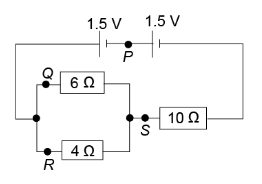
In the circuit shown here, at which point is the current least?
  • A
    $P$
  • $Q$
  • C
    $R$
  • D
    $S$
Answer
Correct option: B.
$Q$
Current flowing through $S$ is the combined current from $Q$ and $R.$
Current flowing through $S$ is the same as the current from through $P.$
Current follows the path of least resistance.
Hence more current would flow through the $4\ ohm$ resistor.
View full question & answer
M.C.Q (1 Marks) - Physics STD 12 Science Questions - Vidyadip