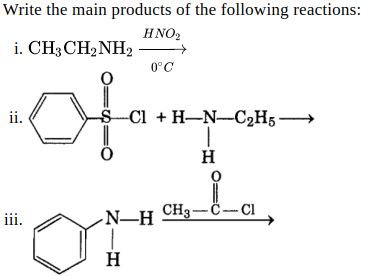
Question
Image

Answer

Get the step-by-step solution for this question inside the Vidyadip app.

Get the answer in the app

Need a full question paper?

Generate a complete, print-ready paper with questions like this in minutes — across 16+ boards, with answer keys.

Start Generating Free

Similar questions

Method of formation of solution is given in Column I. Match it with the type of solution given in Column II.
  Column I   Column II
(i) Sulphur vapours passed through cold water. (a) Normal electrolyte solution.
(ii) Soap mixed with water above critical micelle concentration. (b) Molecular colloids.
(iii) White of egg whipped with water. (c) Associated colloid.
(iv) Soap mixed with water below critical micelle concentration. (d) Macro molecular colloids.
A colourless substance 'A' $(C_6H_7N)$ is sparingly soluble in water and gives a water soluble compound 'B' on treating with mineral acid. On reacting with $CHCl_3$ and alcoholic potash 'A' produces an obnoxious smell due to the formation of compound 'C'. Reaction of 'A' with benzenesulphonyl chloride gives compound 'D' which is soluble in alkali. With $NaNO_2$ and HCl, 'A' forms compound 'E' which reacts with phenol in alkaline medium to give an orange dye 'F'. Identify compounds 'A' to 'F'.
Explain the various methods of preparation of $CHCl _3$ and its chemical properties.
What happens to most probable kinetic energy and the energy of activation with increase in temperature?
After watching a programme on TV about the presence of carcinogens (cancer causing agents) Potassium bromate and Potassium iodate in bread and other bakery products, Rupali a Class XII student decided to make others aware about the adverse effects of these carcinogens in foods. She consulted the school principal and requested him to instruct the canteen contractor to stop selling sandwiches, pizzas, burgers and other bakery products to the students. The principal took an immediate action and instructed the canteen contractor to replace the bakery products with some protein and vitamin rich food like fruits, salads, sprouts, etc. The decision was welcomed by the parents and the students.
After reading the above passage, answer the following questions:
  1. What are the values (at least two) displayed by Rupali?
  2. Which polysaccharide component of carbohydrates is commonly present in bread?
  3. Write the two types of secondary structures of proteins.
  4. Give two examples of water soluble vitamins.
What is a semiconductor? Describe the two main types of semiconductors and contrast their conduction mechanism.
Explain the methods of preparation alcohol from the following compounds:
(a) From carbonyl compound
(b) From carboxylic acid
(c) From esters
(d) From Grignard reagent
  1. Draw the molecular structures of the following compounds:
  1. $N_2O_5$.
  2. $XeOF_4$.
  1. Explain the following observations:
  1. Sulphur has a greater tendency for catenation than oxygen.
  2. ICl is more reactive than $I_2$.
  3. Despite lower value of its electron gain enthalpy with negative sign, fluorine $(F_2)$ is a stronger oxidising agent than $Cl_2$​​​​​​​.
Discuss in detail DNA and RNA.
Give reasons for the following:
  1. Molten aluminium bromide is poor conductor of electricity.
  2. Nitric oxide becomes brown when released in air.
  3. $PCl_5$​​​​​​​ is ionic in nature in the solid state.
  4. Ammonia acts as a ligand.
  5. Sulphur disappears when boiled with an aqueous solution of sodium sulphite.