MCQ
$1V$ equals:
  • A
    $1J$
  • $1 JC ^{-1}$
  • C
    $1 CJ ^{-1}$
  • D
    $1JC$

Answer

Correct option: B.
$1 JC ^{-1}$
b. $1 JC ^{-1}$
Explanation:
$1$ volt is equal to $1$ joule of electric potential energy per (divided by) $1$ coulomb of charge. $V = J / C =$ joule/ coulomb

Need a full question paper?

Generate a complete, print-ready paper with questions like this in minutes — across 16+ boards, with answer keys.
Start Generating Free

Similar questions

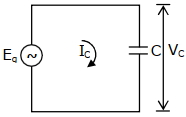
In a circuit consisting of a capacitance and a generator with alternating emf $E_{g}=E_{g0}$ $sin\omega t,$ $V_{C}$ and ${I}_{{C}}$ are the voltage and current. Correct phasor diagram for such circuit is :
Consider an electromagnetic wave propagating in vacuum . Choose the correct statement
An AM wave has 1800 watt of total power content, For 100% modulation the carrier should have power content equal to
In an experiment of measuring the refractive index of a glass slab using travelling microscope in physics lab, a student measures real thickness of the glass slab as $5.25\,mm$ and apparent thickness of the glass slab at $5.00\,mm$. Travelling microscope has $20$ divisions in one $cm$ on main scale and $50$ divisions on Vernier scale is equal to $49$ divisions on main scale. The estimated uncertainty in the measurement of refractive index of the slab is $\frac{x}{10} \times 10^{-3}$, where $x$ is $..............$
The electric intensity due to an infinite cylinder of radius $R$ and having charge $q$ per unit length at a distance $r(r > R)$ from its axis is
Six protons and six neutrons are brought together to form a carbon nucleus, but the mass of the carbon nucleus is less than the sum of the masses of the individual particles due to the mass defect, This deducted mass has been:
White light may be considered to be a mixture of waves with l ranging between 3900 Å and 7800 Å. An oil film of thickness 10,000 Å is examined normally by reflected light. If m = 1.4, then the film appears bright for
In an alpha particle scattering experiment distance of closest approach for the $\alpha$ particle is $4.5 \times 10^{-14} \mathrm{~m}$. If target nucleus has atomic number $80$ , then maximum velocity of $\alpha$-particle is . . . . .. $\times 10^5$ $\mathrm{m} / \mathrm{s}$ approximately.

$\left(\frac{1}{4 \pi \in_0}=9 \times 10^9 \mathrm{SI}\right.$ unit, mass of $\alpha$ particle $=$ $\left.6.72 \times 10^{-27} \mathrm{~kg}\right)$
Correct relation for triode is
 
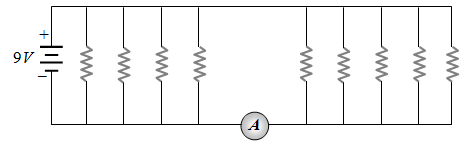
If each resistance in the figure is of 9 W then reading of ammeter is