MCQ
Consider an electromagnetic wave propagating in vacuum . Choose the correct statement
  • A
    For an electromagnetic wave propagating in $+y$ direction the electric field is $\vec E = \frac{1}{{\sqrt 2 }}\,{E_{yz}}\,\left( {x,t} \right)\,\hat z$ and the magnetic field is $\vec B = \frac{1}{{\sqrt 2 }}\,{B_z}\,\left( {x,t} \right)\hat y$ 
  • B
    For an electromagnetic wave propagating in $+y$ direction the electric field is $\vec E = \frac{1}{{\sqrt 2 }}\,{E_{yz}}\,\left( {x,t} \right)\,\hat y$ and the magnetic field is $\vec B = \frac{1}{{\sqrt 2 }}\,B_{yz}\,\left( {x,t} \right)\hat z$
  • C
    For an electromagnetic wave propagating in $+x$ direction the electric field is $\vec E = \frac{1}{{\sqrt 2 }}\,{E_{yz}}\,\left( {y,z,t} \right)\,\left( {\hat y + \hat z} \right)$ and the magnetic field is $\vec B = \frac{1}{{\sqrt 2 }}\,B_{yz}\,\left( {y,z,t} \right)\,\left( {\hat y + \hat z} \right)$
  • For an electromagnetic wave propagating in $+x$ direction the electric field is $\vec E = \frac{1}{{\sqrt 2 }}\,{E_{yz}}\,\left( {x,t} \right)\,\left( {\hat y - \hat z} \right)$ and the magnetic field is $\vec B = \frac{1}{{\sqrt 2 }}\,B_{yz}\,\left( {x,t} \right)\,\left( {\hat y + \hat z} \right)$
Answer

Correct option: D.
For an electromagnetic wave propagating in $+x$ direction the electric field is $\vec E = \frac{1}{{\sqrt 2 }}\,{E_{yz}}\,\left( {x,t} \right)\,\left( {\hat y - \hat z} \right)$ and the magnetic field is $\vec B = \frac{1}{{\sqrt 2 }}\,B_{yz}\,\left( {x,t} \right)\,\left( {\hat y + \hat z} \right)$
d
Wave in $X-$ direction means $E$ and $B$ should be function of $x$ and $t$

$\overset\frown{y}-\overset\frown{z}\,\bot \,\overset\frown{y}+\overset\frown{z}\,$

Need a full question paper?

Generate a complete, print-ready paper with questions like this in minutes — across 16+ boards, with answer keys.

Start Generating Free

Similar questions

In a region $10^{19}$ $\alpha -$ particels and $10^{19}$ protons per second move to the left, while $10^{19}$ electrons moves to the right per second. The current is
A $60\, watt$ bulb carries a current of $0.5\, amp$. The total charge passing through it in $1$ hour is ............ $coulomb$
The energy that should be added to an electron to reduce its de Broglie wavelength from one nm to 0.5 nm is
Consider four circuits shown in the figure below. In which circuit power dissipated is greatest (Neglect the internal resistance of the power supply)
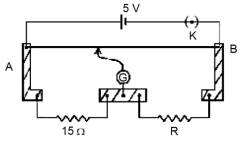
A meter bridge setup is shown in the figure. It is used to determine an unknown resistance $R$ using a given resistor of $15\,\Omega$. The galvanometer $(G)$ shows null deflection when tapping key is at $43\,cm$ mark from end $A$. If the end correction for end $A$ is $2\,cm$. then the determined value of $R$ will be__________ $\Omega$
Three concentric metal shells $A, B$ and $C$ of respective radii $a, b$ and $c (a < b < c)$ have surface charge densities $+\sigma,-\sigma$ and $+\sigma$ respectively. The potential of shell $B$ is
A particle moving with velocity v having specific charge $(q/m)$ enters a region of  magnetic field $B$ having width $d=\frac{{3mv}}{{5qB}}$ at angle $53^o$ to the boundary of magnetic field. Find the angle $\theta$ in the diagram......$^o$ 
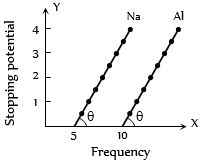
From the figure describing photoelectric effect we may infer correctly that
The magnetic field in a plane electromagnetic wave is given by $=2 \times 10^{-7} \sin \left(0.5 \times 10^3 x+1.5 \times 10^{11} t\right)$. This electromagnetic wave is .........
When a current is passed through water, acidified with a dilute sulphuric acid, the gases formed at the platinum electrodes are