MCQ
$2\,\mu F$ capacitance has potential difference across its two terminals $200\;volts$. It is disconnected with battery and then another uncharged capacitance is connected in parallel to it, then $P.D.$ becomes $20\;volts$. Then the capacity of another capacitance will be.......$\mu F$
  • A
    $2$
  • B
    $4$
  • $18$
  • D
    $10$

Answer

Correct option: C.
$18$
c
(c) By using, common potential $V = \frac{{{C_1}{V_1} + {C_2}{V_2}}}{{{C_1} + {C_2}}}$
$==>$ $20 = \frac{{2 \times 200 + {C_2} \times 0}}{{2 + {C_2}}}$ $==>$ ${C_2} = 18\,\mu F$

Need a full question paper?

Generate a complete, print-ready paper with questions like this in minutes — across 16+ boards, with answer keys.

Start Generating Free

Similar questions

A proton moving with a constant velocity, passes through a region of space without change in its velocity. If $E$ $\& B$ represent the electric and magnetic fields respectively, this region may have
A string of length $0.4\, m$ and mass ${10^{ - 2}}\,kg$ is tightly clamped at its ends. The tension in the string is $1.6\, N.$ Identical wave pulses are produced at one end at equal intervals of time $\Delta t$. The minimum value of $\Delta t$ which allows constructive interference between successive pulses is  .... $s$
When electric bulbs of same power, but different marked voltage are connected in series across the power line, their brightness will be :
$32$ cells, each of $emf$ $3V$, are connected in series and kept in a box. Externally, the combination shows an $emf$ of $84\, V$. The number of cells reversed in the combination is 
One yard in $SI$ units is equal
A current of $1\,A$ is flowing on the sides of an equilateral triangle of side $4.5\times10^{-2}\,m$ . The magnetic field at the centre of the triangle will be
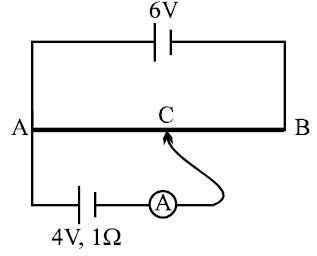
$A \,6 \,V$ battery of negligible internal resistance is connected across a uniform wire of length $1\, m$. The positive terminal of another battery of emf $4\,V$ and internal resistance $1\, \Omega$ is joined to the point $A$ as shown in figure. The ammeter shows zero deflection when the jockey touches the wire at the point $C$. The $AC$ is equal to
A vertical spring with force constant $k$ is fixed on a table. A ball of mass $m$ at a height $h$ above the free upper end of the spring falls vertically on the spring so that the spring is compressed by a distance $d.$ The net work done in the process is
A particle returns to the starting point after $10\,s$. If the rate of change of velocity during the motion is constant, then its location after $7\,s$ will be same as that after $...........\,s$
A nucleus with $Z = 92$ emits the following in a sequence: $\alpha ,\,{\beta ^ - },\,{\beta ^ - },\,\alpha ,\alpha ,\alpha ,\alpha ,\alpha ,{\beta ^ - },\,{\beta ^ - },\alpha ,\,{\beta ^ + },\,{\beta ^ + },\,\alpha $. The $Z$ of the resulting nucleus is