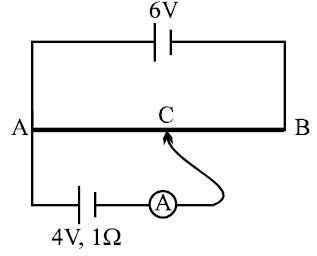
$A \,6 \,V$ battery of negligible internal resistance is connected across a uniform wire of length $1\, m$. The positive terminal of another battery of emf $4\,V$ and internal resistance $1\, \Omega$ is joined to the point $A$ as shown in figure. The ammeter shows zero deflection when the jockey touches the wire at the point $C$. The $AC$ is equal to
Medium
Download our app for free and get started
$x=\frac{6}{1} v / m \Rightarrow 6 \times l_{A C}=4$
$l_{A C}=\frac{2}{3} m$

Download our appand get started for free
Experience the future of education. Simply download our apps or reach out to us for more information. Let's shape the future of learning together!No signup needed.*
Similar Questions
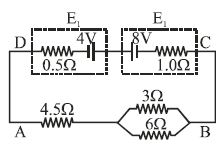
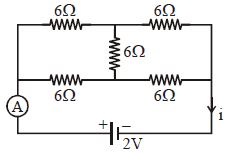
- 1View SolutionReading of ammeter in ampere for the following circuit is
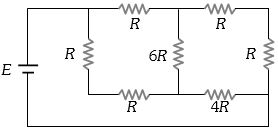
- 2A battery of internal resistance $4$ $\Omega$ is connected to the network of resistances as shown. In order to give the maximum power to the network, the value of $R$ (in $\Omega $) should beView Solution
- 3A potentiometer wire has length $4\,\, m$ and resistance $8\,\,\Omega $. The resistance that must be connected in series with the wire and an accumulator of e.m.f. $2\,\, V,$ so as to get a potential gradient $1\,\, m \,V$ per $cm$ on the wire is ............. $\Omega$View Solution
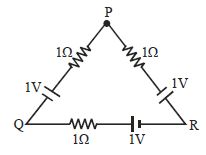
- 4In given circuit find potential difference between $P$ and $Q$ .................. $V$View Solution
- 5An electric bulb is rated $220\, volt$ and $100\, watt$. Power consumed by it when operated on $110\, volt$ is ............. $watt$View Solution
- 6View SolutionIt is easier to start a car engine on a hot day than on a cold day. This is because the internal resistance of the car battery
- 7View SolutionA thick wire is stretched so that its length become two times. Assuming that there is no change in its density, then what is the ratio of change in resistance of wire to the initial resistance of wire
- 8Two electric bulbs have tungsten filament of same length. If one of them gives $60\ W$ and the other $100\ W$ , thenView Solution
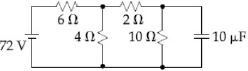
- 9Determine the charge on the capacitor in the following circuit ................ $\mu C$View Solution
- 10In the given circuit, calculate the value of current in $4.5\,\Omega $ resistor .............. $\mathrm{A}$View Solution