Question
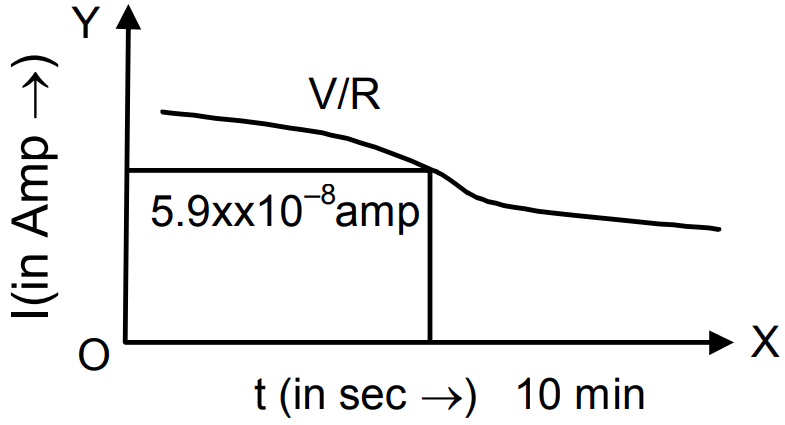
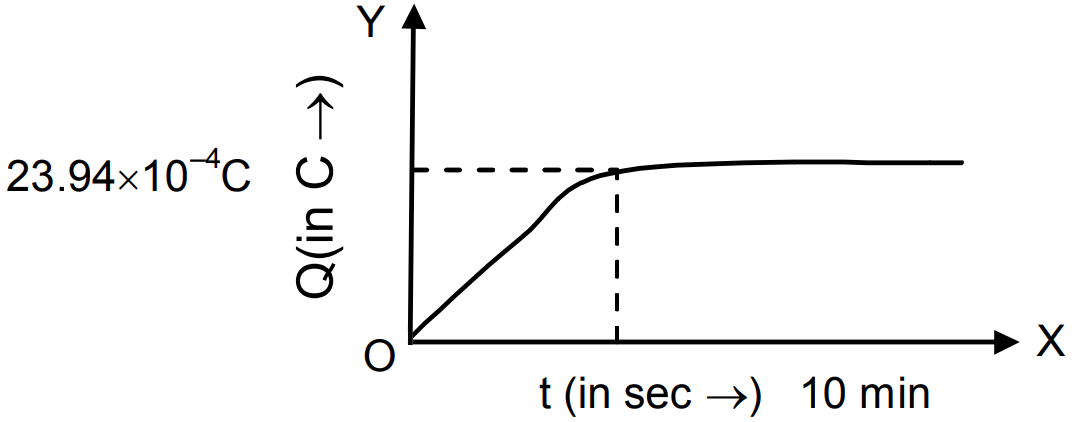
A $100\mu\text{F}$ capacitor is joined to a 24V battery through a $1.0\text{M}\Omega$ resistor. Plot qualitative graphs (a) between current and time for the first 10 minutes and (b) between charge and time for the same period.
Answer

Time constant $\text{RC} = 1 \times 10^6 \times 100 \times 10^6 = 100 \text{sec}$
  1. $\text{q}=\text{VC}\Big(1-\text{e}^{\frac{-\text{t}}{\text{CR}}}\Big)$


I = Current $=\frac{\text{dq}}{\text{dt}}=\text{VC}.(-)\text{e}^{\frac{-\text{t}}{\text{RC}}},\frac{-1}{\text{RC}}$

$=\frac{\text{V}}{\text{R}}\text{e}^{\frac{-\text{t}}{\text{RC}}}=\frac{\text{V}}{\text{R}\cdot\text{e}^{\frac{\text{t}}{\text{RC}}}}=\frac{24}{10^6}\times\frac{1}{\text{e}^{\frac{\text{t}}{100}}}$

$=24\times10^{-6}\frac{1}{\text{e}^{\frac{\text{t}}{100}}}$

$\text{t}=10\text{min},600\text{sec}.$


$\text{Q}=24\times10+-4\times\big(1-\text{e}^{-6}\big)=23.99\times10^{-4}$

$\text{I}=\frac{24}{10^6}\times\frac{1}{\text{e}^6}=5.9\times10^{-8}\text{Amp}.$
  1. $\text{q}=\text{VC}\Big(1-\text{e}^\frac{-\text{t}}{\text{CR}}\Big)$

Need a full question paper?

Generate a complete, print-ready paper with questions like this in minutes — across 16+ boards, with answer keys.
Start Generating Free

Similar questions

Particles of masses 1g, 2g, 3g, ........, 100g are kept at the marks 1cm, 2cm, 3cm, ........, 100cm respectively on a metre scale. Find the moment of inertia of the system of particles about a perpendicular bisector of the metre scale.
Two point charges $q$ and $-q$ are located at points $(0,0,-a)$ and $(0,0, a)$ respectively.
$i$. Find the electrostatic potential at $(0,0, z)$ and $(x, y, 0)$.
$ii.$ How much work is done in moving a small test charge from the point $(5,0,0)$ to $(-7,0,0)$ along the $X$-axis?
$iii.$ How would your answer change if the path of the test charge between the same points is not along the $x$-axis but along any other random path?
$iv$. If the above point charges are now placed in the same positions in a uniform external electric field $\vec{E}$, what would be the potential energy of the charge system in its orientation of unstable equilibrium? Justify your answer in each case.
The force of buoyancy exerted by the atmosphere on a balloon is B in the upward direction and remains constant. The force of air resistance on the balloon acts opposite to the direction of velocity and is proportional to it. The balloon carries a mass M and is found to fall down near the earth's surface with a constant velocity v. How much mass should be removed from the balloon so that it may rise with a constant velocity v?
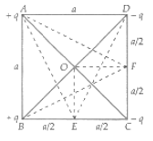
Four charges $+ q ,+ q ,- q$ and $- q$ are placed respectively at the corners $A , B , C$ and $D$ of a square of side a arranged in the given order. Calculate the electric potential at the centre $O$ . If A a $E$ and $F$ are the midpoints of sides $BC$ and $CD$ respectively, what will be the work done in carrying a charge e from $O$ to $E$ and from $O$ to $F$ ?
Image
In a Young's double slit interference experiment the fringe pattern is observed on a screen placed at a distance D from the slits. The slits are separated by a distance d and are illuminated by monochromatic light of wavelength $\lambda$. Find the distance from the central point where the intensity falls to,
  1. Half the maximum.
  2. One fourth of the maximum.
A parallel-plate capacitor has plate area $25.0cm^2$ and a separation of 2.00mm between the plates. The capacitor is connected to a battery of 12.0V:
  1. Find the charge on the capacitor.
  2. The plate separation is decreased to 1.00mm. Find the extra charge given by the battery to the positive plate.
The initial pressure and volume of a given mass of a gas $\Big(\frac{\text{C}_\text{P}}{\text{C}_\text{V}}=\gamma\Big)$ are $P_0$ and $V_0$. The gas can exchange heat with the surrounding.
  1. It is slowly compressed to a volume $\frac{\text{V}_0}{2}$ and then suddenly compressed to $\frac{\text{V}_0}{4}.$ Find the final pressure.
  2. If the gas is suddenly compressed from the volume $V_0$ to $\frac{\text{V}_0}{2}$ and then slowly compressed to $\frac{\text{V}_0}{4},$ what will be the final pressure?
Two parallel coaxial circular coils of equal radius ‘R’ and equal number of turns ‘N’, carry equal currents ‘I’ in the same direction and are separated by a distance ‘2R’. Find the magnitude and direction of the net magnetic field produced at the mid-point of the line joining their centres.
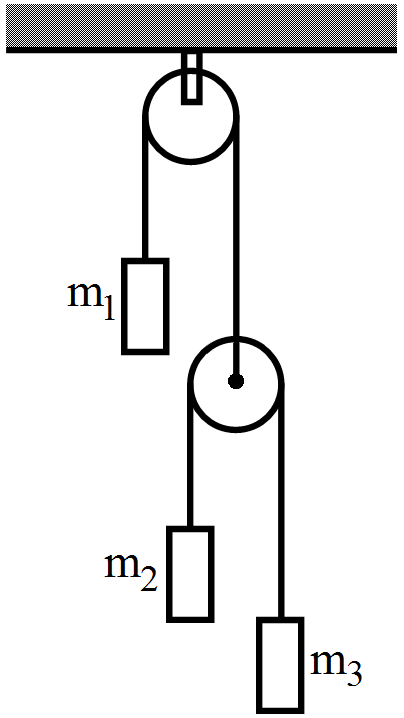
Let $m_1 = 1kg, m_2 = 2$ kg and $m_3 = 3$ kg in figure. Find the accelerations of $m_1, m_2$ and $m_3$. The string from the upper pulley to $m_1$ is 20cm when the system is released from rest. How long will it take before m, strikes the pulley?
How many time constants will elapse before the energy stored in the capacitor reaches half of its equilibrium value in a charging RC circuit?