Question
How many time constants will elapse before the energy stored in the capacitor reaches half of its equilibrium value in a charging RC circuit?

Answer

$\text{q}=\text{Q}\big(1-\text{e}^{-\text{n}}\big)$
$\frac{1}{2}\frac{\text{Q}^2}{\text{C}}$ = Initial value; $\frac{1}{2}\frac{\text{q}^2}{\text{c}}$ = Final value
$\frac{1}{2}\frac{\text{q}^2}{\text{c}}\times2=\frac{1}{2}\frac{\text{Q}^2}{\text{C}}$
$\Rightarrow\text{q}^2=\frac{\text{Q}^2}{2}\Rightarrow\text{q}=\frac{\text{Q}}{\sqrt{2}}$
$\frac{\text{Q}}{\sqrt{2}}=\text{Q}(1-\text{e}^{\text{n}})$
$\Rightarrow\frac{1}{\sqrt{2}}=1-\text{e}^{-\text{n}}\Rightarrow\text{e}^{-\text{n}}=1-\frac{1}{\sqrt{2}}$
$\Rightarrow\text{n}=\log\Big(\frac{\sqrt{2}}{\sqrt{2}-1}\Big)=1.22$

Need a full question paper?

Generate a complete, print-ready paper with questions like this in minutes — across 16+ boards, with answer keys.
Start Generating Free

Similar questions

Doubly-ionised helium ions are projected with a speed of $10km/s^{-1}$ in a direction perpendicular to a uniform magnetic field of magnitude 1.0T. Find
  1. The force acting on an ion.
  2. The radius of the circle in which it circulates.
  3. The time taken by an ion to complete the circle.
The two square faces of a rectangular dielectric slab (dielectric constant 4.0) of dimensions 20cm × 20cm × 1.0mm are metal-coated. Find the capacitance between the coated surfaces.

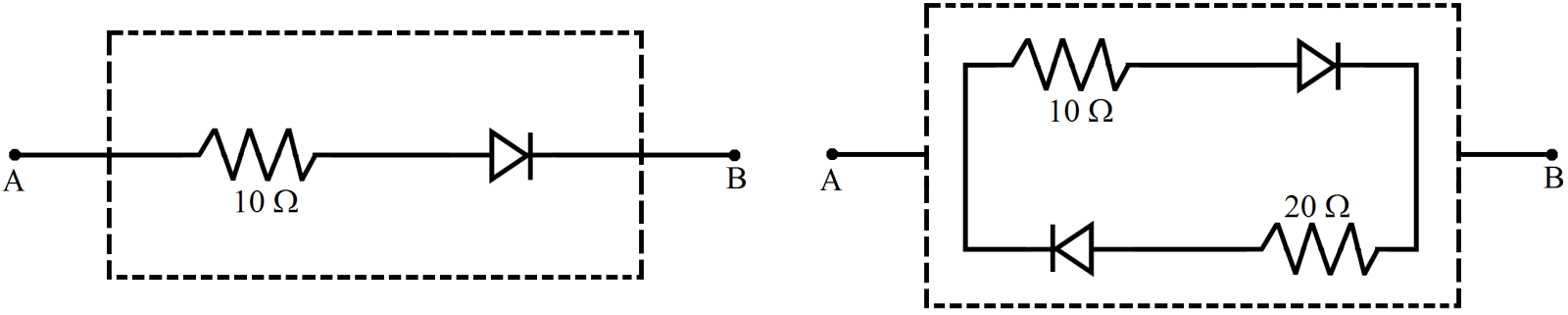
Draw the current-voltage characteristics for the device shown in figure. between the terminals A and B.
A magnetic field B is confined to a region r ≤ a and points out of the paper (the z-axis), r = 0 being the centre of the circular region. A charged ring (charge = Q) of radius b, b > a and mass m lies in the x-y plane with its centre at the origin. The ring is free to rotate and is at rest. The magnetic field is brought to zero in time Δt. Find the angular velocity ω of the ring after the field vanishes.
A small object is placed at the centre of the bottom of a cylindrical vessel of radius 3cm and height 4cm filled completely with water. Consider the ray leaving the vessel through a corner. Suppose this ray and the ray along the axis of the vessel are used to trace the image. Find the apparent depth of the image and the ratio of real depth to the apparent depth under the assumptions taken. Refractive index of water = 1.33
A room has a window fitted with a single 1.0m × 2.0m glass of thickness 2mm.
  1. Calculate the rate of heat flow through the closed window when the temperature inside the room is 32°C and that outside is 40°C.
  2. The glass is now replaced by two glasspanes, each having a thickness of 1mm and separated by a distance of 1mm. Calculate the rate of heat flow under the same conditions of temperature. Thermal conductivity of window glass $= 1.0Js^{-1}m^{-1}{^\circ}C^{-1} $ and that of air $= 0.025Js^{-1}m^{-1}{^\circ}C^{-1}.$
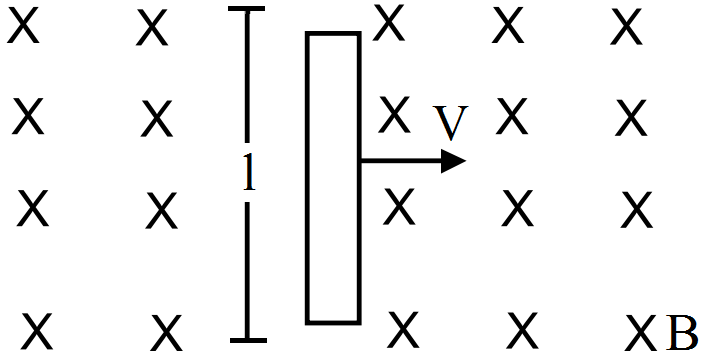
A conducting wire of length l, lying normal to a magnetic field B, moves with a velocity v, as shown in the figure.
  1. Find the average magnetic force on a free electron of the wire.
  2. Due to this magnetic force, electrons concentrate at one end, resulting in an electric field inside the wire. The redistribution stops when the electric force on the free electrons balances the magnetic force. Find the electric field developed inside the wire when the redistribution stops.
  3. What potential difference is developed between the ends of the wire?
The activity R of an unknown radioactive nuclide is measured at hourly intervals. The results found are tabulated as follows:
t(h) 0 1 2 3 4
R(MBq) 100 35.36 12.51 4.42 1.56
  1. Plot the graph of R versus t and calculate half-life from the graph.
  2. Plot the graph of 0 ln $\Big(\frac{\text{R}}{\text{R}_0}\Big)$ versus t and obtain the value of half-life from the graph.
Consider the situation of the previous problem. A charges of $-2.0 \times 10^{-4}C$ is moved from the point A to the point B. Find the change in electrical potential energy $U_B - U_A$ for the cases (a), (b) and (c).
  1. Derive an expression for the force between two long parallel current carrying conductors.
  2. Use this expression to define S.I. unit of current.
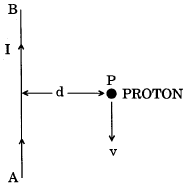
  3. A long straight wire AB carries a current I. A proton P travels with a speed v, parallel to the wire, at a distance d from it in a direction opposite to the current as shown in the figure. What is the force experienced by the proton and what is its direction?