MCQ
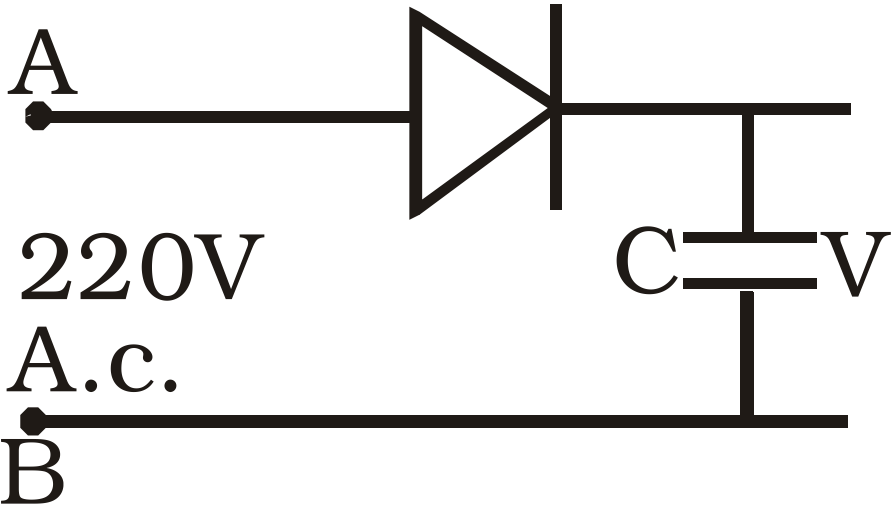
A $220 V A.C$. supply is connected between points $A$ and $B ($Fig.$)$. What will be the potential difference $V$ across the capacitor?
  • A
    $220V.$
  • B
    $110V.$
  • C
    $0V.$
  • $220\sqrt{2}\text{V}.$

Answer

Correct option: D.
$220\sqrt{2}\text{V}.$
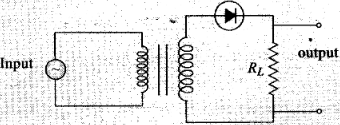
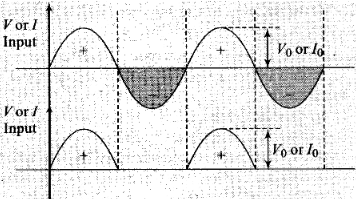
Key concept: Half wave rectifier: When the $P-N$ junction diode rectifies half of the ac wave, it is called half wave rectifier.

  1. During positive half cycle,
Diode $\rightarrow$ Forward biased
Output signal $\rightarrow$ obtained
  1. During negative half cycle,
Diode $\rightarrow$ reverse biased
Output signal $\rightarrow$ not obtained
  1. Output voltage is obtained across the load resistance $RL$. It is not constant but pulsating $($mixture of ac and $dc)$ in nature.
  2. Average output in one cycle
$\text{I}_\text{dc}=\frac{\text{I}_0}{\pi}\text{ and }\text{V}_\text{dc}=\frac{\text{V}_0}{\pi};\text{I}_0=\frac{\text{V}_0}{\text{r}_\text{f}+\text{R}_\text{I}}$
$(rf =$ forward biased resistance$)$
  1. $r.m.s$. output: $\text{I}_\text{rms}=\frac{\text{I}_0}{2},\text{V}_\text{rms}=\frac{\text{V}_0}{2}$
As $p-n$ junction diode will consuct during positive half cycle only, during negative half cycle diode is reverse biased. During this diode will not give any output. So, potential difference across capacitor $C =$ peak voltage of the given $AC$ voltage
$=\text{V}_0=\text{V}_\text{rms}\sqrt{2}=220\sqrt{2}\text{V}$

Need a full question paper?

Generate a complete, print-ready paper with questions like this in minutes — across 16+ boards, with answer keys.

Start Generating Free