Question
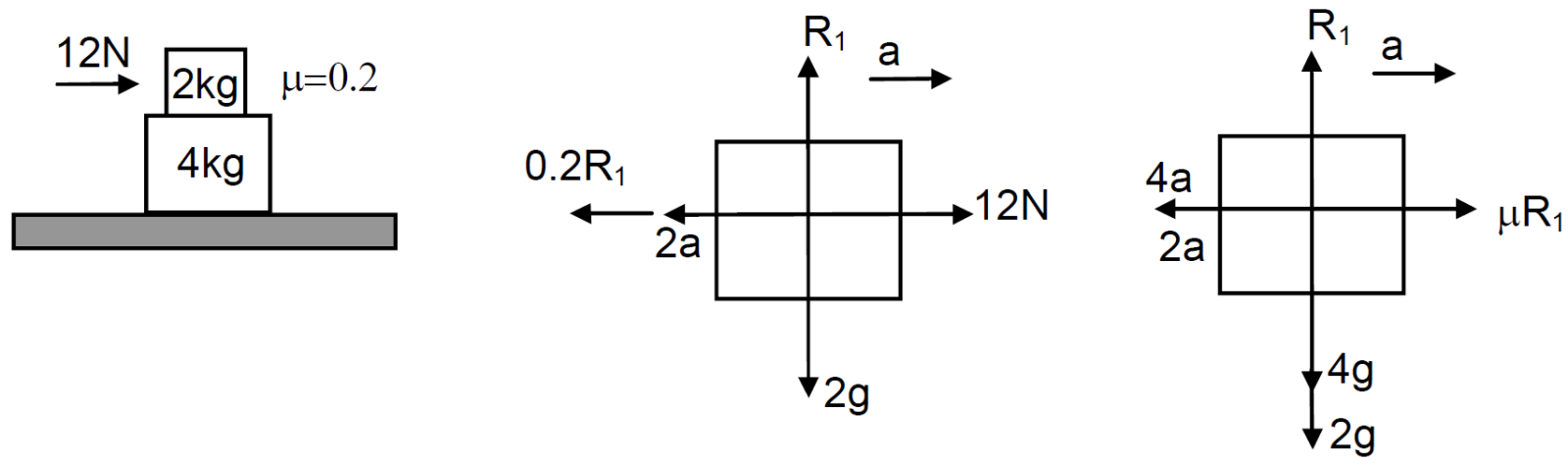
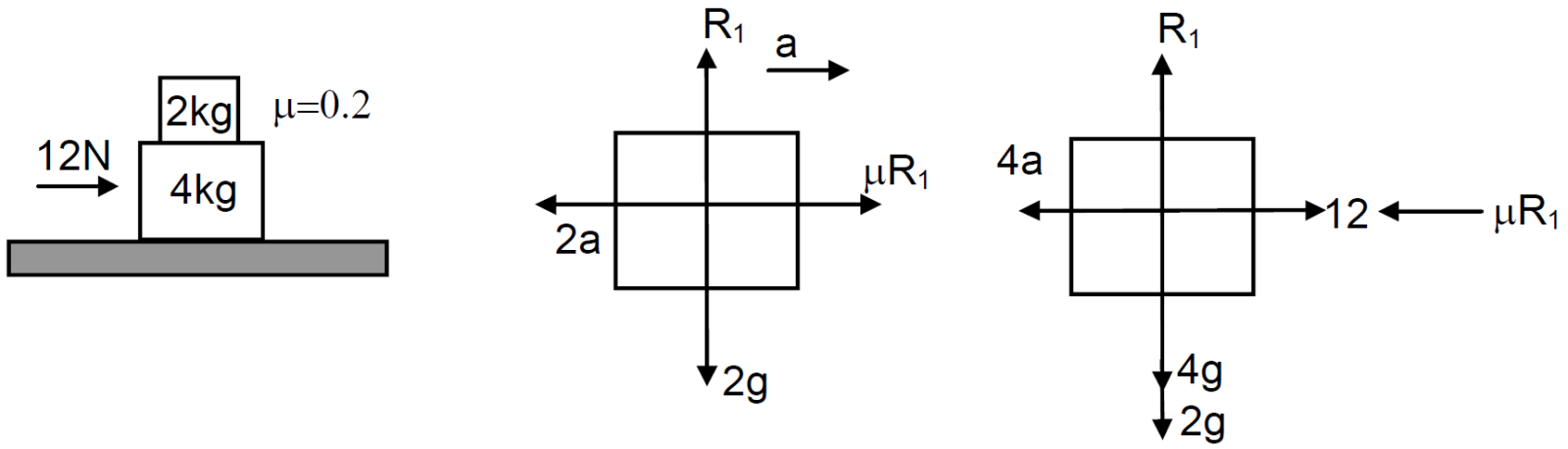
A 2kg block is placed over a 4kg block and both are placed on a smooth horizontal surface. The coefficient of friction between the blocks is 0.20. Find the acceleration of the two blocks if a horizontal force of 12N is applied to:
  1. The upper block.
  2. The lower block. Take g = 10m/s2.

Answer

  1.  

R1 - 2g = 0

⇒ R1 = 2 × 10 = 20

2a + 0.2 R1 - 12 = 0

⇒ 2a + 0.2(20) = 12

⇒ 2a = 12 - 4 = 8

⇒ a = 4m/s2

$4\text{a}_1-\mu\text{R}_1=0$

$\Rightarrow4\text{a}_1=\mu\text{R}_1=0.2(20)$

⇒ 4a1 = 4

⇒ a1 = 1m/s2

2kg block has acceleration 4m/s2 & that of 4kg is 1m/s2

  1.  

R1 = 2g = 20

$\text{Ma}-\mu\text{R}_1=0$

⇒ 2a = 0.2(20) = 4

⇒ a = 2m/s2

4a + 0.2 × 2 × 10 - 12 = 0

⇒ 4a + 4 = 12

⇒ 4a = 8

⇒ a = 2m/s2

Need a full question paper?

Generate a complete, print-ready paper with questions like this in minutes — across 16+ boards, with answer keys.

Start Generating Free

Similar questions

The refractive index of a material M1 changes by 0.014 and that of another material M2 changes by 0.024 as the colour of the light is changed from red to violet. Two thin prisms one made of M1(A = 5.3°) and other made of M2(A = 3.7°) are combined with their refracting angles oppositely directed.
  1. Find the angular dispersion produced by the combination.
  2. The prisms are now combined with their refracting angles similarly directed. Find the angular dispersion produced by the combination.
Write in detail the important results related to conductive electrostatics.
Monochromatic radiation of wavelength 640.2 nm (1nm = 10–9 m) from a neon lamp irradiates photosensitive material made of caesium on tungsten. The stopping voltage is measured to be 0.54 V. The source is replaced by an iron source and its 427.2 nm line irradiates the same photo-cell. Predict the new stopping voltage.
Consider a neutron and an electron bound to each other due to gravitational force. Assuming Bohr's quantization rule for angular momentum to be valid in this case, derive an expression for the energy of the neutron-electron system.
On the basis of Bohr's postulates, derive the expression for orbital speed of electron for $n ^{\text {th }}$ stable orbit in hydrogen atom.
Energy in ground state of hydrogen atom is $(-) XeV$. What will be the kinetic energy in this state?
A person travelling in a fast spaceship measures the distance between the earth and the moon. Is it the same, smaller or larger than the value quoted in this book?
Two capacitors of capacitances 20.0pF and 50.0pF are connected in series with a 6.00V battery. Find:
  1. The potential difference across each capacitor.
  2. The energy stored in each capacitor.
An inductor-coil of resistance $10\Omega$ and induetanes 120mH is connected across a battery of emf 6V and Internal resistance $2\Omega.$ Find the charge which flows through the inductor in:
  1. 10ms
  2. 20ms
  3. 100 ms after the connections are made.
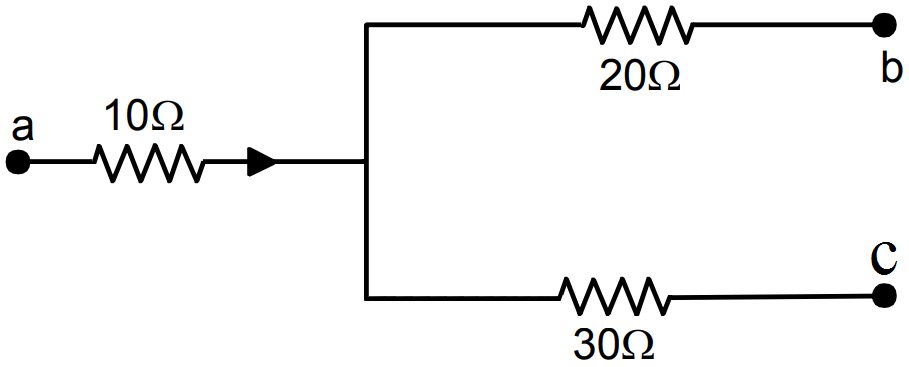
Figure. showa a part of an electric circuit. The potentials at the point a, b and c are 30V, 12V and 2V respectively. Find the currents through the three resistors.

An electric current flows in a wire from north to south. What will be the direction of the magnetic field due to this wire at a point east of the wire? West of the wire? Vertically above the wire? Vertically below the wire?