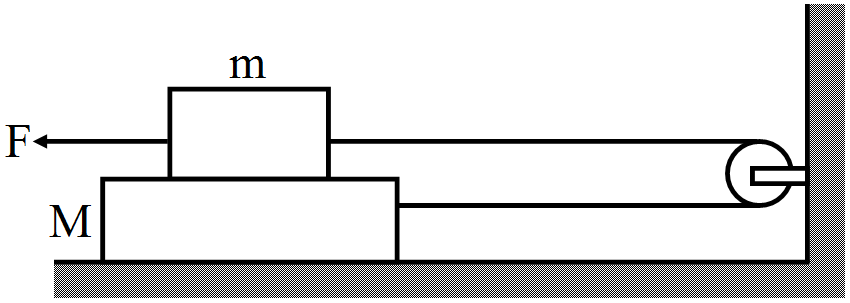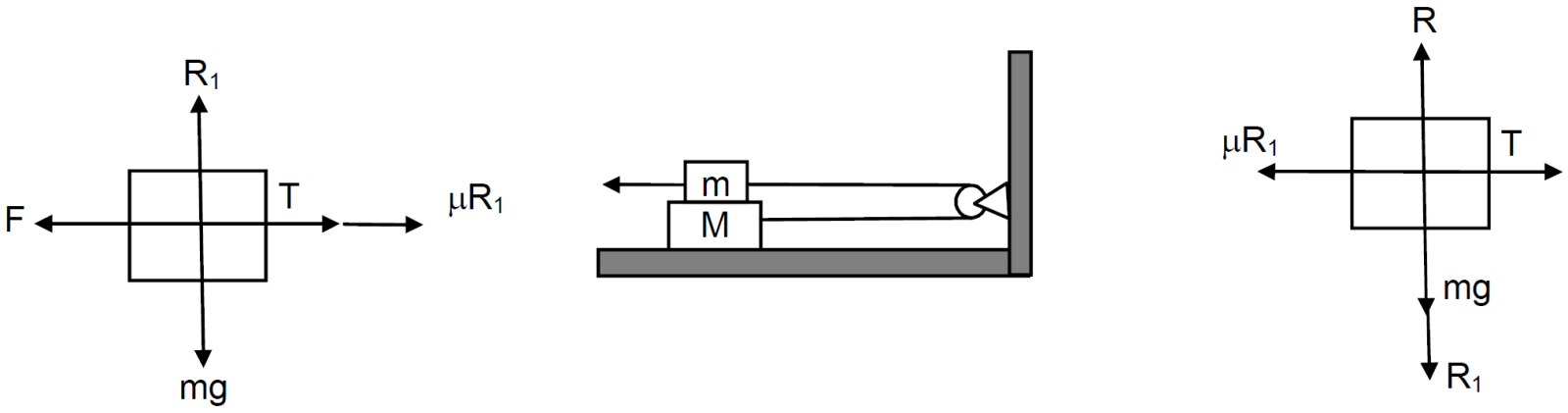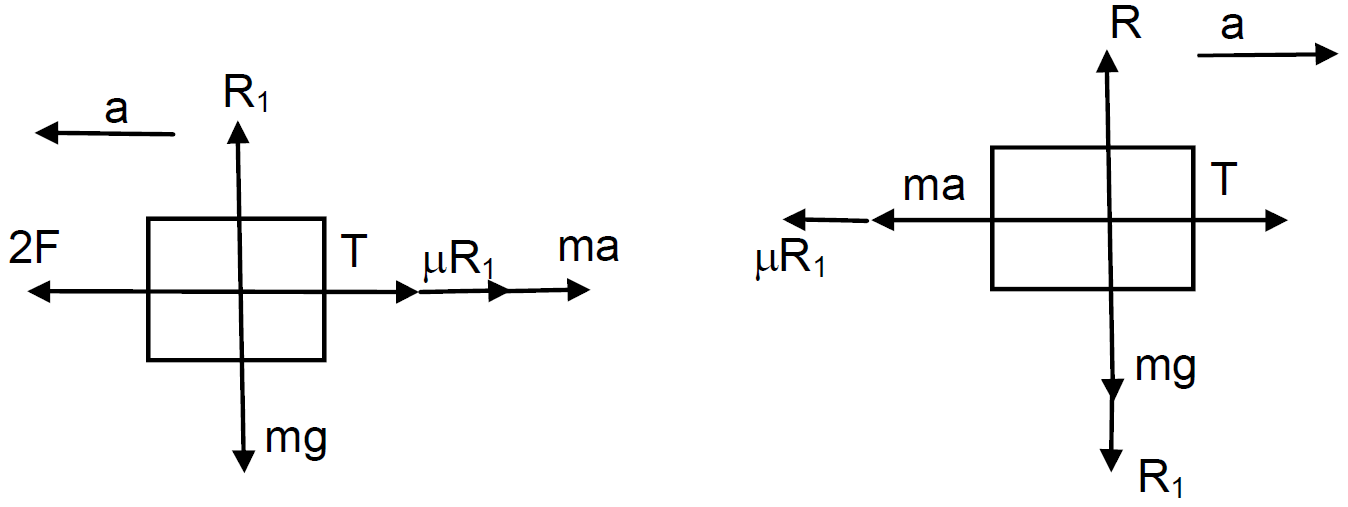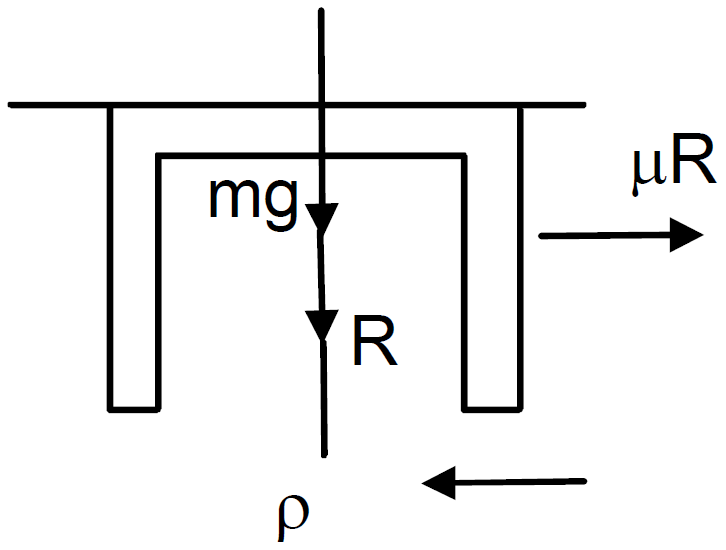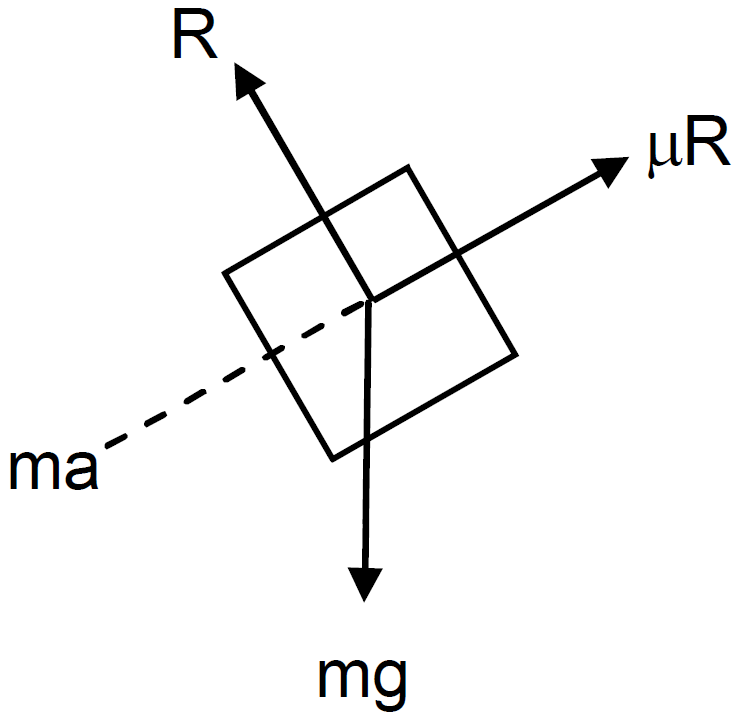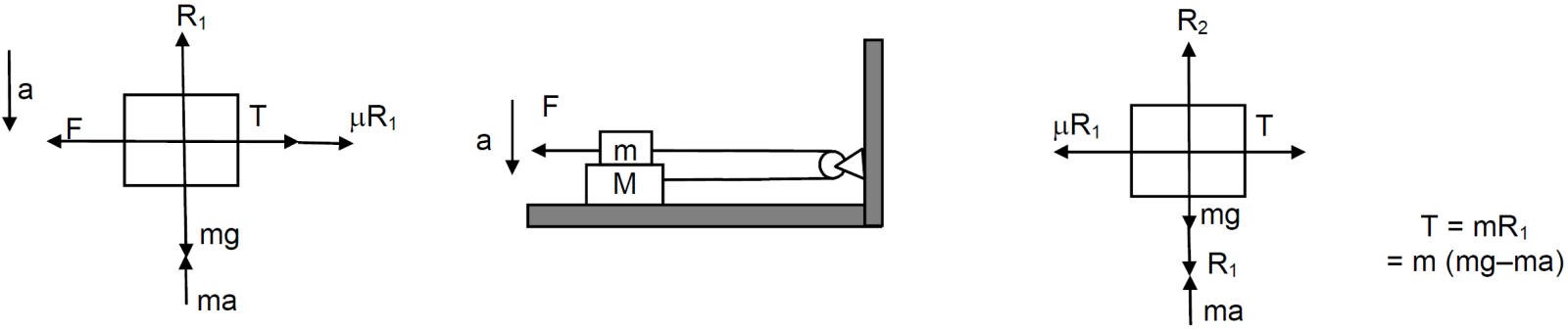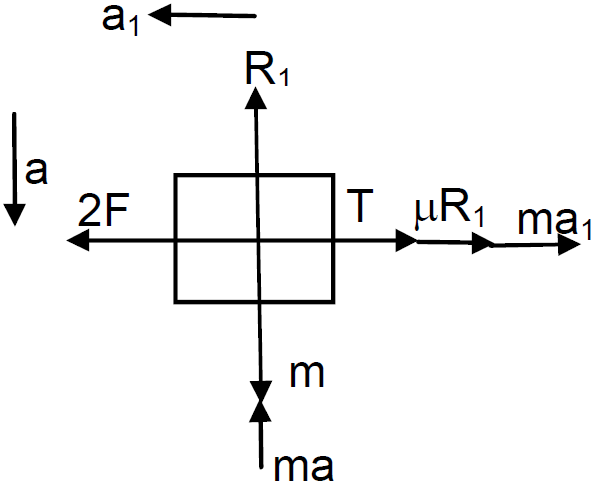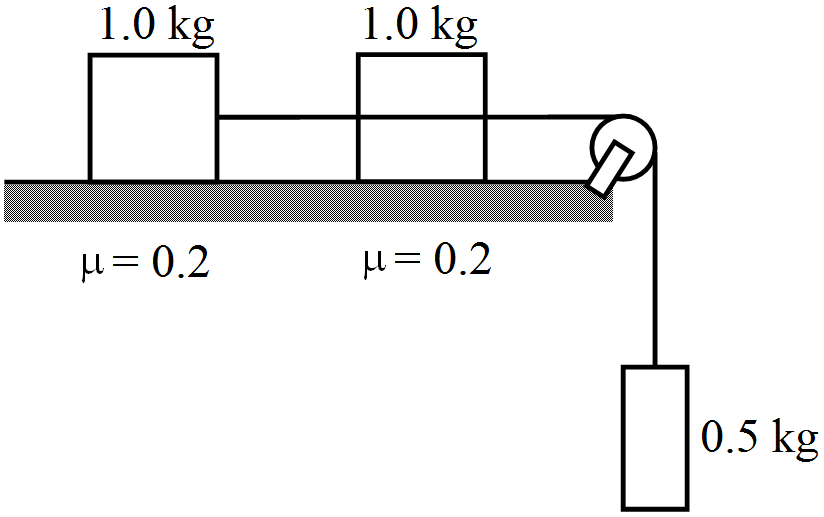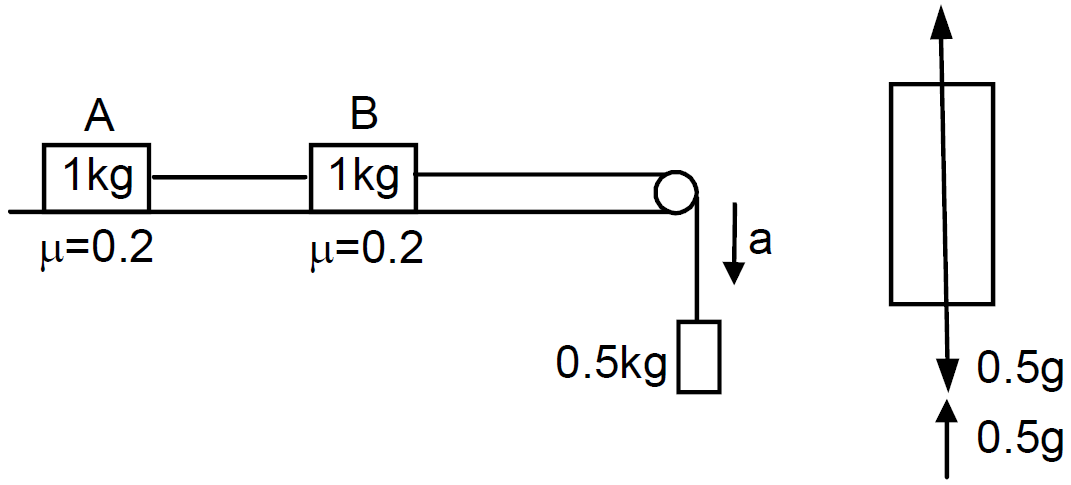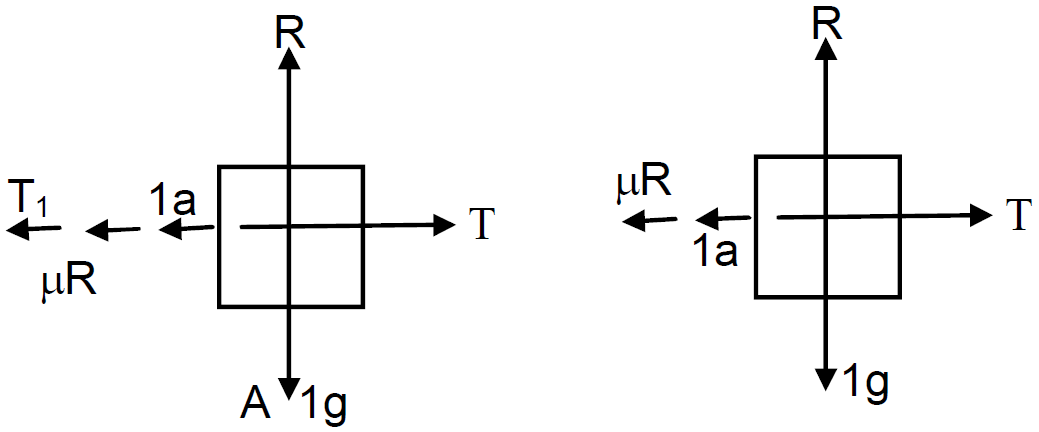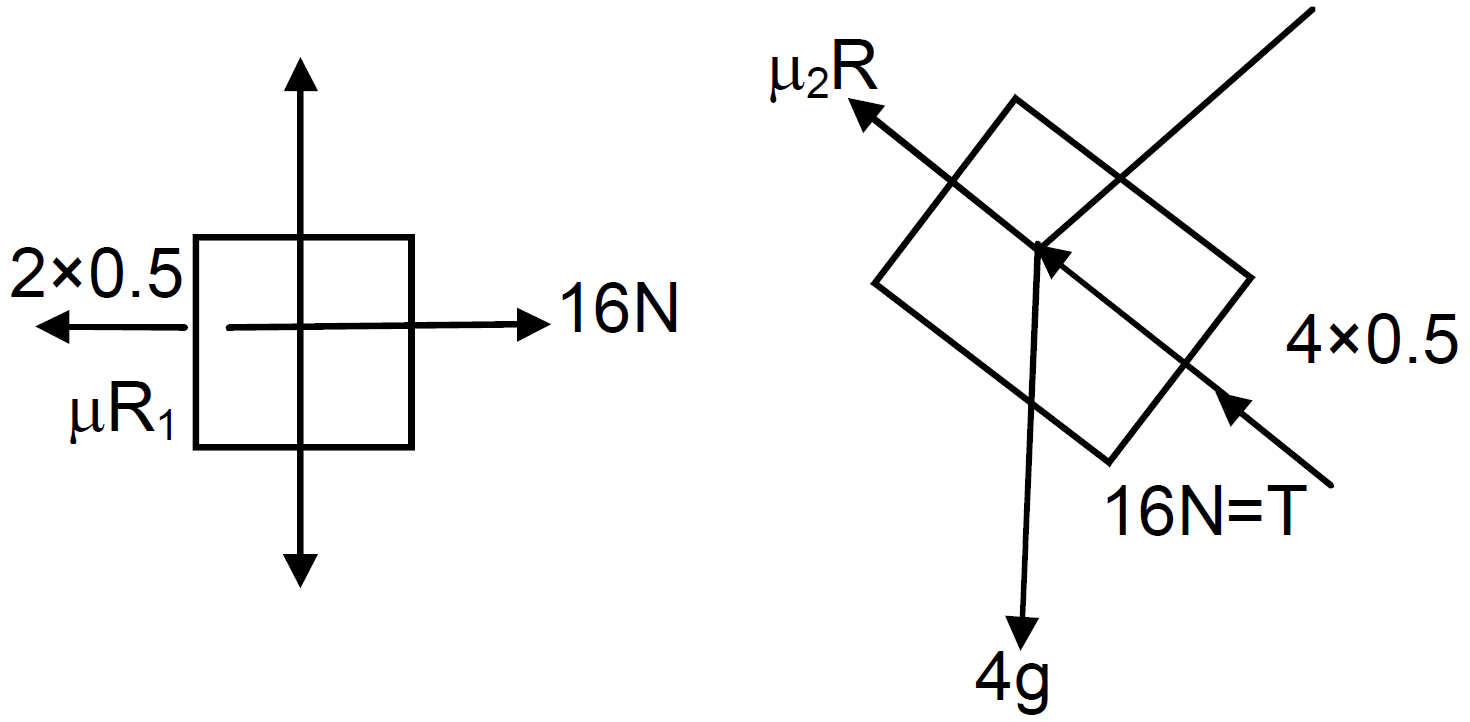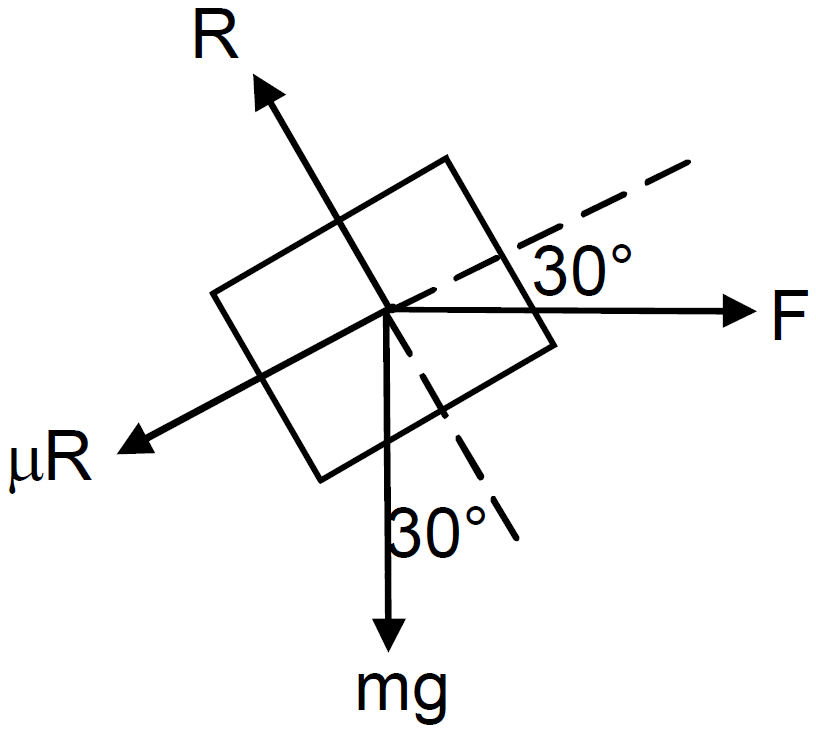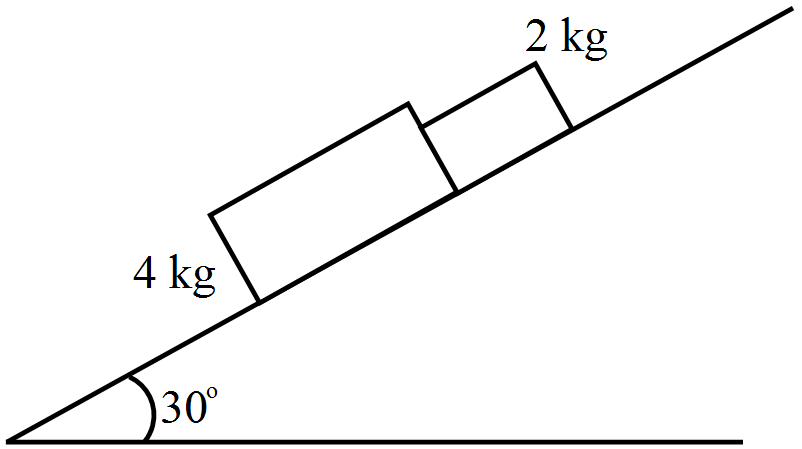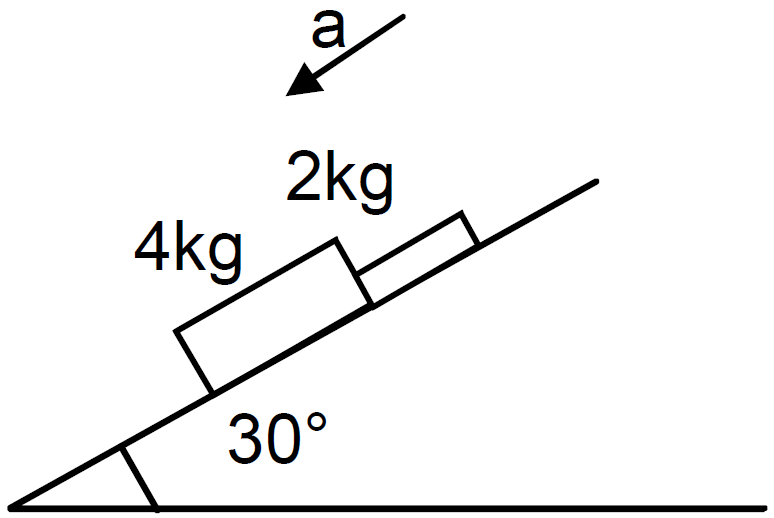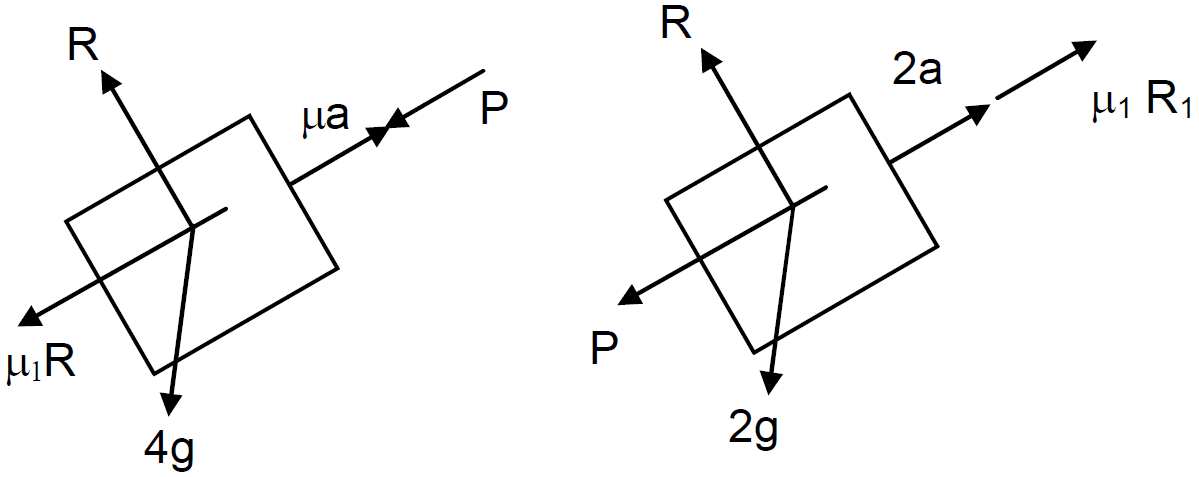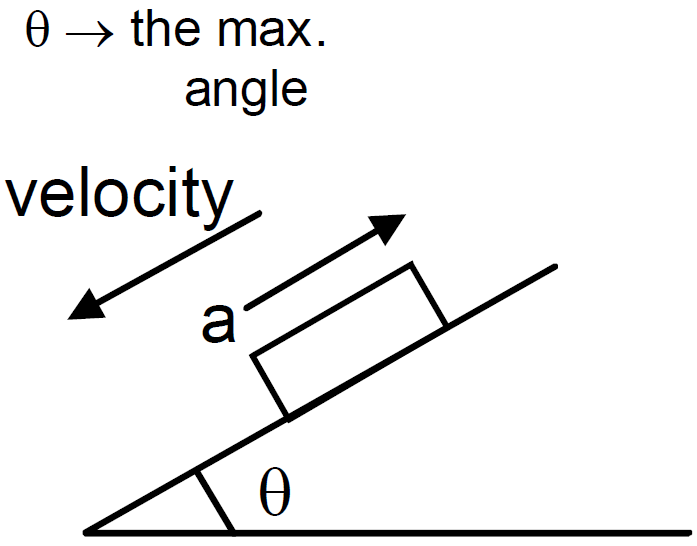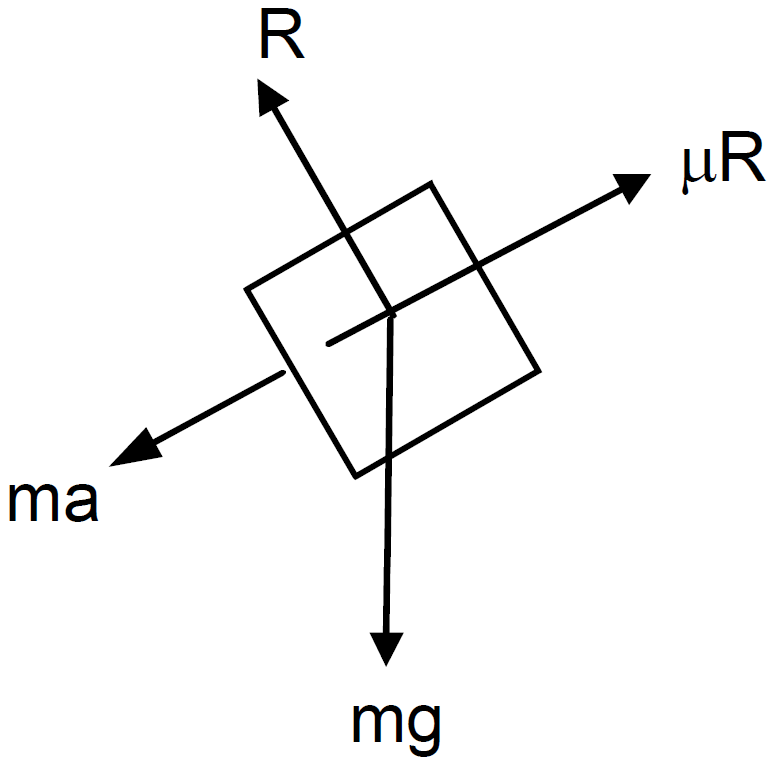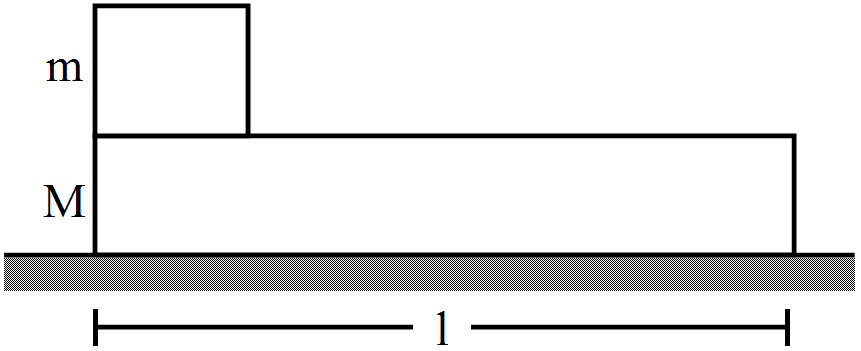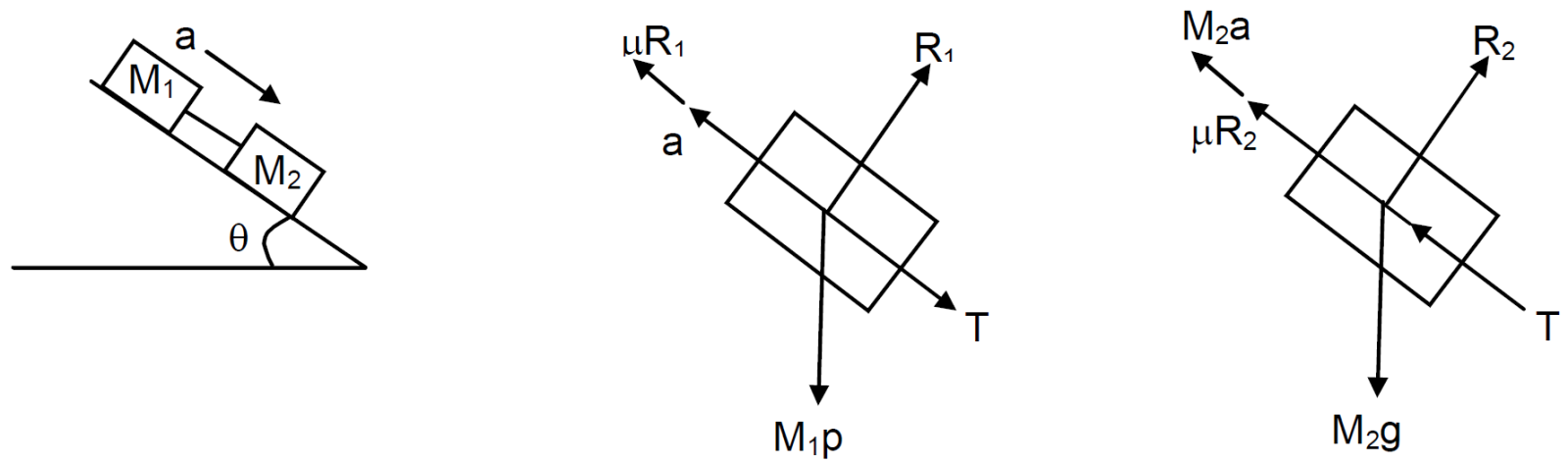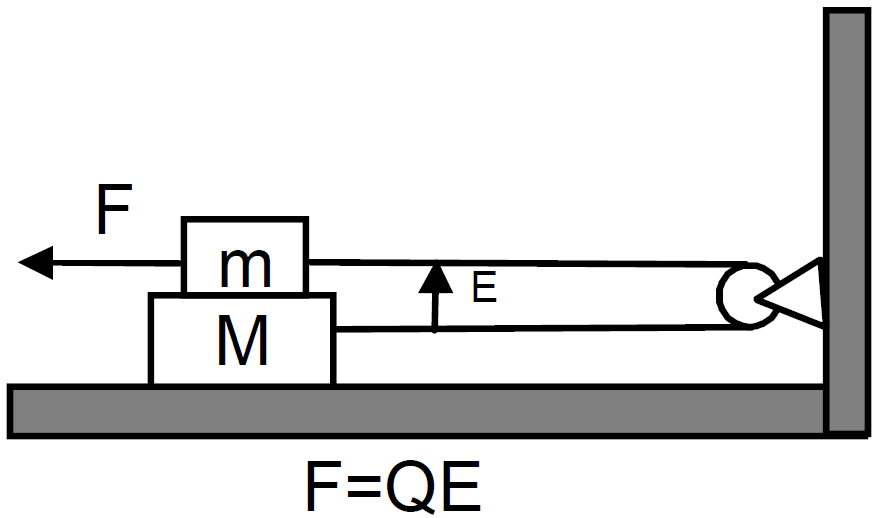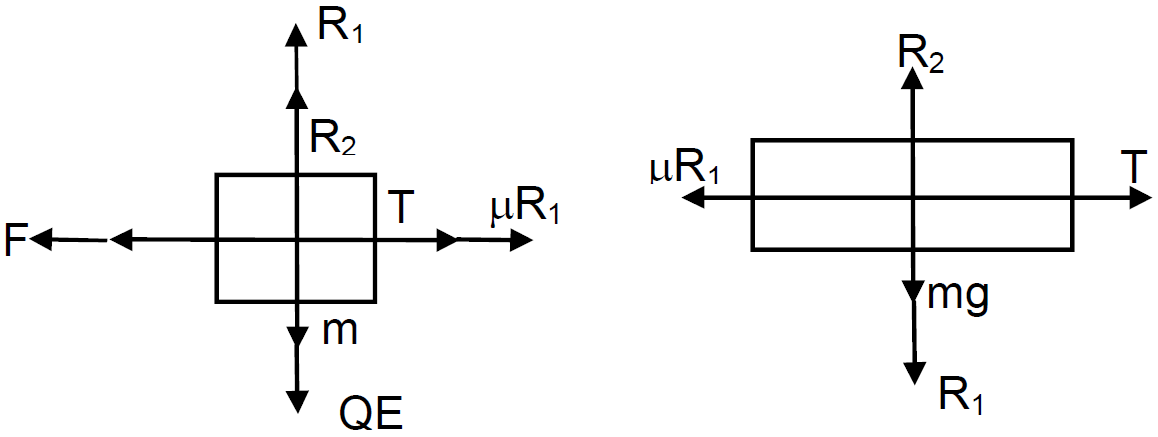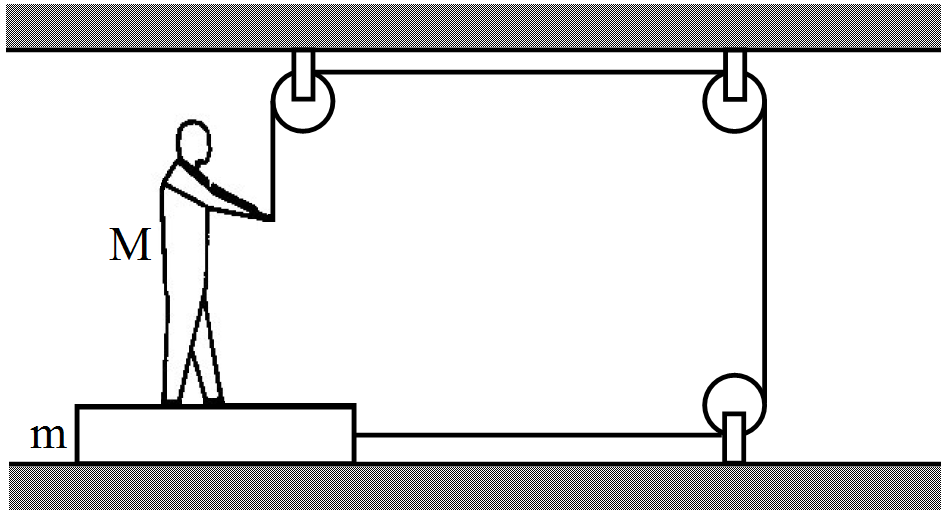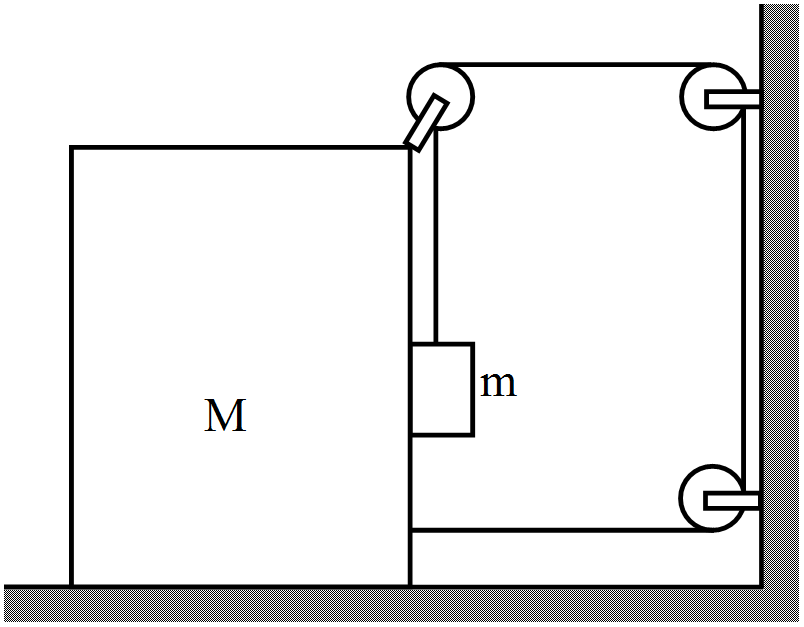
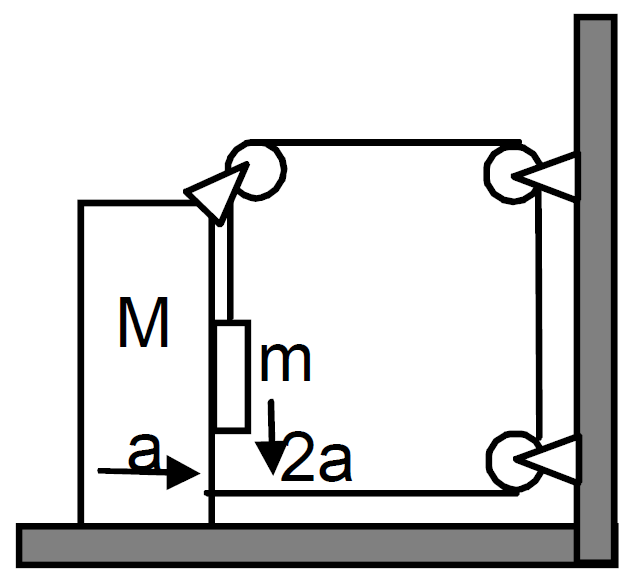
 As the block ‘m’ is in contact with the block ‘M’, it will also have acceleration ‘a’ towards right. So, it will experience two inertia forces as shown in the free body diagram-1. From free body diagram-1
 $\text{R}_1-\text{ma}=0\Rightarrow\text{R}_1=\text{ma} \ ...(\text{i})$
Again, $2\text{ma + T}-\text{mg}+\mu_1\text{R}_1=0$$\Rightarrow\text{T = mg}-(2-\mu_1)\text{ma} \ ...(\text{ii})$
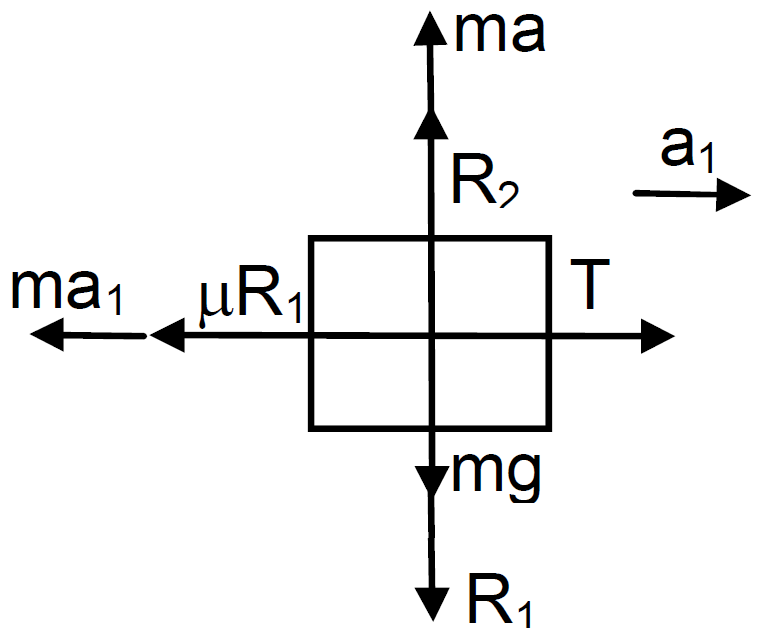
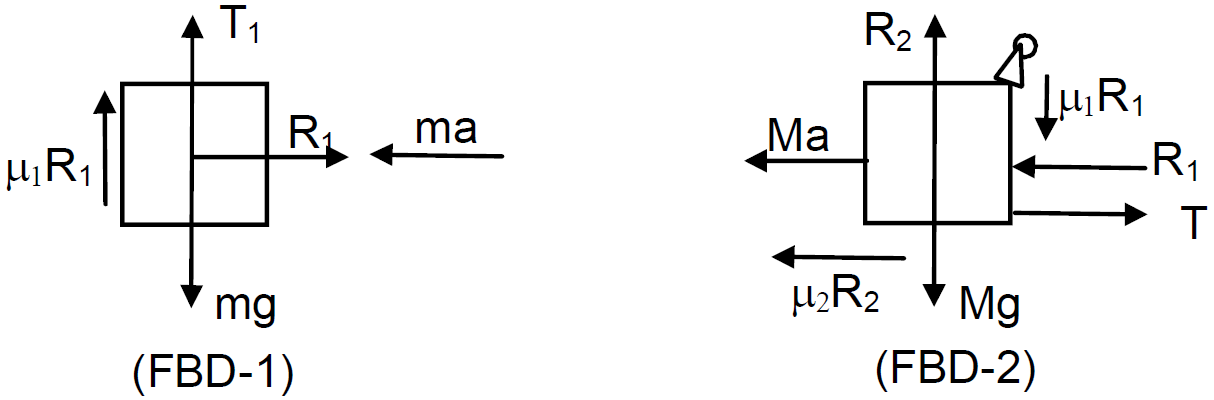 From free body diagram-2
 $\text{T}+\mu_1\text{R}_1+\text{mg}-\text{R}_2=0$
$\Rightarrow\text{R}_2=\text{T}+\mu_1\text{ma + Mg}$ [Putting the value of R1 from (i)]
$=(\text{mg}-2\text{ma}-\mu_1\text{ma})+\mu_1\text{ma + Mg}$ [Putting the value of T from (ii)]
$\therefore\text{R}_2=\text{Mg + mg}-2\text{ma} \ ...(\text{iii})$
Again, form the free body diagram-2$\text{T + T}-\text{R}-\text{Ma}-\mu_2\text{R}_2=0$
$\Rightarrow2\text{T}-\text{MA}-\text{mA}-\mu_2(\text{Mg + mg}-2\text{ma})=0$ [Putting the values of R1 and R2 from (i) and (iii)]
$\Rightarrow2\text{T}=\text{(M + m})+\mu_2(\text{Mg + mg}-2\text{ma}) \ ...(\text{iv})$
From equation (ii) and (iv)$2\text{T = 2mg}-2(2+\mu_1)\text{mg}$
$= \text{(M + m)a}+\mu_2(\text{Mg + mg}-2\text{ma})$
$\Rightarrow2\text{mg}-\mu_2(\text{M + m)g}$
$= \text{ a}\text{(M + m}-2\mu_2\text{m}+4\text{m}+2\mu_1\text{m})$
$\Rightarrow\text{a}=\frac{[2\text{m}-\mu_2(\text{M + m})]\text{g}}{\text{M + m}[5+2(\mu_1-\mu_2)]}$