MCQ
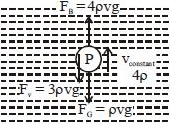
A ball rises to surface at a constant velocity in a liquid whose density is $4$ times greater than that of the material of the ball. The ratio of the force of friction acting on the rising ball and its weight is
  • $3 : 1$
  • B
    $4 : 1$
  • C
    $1 : 3$
  • D
    $1 : 4$

Answer

Correct option: A.
$3 : 1$
a
$\mathrm{F}_{\mathrm{B}}=\mathrm{F}_{\mathrm{v}}+\mathrm{F}_{\mathrm{G}}$

$\mathrm{F}_{\mathrm{v}}=3 \rho \mathrm{vg}$

$\frac{\mathrm{F}_{\mathrm{v}}}{\mathrm{F}_{\mathrm{G}}}=\frac{3 \mathrm{pvg}}{\rho \mathrm{vg}}$

Need a full question paper?

Generate a complete, print-ready paper with questions like this in minutes — across 16+ boards, with answer keys.

Start Generating Free

Similar questions

Let E, G and N represent the magnitudes of electromagnetic gravitational and nuclear forces between two electrons at a given separation. Then:
A sine wave has an amplitude $A$ and wavelength $\lambda$. Let $V$ be the wave velocity and $v$ be the maximum velocity of a particle in the medium. Then 
If a system undergoes contraction of volume then the work done by the system will be
$2$ mole of $N_2$ gas at $27\,^oC$ is mixed with $1$ mole $He$ gas at $-73\,^oC$. Find $T_{mix}$ of the mixture
Change in temperature of the medium changes:
The density of the atmosphere is $1.29\, kg/m^3$, then how high would the atmosphere extend ? $(g = 9.81\, m/sec^2)$ ........ $km$
For a black body at temperature $727^{\circ} C$, its radiating power is $60\; watt$ and temperature of surrounding is $227^{\circ} C$. If temperature of black body is changed to $1227^{\circ} C$ then its radiating power will be ..... $watt$
A test particle is moving in a circular orbit in the gravitational field produced by a mass density $\rho \left( r \right) = \frac{K}{{{r^2}}}$. Identify the correct relation between the radius $R$ of the particle’s orbit and its period $T$
A ball projected from ground vertically upward is at same height at time $t_1$ and $t_2$. The speed of projection of ball is [Neglect the effect of air resistance]
A film of water is formed between two straight parallel wires of length $10\,cm$ each separated by $0.5\, cm$. If their separation is increased by $1\, mm$ while still maintaining their parallelism, how much work will have to be done (Surface tension of water = $7.2 \times {10^{ - 2}}\,N/m)$