Question
A batsman deflects a ball by an angle of 45° without changing its initial speed which is equal to 54km/h. What is the impulse imparted to the ball? (Mass of the ball is 0.15 kg)
Answer

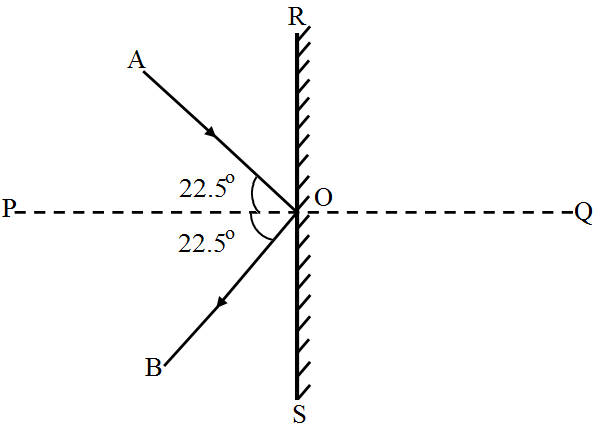
The given situation can be represented as shown in the following figure.

Where,
AO = Incident path of the ball
OB = Path followed by the ball after deflection
$\angle\text{AOB}$ = Angle between the incident and deflected paths of the ball = 45°
$\angle\text{AOP}=\angle\text{BOP}=22.5^\circ=\theta$
Initial and final velocities of the ball = v
Horizontal component of the initial velocity = $\text{v}\cos\theta$ along RO
Vertical component of the initial velocity = $\text{v}\sin\theta$ along PO
Horizontal component of the final velocity = $\text{v}\cos\theta$ along OS
Vertical component of the final velocity = $\text{v}\cos\theta$ along OP
The horizontal components of velocities suffer no change. The vertical components of velocities are in the opposite directions.
$\therefore$ Impulse imparted to the ball = Change in the linear momentum of the ball
$=\text{mv}\cos\theta-(-\text{mv}\cos\theta)=2\text{mv}\cos\theta$
Mass of the ball, m = 0.15kg
Velocity of the ball, v = 54km/h = 15m/s
$\therefore$ Impulse $2\times0.15\times15\cos22.5^\circ=4.16\text{kgm/s}$

Need a full question paper?

Generate a complete, print-ready paper with questions like this in minutes — across 16+ boards, with answer keys.
Start Generating Free

Similar questions

What is the effect of rotation on the value of 'g'? Derive the relation.
Define gravitational potential. Derive the formulas of gravitional potential due to a solid sphere of mass M and radius R at points located on its outer surface and inside.
A solid aluminium sphere and a solid copper sphere of twice the radius are heated to the same temperature and are allowed to cool under identical surrounding temperatures. Assume that the emissivity of both the spheres is the same. Find the ratio of:
  1. The rate of heat loss from the aluminium sphere to the rate of heat loss from the copper sphere.
  2. The rate of fall of temperature of the aluminium sphere to the rate of fall of temperature of the copper sphere. The specific heat capacity of aluminium = 900Jkg-1°C-1 and that of copper= 390Jkg-1°C-1. The density of copper = 3.4 times the density of aluminium.
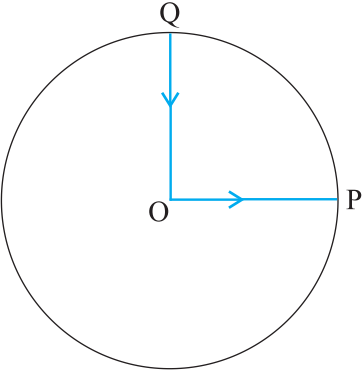
A cyclist starts from the centre O of a circular park of radius 1km, reaches the edge P of the park, then cycles along the circumference, and returns to the centre along QO as shown in Fig. If the round trip takes 10 min, what is the (a) net displacement, (b) average velocity, and (c) average speed of the cyclist?

Plot the corresponding reference circle for each of the following simple harmonic motions. Indicate the initial $(t=0)$ position of the particle, the radius of the circle, and the angular speed of the rotating particle. For simplicity, the sense of rotation may be fixed to be anticlockwise in every case: ( $x$ is in cm and t is in s ).
a. $x=-2 \sin \left(3 t+\frac{\pi}{3}\right)$
b. $x=\cos \left(\frac{\pi}{6}-t\right)$
c. $x=3 \sin \left(2 \pi t+\frac{\pi}{4}\right)$
d. $x=2 \cos \pi t$
What is a mess pendulum? Discuss its motion for small angular displacement. Deduce the formula for period. On which quantities does the periodic period depend?
A stone of mass m tied to the end of a string revolves in a vertical circle of radius R. The net forces at the lowest and highest points of the circle directed vertically downwards are: [Choose the correct alternative]
 
Lowest Point
Highest Point
(a)
mg - T1
mg + T2
(b)
mg + T1
mg - T2
(c)
mg + T1 - (mv12)/R
mg - T2 + (mv12)/R
(d)
mg - T1 - (mv12)/R
mg + T2 + (mv12)/R
T1 and v1 denote the tension and speed at the lowest point. T2 and v2 denote corresponding values at the highest point.
A small block of superdense material has a mass of 3 × 1024kg. It is situated at a height h (much smaller than the earth's radius) from where it falls on the earth's surface. Find its speed when its height from the earth's surface has reduced to $\frac{\text{h}}{2}.$ The mass of the earth is 6 × 1024kg.
Identical springs of steel and copper are equally stretched. On which, more work will have to be done?
Establish the following vector in equalities geometrically or otherwise :
(a) $|\vec{a}+\vec{b}| \leq|\vec{a}|+|\vec{b}|$
(b) $|\vec{a}+\vec{b}| \geq|\vec{a}|-|\vec{b}| \mid$
(c) $|\vec{a}-\vec{b}| \leq|\vec{a}|+|\vec{b}|$
(d) $|\vec{a}-\vec{b}| \geq|\vec{a}|-|\vec{b}| \mid$
When does the equality sign above apply?