MCQ
A batsman deflects a ball by an angle of $45^o$ without changing its initial speed which is equal to $54\; km/h$. What is the impulse imparted to the ball in $kg\;m/s$? (Mass of the ball is $0.15 \;kg.)$
  • A
    $6.8$
  • B
    $8.32$
  • C
    $2.8$
  • $4.16$

Answer

Correct option: D.
$4.16$
d
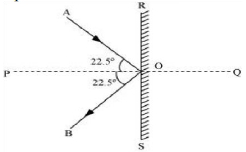
The given situation can be represented as shown in the following figure

Where, $AO =$ Incident path of the ball

$OB =$ Path followed by the ball after deflection

$\angle AOB =$ Angle between the incident and deflected paths of the ball $=45^{\circ}$

$\angle AOP =\angle BOP =22.5^{\circ}=\theta$

Initial and final velocities of the ball $=v$

Horizontal component of the initial velocity $=v \cos \theta$ along $RO$

Vertical component of the initial velocity $=v \sin \theta$ along $PO$

Horizontal component of the final velocity $=v \cos \theta$ along $OS$

Vertical component of the final velocity $=v \sin \theta$ along $OP$

The horizontal components of velocities suffer no change. The vertical components of velocities are in the opposite directions.

$\therefore$ Impulse imparted to the ball $=$ Change in the linear momentum of the ball $=m v \cos \theta-(-m v \cos \theta)$ $=2 m v \cos \theta$

Mass of the ball, $m=0.15\, kg$

Velocity of the ball, $v=54 \,km / h =15 \,m / s$

$\therefore \text { Impulse }=2 \times 0.15 \times 15 \cos 22.5^{\circ}=4.16\, kg\, m / s$
Need a full question paper?

Generate a complete, print-ready paper with questions like this in minutes — across 16+ boards, with answer keys.

Start Generating Free

Similar questions

A body of mass $5\ kg$ is thrown vertically up with a kinetic energy of $490J.$ The height at which the kinetic energy of the body becomes half of the original value is:
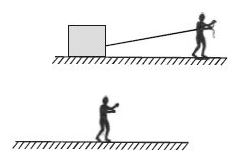
$Assertion$ : A man and a block rest on smooth horizontal surface. The man holds a rope which is connected to block. The man cannot move on the horizontal surface

$Reason$ : A man standing at rest on smooth horizontal surface cannot start walking due to absence of friction (The man is only in contact with floor as shown).
Three perfect gases at absolute temperatures $T_1 , T_2$ and $T_3$ are mixed. The masses of molecules are $m_1 , m_2$ and $m_3$ and the number of molecules are $n_1, n_2$ and $n_3$ respectively. Assuming no loss of energy, the final temperature of the mixture is
If the tension on a wire is removed at once, then
A particle undergoes uniform circular  motion. About which point on the plane of the circle,  will the angular momentum of the particle remain conserved ?
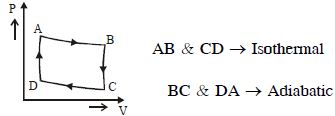
The $P-V$ diagram of a certain process (carnot cycle) is as shown. The process is also represent as
A cube of external dimension $10\  cm$ has an inner cubical portion of side $5\  cm$ whose density is twice that of the outer portion. If this cube is just floating in a liquid of density $2\  g/cm^3$, find the density of the inner portion
The photocurrent in an experiment on photoelectric effect increases if:
A pendulum is formed by pivoting a disc. What distance from center of mass, it should be pivoted for minimum time period while performing $SHM$ ?
 A uniform metal rod of  $2\,\,mm^2$ cross section fixed between two walls is heated from $0\,^oC$ to $20\,^oC$ . The coefficient of linear expansion of rod is $12\,\,\times\,\,10^{-6}\,/^oC$ . Its Young's modulus of elasticity is $10^{11}\,\,N/m^2$ . The energy stored per unit volume of rod will be  ....... $J/m^3$