A battery is charged at a potential of $15\, V$ for $8$ hours when the current flowing is $10\, A$. The battery on discharge supplies a current of $5\, A$ for $15$ hours. The mean terminal voltage during discharge is $14\, V$. The "Watt-hour" efficiency of the battery is .............. $\%$
AIPMT 2004, Medium


Download our appand get started for free
Experience the future of education. Simply download our apps or reach out to us for more information. Let's shape the future of learning together!No signup needed.*
Similar Questions
- 1At what rate the potential difference between the plates of a capacitor be changed to set up a displacement current of $1\, A$ in a capacitor of $2\,\mu F$ ?View Solution
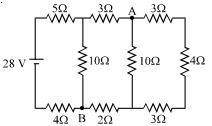
- 2View SolutionConsider the circuit shown in the figure
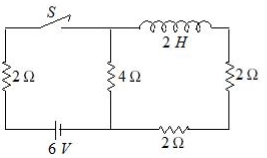
- 3For the given circuit the current through battery of $6\,V$ just after closing the switch ' $S$ ' will be$.......A$.View Solution
- 4Two electric bulbs ($60\,W$ and $100\,W$ respectively) are connected in series. The current passing through them isView Solution
- 5A battery consists of a variable number '$n$' of identical cells having internal resistances connected in series. The terminals of battery are short circuited and the current $i$ is measured. Which of the graph below shows the relation ship between $i$ and $n$View Solution
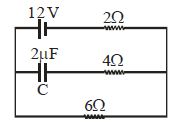
- 6Find the maximum charge on the capacitor $C$ in the following circuit ............ $\mu C$View Solution
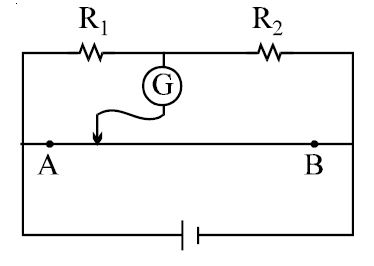
- 7In the figure shown for gives values of $R_1$ and $R_2$ the balance point for Jockey is at $40\,cm$ from $A$. When $R_2$ is shunted by a resistance of $10\, \Omega$ , balance shifts to $50\,cm.$ $R_1$ and $R_2$ are $(AB = 1 \,m)$View Solution
- 8The current in a conductor varies with time t as $I = 2t + 3{t^2}$ where $I$ is in ampere and $t$ in seconds. Electric charge flowing through a section of the conductor during $t = 2\,\sec$ to $t = 3\,\sec$ is ............. $C$View Solution
- 9Two wires $A$ and $B$ of the same material, having radii in the ratio $1: 2$ carry currents in the ratio $4: 1$. The ratio of drift speed of electrons in $A$ and $B$ isView Solution
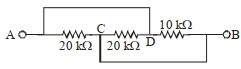
- 10The equivalent resistance between $A$ and $B$ as shown in figure is $........\,k\Omega$View Solution