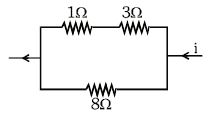
A battery of $24$ cells, each of emf $1.5\, V$ and internal resistance $2\, \Omega$ is to be connected in order to send the maximum current through a $12 \,\Omega$ resistor. The correct arrangement of cells will be
Medium
Download our app for free and get started
Suppose $m$ rows are connected in parallel and each row contains $n$ identical cells (each cell having $E = 15\, V$ and $r = 2\, \Omega$)
For maximum current in the external resistance $R$, the necessary condition is $R = \frac{{nr}}{m}$
$ \Rightarrow $ $12 = \frac{{n \times 2}}{m}$ $ \Rightarrow $ $n = 6\,m$ ..... $(i)$
Total cells $= 24 = n \times m$ ..... $(ii)$
On solving equations $(i)$ and $(ii)$
$n = 12$ and $m = 2$
i.e. $2$ rows of $12$ cells are connected in parallel.

Download our appand get started for free
Experience the future of education. Simply download our apps or reach out to us for more information. Let's shape the future of learning together!No signup needed.*
Similar Questions
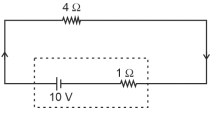
- 1The terminal voltage of the battery, whose emf is $10 \mathrm{~V}$ and internal resistance $1 \Omega$, when connected through an external resistance of $4 \Omega$ as shown in the figure is:View Solution
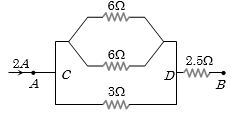
- 2The equivalent resistance and potential difference between $A$ and $B$ for the circuit is respectivelyView Solution
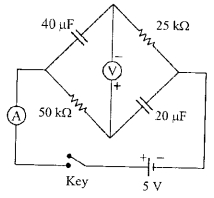
- 3In the circuit shown below, the key is pressed at time $t=0$. Which of the following statement(s) is(are) true?View Solution
($A$) The voltmeter displays $-5 \mathrm{~V}$ as soon as the key is pressed, znd displays $+5 \mathrm{~V}$ after a long time
($B$) The voltmeter will display $0 \mathrm{~V}$ at time $t=\ln 2$ seconds
($C$) The current in the ammeter becomes $1 / e$ of the initial value after $1$ second
($D$) The current in the ammeter becomes zero after a long time
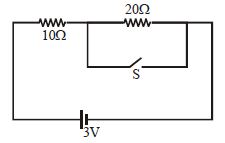
- 4Consider the circuit shown in fig. The current through the $10\,\Omega $ resistor when switch $'s'$ is $(a)$ open $(b)$ closed.View Solution
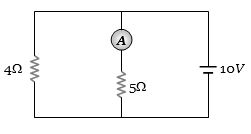
- 5In the circuit, the reading of the ammeter is ................. $A$ (assume internal resistance of the battery be zero)View Solution
- 6The drift velocity of electrons for a conductor connected in an electrical circuit is $V _{ d }$. The conductor in now replaced by another conductor with same material and same length but double the area of cross section. The applied voltage remains same. The new drift velocity of electrons will beView Solution
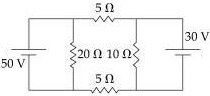
- 7In the circuit shown, current (in $A$) through $50\; V$ and $30\; V$ batteries are, respectivelyView Solution
- 8The resistivity of a potentiometer wire is $40 \times {10^{ - 8}}\,ohm - m$ and its area of cross-section is $8 \times {10^{ - 6}}\,{m^2}$. If $0.2\, amp$ current is flowing through the wire, the potential gradient will beView Solution
- 9A current of $2\,A$ flows through a $2\,\Omega$ resistor when connected across a battery. The same battery supplies a current of $0.5\,\, A$ when connected across a $9 \,\,\Omega$ resistor. The internal resistance of the battery isView Solution
- 10Power dissipated across the $8\,\Omega $ resistor in the circuit shown here is $2\, watt$. The power dissipated in watt units across the $3\,\Omega $ resistor isView Solution