In the circuit shown below, the key is pressed at time $t=0$. Which of the following statement(s) is(are) true?
($A$) The voltmeter displays $-5 \mathrm{~V}$ as soon as the key is pressed, znd displays $+5 \mathrm{~V}$ after a long time
($B$) The voltmeter will display $0 \mathrm{~V}$ at time $t=\ln 2$ seconds
($C$) The current in the ammeter becomes $1 / e$ of the initial value after $1$ second
($D$) The current in the ammeter becomes zero after a long time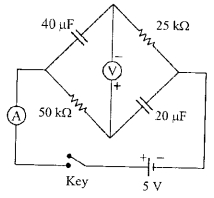
IIT 2016, Advanced
Download our app for free and get started
Writing instantaneous equation, with $q_1$ being charge on upper and $q_2$ being that on lower capacitor,
$q _1=\left(200 \times 10^{-3}\right)\left(1- e ^{- t }\right)$
$q _2=\left(100 \times 10^{-3}\right)\left(1- e ^{- t }\right)$
$\frac{ q _1}{ C }=\left(50 \times 10^3\right) \frac{ dq }{ dt }$
$\frac{200 \times 10^{-3}\left(1- e ^{- t }\right)}{40 \times 10^{-6}}=\left(50 \times 10^3\right)\left(100 \times 10^{-3}\right) e ^{- t }$
$e ^{- t }=0.5$
$t =\ln (2)$
$I = I _1+ I _2=\left(200 \times 10^{-3}\right)\left( e ^{- t }\right)+\left(100 \times 10^{-3}\right) e ^{- t }$
$=100 \times 10^{-3}\left[2 e ^{- t }+ e ^{- t }\right]$
$=0.3 e ^{- t }$
Att $=\infty, \quad I = o$
Answer is $A,B,C$ and $D.$

Download our appand get started for free
Experience the future of education. Simply download our apps or reach out to us for more information. Let's shape the future of learning together!No signup needed.*
Similar Questions
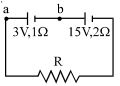
- 1Two batteries one of the $\mathrm{emf}$ $3\,V$, internal resistance $1$ ohm and the other of $\mathrm{emf}$ $15\, V$, internal resistance $2$ $\mathrm{ohm}$ are connected in series with a resistance $R$ as shown. If the potential difference between $a$ and $b$ is zero the resistance of $R$ in $\mathrm{ohm}$ isView Solution
- 2The total momentum of electrons in a straight wire of copper of length $1\, metre$ carrying a current of $16\, A$ isView Solution
- 3A wire of resistance $x$ ohm is drawn out, so that its length is increased to twice its original length, and its new resistance becomes $20 \,\Omega$, then $x$ will be ........ $\Omega$View Solution
- 4With the help of potentiometer, we can determine the value of emf of a given cell. The sensitivity of the potentiometer isView Solution
$(A)$ directly proportional to the length of the potentiometer wire
$(B)$ directly proportional to the potential gradient of the wire
$(C)$ inversely proportional to the potential gradient of the wire
$(D)$ inversely proportional to the length of the potentiometer wire
Choose the correct option for the above statements:
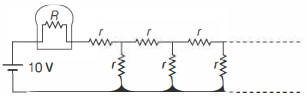
- 5A light bulb of resistance $R=16 \,\Omega$ is attached in series with an infinite resistor network with identical resistances $r$ as shown below. A $10 \,V$ battery drives current in the circuit. ............. $\Omega$ the value of $r$ such that the bulb dissipates about $1 \,W$ of power.View Solution
- 6A $220\, volt$ and $800\, watt$ electric kettle and three $220\, volt$ and $100\, watt$ bulbs are connected in parallel. On connecting this combination with $220\, volt$ electric supply, the total current will be ................ $ampere$View Solution
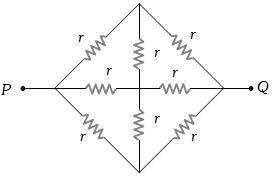
- 7The equivalent resistance between the points $P$ and $Q$ in the network given here is equal to ................ $\Omega$ (given $r = \frac{3}{2}\Omega $)View Solution
- 8Electric bulb $50\, W$ - $100\, V$ glowing at full power are to be used in parallel with battery $120\, V$, $10 \,\Omega$. Maximum number of bulbs that can be connected so that they glow in full power isView Solution
- 9A potentiometer is used for the comparison of $e.m.f.$ of two cells ${E_1}$ and ${E_2}$. For cell ${E_1}$ the no deflection point is obtained at $20\,cm$ and for ${E_2}$ the no deflection point is obtained at $30\,cm$. The ratio of their $e.m.f.$'s will beView Solution
- 10A $2\, W$ carbon resistor is color coded with green, black, red and brown respectively. The maximum current which can be passed through this resistor is .............. $mA$View Solution