A battery of $6\, volts$ is connected to the terminals of a three meter long wire of uniform thickness and resistance of the order of $100\,\Omega $. The difference of potential between two points separated by $50\,cm$ on the wire will be .......... $V$
AIPMT 2004, Easy
Download our app for free and get started
(a) Here same current is passing throughout the length of the wire, hence $V \propto R \propto l$
$ \Rightarrow $ $\frac{{{V_1}}}{{{V_2}}} = \frac{{{l_1}}}{{{l_2}}}$ $ \Rightarrow $ $\frac{6}{{{V_2}}} = \frac{{300}}{{50}} $ $\Rightarrow $ $ V_2 =1 \,V.$

Download our appand get started for free
Experience the future of education. Simply download our apps or reach out to us for more information. Let's shape the future of learning together!No signup needed.*
Similar Questions
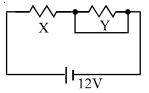
- 1When an ammeter of negligible internal resistance is inserted in series with circuit it reads $1A$. When the voltmeter of very large resistance is connected across $X$ it reads $1V$. When the point $A$ and $B$ are shorted by a conducting wire, the voltmeter measures $10\, V$ across the battery. The internal resistance of the battery is equal to .............. $\Omega$View Solution
- 2A $6\,\,V$ battery is connected to the terminals of a $3\, m$ long uniform wire having resistance $100\,\Omega $. The difference in potential between two points on the wire separated by a distance of $50\, cm$ will be ............. $V$View Solution
- 3The current in a simple series circuit is $5.0\, amp$. When an additional resistance of $2.0\, ohms$ is inserted, the current drops to $4.0\, amp$. The original resistance of the circuit in $ohms$ wasView Solution
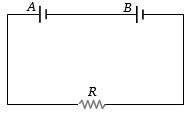
- 4Two batteries $A$ and $B$ each of $e.m.f.$ $2\, V$ are connected in series to an external resistance $R = 1 \,ohm$. If the internal resistance of battery $A$ is $1.9\, ohms$ and that of $B$ is $0.9\, ohm$, what is the potential difference between the terminals of battery $A$ ............. $V$View Solution
- 5For a wire $\frac{R}{l}=\frac{1}{2}$ and length of wire is $l=5\, cm .$ If potential difference $1\, V$ is applied across it, current through wire will be: $( R =$ Resistance $)$ (in $A$)View Solution
- 6$10$ resistors each of resistance $10\,\Omega$ can be connected in such as to get maximum and minimum equivalent resistance. The ratio of maximum and minimum equivalent resistance will be $..........$.View Solution
- 7View SolutionIn a metallic conductor, under the effect of applied electric field, the free electrons of the conductor
- 8An electric bulb rated as $200\, {W}$ at $100 \,{V}$ is used in a circuit having $200\, {V}$ supply. The resistance $'R'$ that must be put in series with the bulb so that the bulb delivers the same power is $.....\,\Omega$View Solution
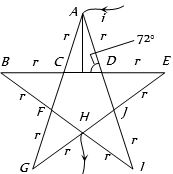
- 9In the following star circuit diagram (figure), the equivalent resistance between the points $A$ and $H$ will be ..............$r$View Solution
- 10The electric current through a wire varies with time as $I=I_0+\beta t$. where $I_0=20 \mathrm{~A}$ and $\beta=3 \mathrm{~A} / \mathrm{s}$. The amount of electric charge crossed through a section of the wire in $20 \mathrm{~s}$ is :View Solution