A $6\,\,V$ battery is connected to the terminals of a $3\, m$ long uniform wire having resistance $100\,\Omega $. The difference in potential between two points on the wire separated by a distance of $50\, cm$ will be ............. $V$
Medium
Download our app for free and get started
$\phi=\frac{6}{3}$
$\Rightarrow \Delta \mathrm{V}=\frac{6}{3} \times 0.5=1 \mathrm{\,V}$

Download our appand get started for free
Experience the future of education. Simply download our apps or reach out to us for more information. Let's shape the future of learning together!No signup needed.*
Similar Questions
- 1Current of $4.8\,A$ is flowing through a conductor. The number of electrons per second will beView Solution
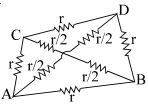
- 2The figure shows a tetrahedron, each side of which has a resistance $r$ Choose the correct diagram $(s),$ which show two-dimensional equivalent of the tetrahedron.View Solution
- 3If $400\; \Omega$ of resistance is made by adding four $100\; \Omega$ resistance of tolerance $5 \%$ then the tolerance of the combination is .....$\%$View Solution
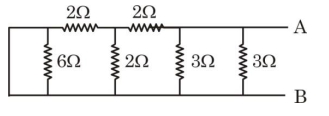
- 4Equivalent resistance of the following network is____ $\Omega$.View Solution
- 5In a potentiometer circuit there is a cell of $e.m.f.$ $2\, volt$, a resistance of $5\, ohm$ and a wire of uniform thickness of length $1000\, cm$ and resistance $15\, ohm$. The potential gradient in the wire isView Solution
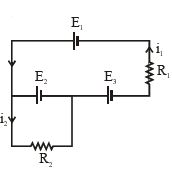
- 6The current $i_1$ and $i_2$ through the resistors $R_1(=10\,\Omega )$ and ${R_2}\left( { = 30\,\Omega } \right)$ in the circuit diagram with $E_1 = 3\,V$, $E_2 = 3\,V$ and $E_3 = 2\,V$ are respectivelyView Solution
- 7Two sources of equal $emf$ are connected to an external resistance $R$. The internal resistances of the two sources are ${R_1}$ and ${R_2}\,({R_2} > {R_1})$. If the potential difference across the source having internal resistance ${R_2}$ is zero, thenView Solution
- 8At room temperature, copper has free electron density of $8.4 \times {10^{28}}$ per ${m^3}$. The copper conductor has a cross-section of $10^{-6} \,m^2$ and carries a current of $5.4\, A$. The electron drift velocity in copper isView Solution
- 9A $10 \,m$ long potentiometer wire is connected to a battery having a steady voltage. A Leclanche cell is balanced at $4 \,m$ length of the wire. If the length is kept the same, but its cross-section is doubled, the null point will be obtained at ........... $m$View Solution
- 10$A$ potentiometer wire has length $10\, m$ and resistance $10\,\Omega$ . It is connected to a battery of $EMF$ $11\, volt$ and internal resistance $1\, \Omega$ , then the potential gradient in the wire is ............... $V/m$View Solution