Question
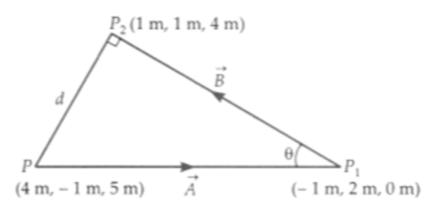
A bird is at a point P whose coordinates are $(4 m,-1 m, 5 m)$. The bird observes two points $P _1$ and $P _2$ having coordinates $(-1 m, 2 m, 0 m)$ and $(1 m, 1 m, 4 m)$ respectively. At time $t =0$, it starts flying in a plane of three positions, with a constant speed of $5 ms^{-1}$ in a direction perpendicular to the straight line $P _1 P _2$ till it sees $P _1$ and $P _2$ collinear at time $t$. Calculate $t$.
Answer

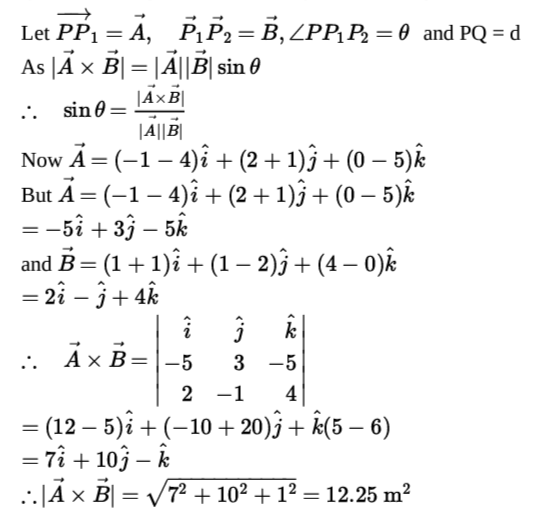
The situation is shown in figure. The bird flies in a direction perpendicular to line $P_1 P_2$. Suppose it reaches the point $Q$ in time $t$ (after starting from point P ) where it sees $P _1$ and $P _2$ as collinear.
Image

Image
$
\begin{aligned}
& \text { and }|\vec{B}|=\sqrt{2^2+1^2+4^2}=4.583 m \\
& \therefore \quad d=\frac{12.25}{4.583}=2.67 m
\end{aligned}
$
Time taken by bird to reach the point Q will be
$
t=\frac{d}{v}=\frac{2.67}{5}=0.5346 s
$

Need a full question paper?

Generate a complete, print-ready paper with questions like this in minutes — across 16+ boards, with answer keys.

Start Generating Free

Similar questions

An ideal gas is trapped between a mercury column and the closed-end of a narrow vertical tube of uniform base containing the column. The upper end of the tube is open to the atmosphere. The atmospheric pressure equals 76cm of mercury. The lengths of the mercury column and the trapped air column are 20cm and 43cm respectively. What will be the length of the air column when the tube is tilted slowly in a vertical plane through an angle of 60°? Assume the temperature to remain constant.
Calculate the center of mass of a uniform thin rod.
A spring having with a spring constant 1200N m-1 is mounted on a horizontal table as shown in Fig. A mass of 3kg is attached to the free end of the spring. The mass is then pulled sideways to a distance of 2.0cm and released.

Determine (i) the frequency of oscillations, (ii) maximum acceleration of the mass, and (iii) the maximum speed of the mass.

A hot body placed in a surrounding of temperature $\theta_0$ obeys Newton's law of cooling $\frac{\text{d}\theta}{\text{dt}}=-\text{k}(\theta-\theta_0).$ Its temperature at t = 0 is $\theta_1.$ The specific heat capacity of the body is s and its mass is m. Find,
  1. The maximum heat that the body can lose.
  2. The time starting from t = 0 in which it will lose 90% of this maximum heat.
Two balls having masses m and 2m are fastened to two light strings of same length (l). The other ends of the strings are fixed at O. The strings are kept in the same horizontal line and the system is released from rest. The collision between the balls is elastic.
  1. Find the velocities of the balls just after their collision.
  2. How high will the balls rise after the collision?

What is the density of water at a depth where pressure is 80.0 atm , given that its density at the surface is $1.03 \times 10^3 kg m ^{-3}$ ?
The pulley shown in figure has a radius 10cm and moment of inertia 0.5kg-m2 about its axis. Assuming the inclined planes to be frictionless, calculate the acceleration of the 4.0kg block.

An air chamber of volume V has a neck area of cross section a into which a ball of mass m just fits and can move up and down without any friction (Fig.). Show that when the ball is pressed down a little and released , it executes SHM. Obtain an expression for the time period of oscillations assuming pressure-volume variations of air to be isothermal [see Fig.].

A hot air balloon is a sphere of radius 8m. The air inside is at a temperature of 60°C. How large a mass can the balloon lift when the outside temperature is 20°C? (Assume air is an ideal gas, R = 8.314J mole-1K-1, 1 atm. = 1.013 × 10⁵ Pa the membrane tension is 5N m-1)
Two vector forces 5 N and 3 N are acting on a particle. Find the magnitude and direction of resultant force.(a) When both the forces are in same direction.(b) When both the forces are at right angles.(c) When both the forces are inclined at angle $60^{\circ}$.