Question
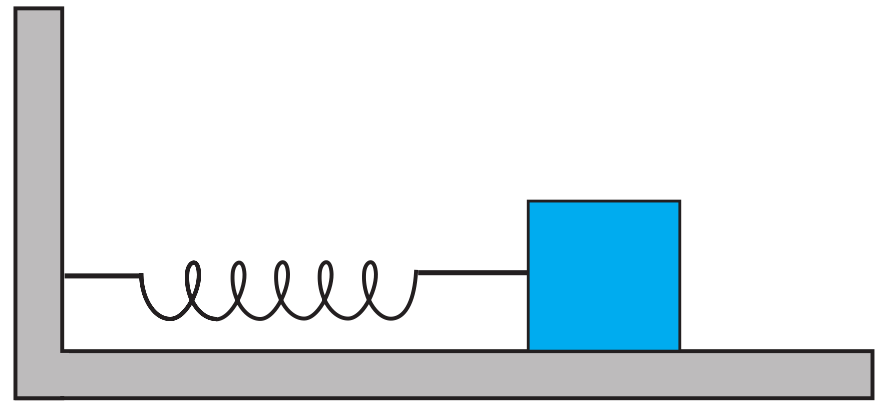
A spring having with a spring constant 1200N m-1 is mounted on a horizontal table as shown in Fig. A mass of 3kg is attached to the free end of the spring. The mass is then pulled sideways to a distance of 2.0cm and released.

Determine (i) the frequency of oscillations, (ii) maximum acceleration of the mass, and (iii) the maximum speed of the mass.

Answer

Spring constant, k = 1200N m-1

Mass, m = 3kg

Displacement, A = 2.0cm = 0.02cm

  1. Frequency of oscillation v, is given by the relation:

$\upsilon=\frac{1}{\text{T}}=\frac{1}{2\pi}\sqrt{\frac{\text{k}}{\text{m}}}$

where, T is time period

$\therefore\ \upsilon=\frac{1}{2\times3.14}\sqrt{\frac{1200}{3}}$

= 3.18m/s

Hence, the frequency of oscillations is 3.18 cycles per second.

  1. Maximum acceleration (a) is given by the relation:

$\text{a}=\omega^2\text{A}$

where,

$\omega=$ Angular frequency $=\sqrt{\frac{\text{k}}{\text{m}}}$

A = maximum displacement

$\therefore\ \text{a}=\frac{\text{k}}{\text{m}}\text{A}=\frac{1200\times0.02}{3}=8\text{ ms}^{-2}$

Hence, the maximum acceleration of the mass is 8.0m/s2.

Maximum velocity, $\text{v}_\text{max}=\text{A}\omega$

$=\text{A}\sqrt{\frac{\text{k}}{\text{m}}}=0.02\times\sqrt{\frac{1200}{3}}=0.4\text{ m/s}$

Hence, the maximum velocity of the mass is 0.4m/s.
Need a full question paper?

Generate a complete, print-ready paper with questions like this in minutes — across 16+ boards, with answer keys.

Start Generating Free

Similar questions

What is the law of conservation of mechanical energy? Explain the conservation of mechanical energy in an elastic spring.
What are the rules for finding the significant figures? Explain each rule with an example.
The factors affecting the time period of a simple pendulum are mass, length and the acceleration due to gravity. Deduce a relation for the time period of a simple pendulum.
Choose the correct alternative:
The energy required to launch an orbiting satellite out of earth’s gravitational influence is more/ less than the energy required to project a stationary object at the same height (as the satellite) out of earth’s influence.
State Newton's law of Gravitation. Find the percentage decrease in the weight of the body when taken to a height of 16km. above the surface of the earth. Radius of the earth is 6400km.
A block of mass 2.0kg kept at rest on an inclined plane of inclination 37° is pulled up the plane by applying a constant force of 20N parallel to the incline. The force acts for one second.
  1. Show that the work done by the applied force does not exceed 40J.
  2. Find the work done by the force of gravity in that one second if the work done by the applied force is 40J.
  3. Find the kinetic energy of the block at the instant the force ceases to act. Take g = 10m/s2.
Two vessels A and B of equal volume V0 are connected by a narrow tube that can be closed by a valve. The vessels are fitted with pistons that can be moved to change the volumes. Initially, the valve is open and the vessels contain an ideal gas $\Big(\frac{\text{C}_\text{P}}{\text{C}_\text{V}}=\gamma\Big)$ at atmospheric pressure p0 and atmospheric temperature T0. The walls of vessel A are diathermic and those of B are adiabatic. The valve is now closed and the pistons are slowly pulled out to increase the volumes of the vessels to double the original value.
  1. Find the temperatures and pressures in the two vessels.
  2. The valve is now opened for sufficient time so that the gases acquire a common temperature and pressure. Find the new values of the temperature and pressure.
Explain why.
There is no atmosphere on moon.
A particle of mass 0.8kg is executing simple harmonic motion with amplitude of 1.0 metre and periodic time $\frac{11}{7}\text{sec}$. Calculate the velocity and the kinetic energy of the particle at the moment when its displacement is 0.6 metre.