MCQ
A block is lying on an inclined plane which makes $60^°$ with the horizontal. If coefficient of friction between block and plane is $0.25$ and $g = 10\,m/{s^2}$, then acceleration of the block when it moves along the plane will be ........ $m/s^2$
  • A
    $2.50$
  • B
    $5.00$
  • $7.4$
  • D
    $8.66$

Answer

Correct option: C.
$7.4$
c
(c) $a = g(\sin \theta - \mu \cos \theta )$ $ = 10(\sin 60^\circ - 0.25\cos 60^\circ )$
$a = 7.4\;m/{s^2}$

Need a full question paper?

Generate a complete, print-ready paper with questions like this in minutes — across 16+ boards, with answer keys.

Start Generating Free

Similar questions

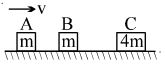
Three blocks are initially placed as shown in the figure. Block $A$ has mass $m$ and initial velocity $v$ to the right. Block $B$ with mass $m$ and block $C$ with mass $4m$ are both initially at rest. Neglect friction. All collisions are elastic. The final velocity of block $A$ is
The physical quantity $'$Energy Density$'$ has same dimensional formula as
When a certain weight is suspended from a long uniform wire, its length increases by one  $cm$. If the same weight is suspended from another wire of the same material and length  but having a diameter half of the first one, the increase in length will be ......... $cm$
The breaking stress of a wire depends on:
Three rigid rods are joined to form an equilateral triangle $\text{ABC}$ of side $1m.$ Three particles carrying charges $20\mu\text{C}$ each are attached to the vertices of the triangle. The whole system is at rest in an inertial frame. The resultant force on the charged particle at $A$ has the magnitude:
A force $F = (5\hat i + 3\hat j)$ newton is applied over a particle which displaces it from its origin to the point $r = (2\hat i - 1\hat j)$ metres. The work done on the particle is....$joules$
By a surface of a liquid we mean.
 
The escape velocity from the earth is about $11$ km/second. The escape velocity from a planet having twice the radius and the same mean density as the earth, is  ......... $km/sec$
If $T$ is the reverberation time of an auditorium of volume $V$ then
The rise of a liquid in a capillary tube depends on