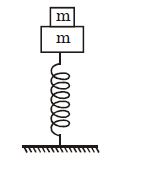
A block of mass $m$ is at rest on an another block of same mass as shown in figure. Lower block is attached to the spring, then the maximum amplitude of motion so that both the block will remain in contact is
Medium


Download our appand get started for free
Experience the future of education. Simply download our apps or reach out to us for more information. Let's shape the future of learning together!No signup needed.*
Similar Questions
- 1A particle has simple harmonic motion. The equation of its motion is $x = 5\sin \left( {4t - \frac{\pi }{6}} \right)$, where $x$ is its displacement. If the displacement of the particle is $3$ units, then it velocity isView Solution
- 2The equation of $SHM$ is given as:View Solution
$x = 3\,sin\, 20\pi t + 4\, cos\, 20\pi t$ ,
where $x$ is in $cms$ and $t$ is in $seconds$ . The amplitude is ..... $cm$
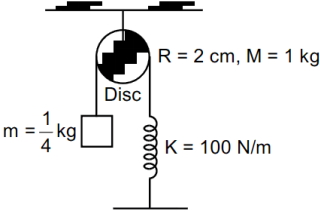
- 3View SolutionFor the system given below, find the angular frequency of oscillation ?
- 4The equation of $S.H.M.$ is $y = a\sin (2\pi nt + \alpha )$, then its phase at time $t$ isView Solution
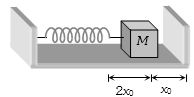
- 5One end of a spring of force constant k is fixed to a vertical wall and the other to a block of mass m resting on a smooth horizontal surface. There is another wall at a distance ${x_0}$ from the black. The spring is then compressed by $2{x_0}$ and released. The time taken to strike the wall isView Solution
- 6Assume that the earth is a solid sphere of uniform density and a tunnel is dug along its diameter throughout the earth. It is found that when a particle is released in this tunnel, it executes a simple harmonic motion. The mass of the particle is $100 g$. The time period of the motion of the particle will be (approximately) (take $g =10\,ms ^{-2}$, radius of earth $=6400\,km$ )View Solution
- 7A $S.H.M.$ is represented by $x = 5\sqrt 2 (\sin 2\pi t + \cos 2\pi t).$ The amplitude of the $S.H.M.$ is .... $cm$View Solution
- 8A block is placed on a horizontal plank. The plank is performing $SHM$ along a vertical line with amplitude of $40\,cm.$ The block just loses contact with the plank when the plank is momentarily at rest. Then :View Solution
- 9View SolutionThe equation of simple harmonic motion may not be expressed as (each term has its usual meaning)
- 10View SolutionIn a simple harmonic oscillator, at the mean position