The equation of $S.H.M.$ is $y = a\sin (2\pi nt + \alpha )$, then its phase at time $t$ is
Easy
Download our app for free and get started
(c) $y = a\sin (2\pi nt + \alpha )$. Its phase at time $t = 2\pi nt + \alpha $

Download our appand get started for free
Experience the future of education. Simply download our apps or reach out to us for more information. Let's shape the future of learning together!No signup needed.*
Similar Questions
- 1A particle executes simple harmonic oscillation with an amplitude $a.$ The period of oscillation is $T.$ The minimum time taken by the particle to travel half of the amplitude from the equilibrium position isView Solution
- 2A particle is placed at the lowest point of a smooth wire frame in the shape of a parabola, lying in the vertical $xy-$ plane having equation $x^2 = 5y$ $(x, y$ are in meter). After slight displacement, the particle is set free. Find angular frequency of oscillation.....$rad/s$ (in $rad/sec$ ) (take $g = 10\ m/s^2$ )View Solution
- 3The displacement of a particle from its mean position (in metre) is given by $y = 0.2\sin (10\pi t + 1.5\pi )\cos (10\pi t + 1.5\pi )$. The motion of particle isView Solution
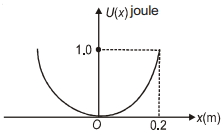
- 4A particle of mass $4 \,kg$ moves simple harmonically such that its $P E(U)$ varies with position $x$, as shown. The period of oscillations is ............View Solution
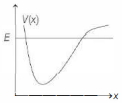
- 5Consider a one-dimensional potential $V(x)$ as shown in the figure below. A classical particle of mass $m$ moves under its influence and has total energy $E$ as shown below. The motion isView Solution
- 6The equation of motion of a particle is $x = a\,cos (\alpha\, t)$ . The motion isView Solution
- 7On the superposition of two harmonic oscillations represented by ${x_1} = a\,\sin \,\left( {\omega t + {\phi _1}} \right)$ and ${x_2} = a\,\sin \,\left( {\omega t + {\phi _2}} \right)$ a resulting oscillation with the same time period and amplitude is obtained. The value of ${\phi _1} - {\phi _2}$ is .... $^o$View Solution
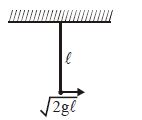
- 8A simple pendulum having length $\ell $ is having speed $\sqrt {2g\ell }$ at bottom most point of its trajectory. Its motion will beView Solution
- 9View SolutionIf a body is released into a tunnel dug across the diameter of earth, it executes simple harmonic motion with time period
- 10A simple harmonic motion having an amplitude $A$ and time period $T$ is represented by the equation : $y = 5 \sin \pi (t + 4) m$View Solution
Then the values of $A$ (in $m$) and $T$ (in $sec$) are :