A block of mass $m$ is having two similar rubber ribbons attached to it as shown in the figure. The force constant of each rubber ribbon is $K$ and surface is frictionless. The block is displaced from mean position by $x\,cm$ and released. At the mean position the ribbons are underformed. Vibration period is
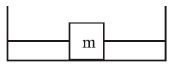
Medium


Download our appand get started for free
Experience the future of education. Simply download our apps or reach out to us for more information. Let's shape the future of learning together!No signup needed.*
Similar Questions
- 1If $x=5 \sin \left(\pi t+\frac{\pi}{3}\right) \mathrm{m}$ represents the motion of a particle executing simple harmonic motion, the amplitude and time period of motion, respectively, areView Solution
- 2silver atom in a solid oscillates in simple harmonic motion in some direction with a frequency of $10^{12} /sec$. What is the force constant of the bonds connecting one atom with the other? ................ $\mathrm{N/m}$ (Mole wt. of silver $= 108 $ andAvagadro number $= 6.02 \times 10^{23}$ $gm \ mole^{ -1}$ )View Solution
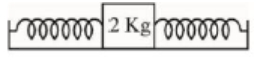
- 3A block of mass $2\,kg$ is attached with two identical springs of spring constant $20\,N / m$ each. The block is placed on a frictionless surface and the ends of the springs are attached to rigid supports (see figure). When the mass is displaced from its equilibrium position, it executes a simple harmonic motion. The time period of oscillation is $\frac{\pi}{\sqrt{x}}$ in SI unit. The value of $x$ is $..........$View Solution
- 4A function is represented by equation$y = A\,\cos \,\omega t\,\cos \,2\omega t + A\,\sin \,\omega t\,\sin \,2\omega t$.View Solution
Than the nature of the function is - 5When the potential energy of a particle executing simple harmonic motion is one-fourth of its maximum value during the oscillation, the displacement of the particle from the equilibrium position in terms of its amplitude $a$ isView Solution
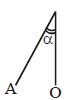
- 6Time period of a simple pendulum is $T$. The angular displacement for amplitude is $\beta$. How much time the bob of pendulum will take to move from equilibrium position $O$ to $A$, making an angle $\alpha$ at the supportView Solution
- 7If $A$ is the area of cross-section of a spring $L$ is its length $E$ is the Young's modulus of the material of the spring then time period and force constant of the spring will be respectivelyView Solution
- 8The time period of a simple pendulum of length $L$ as measured in an elevator descending with acceleration $\frac{g}{3}$ isView Solution
- 9View SolutionWhich of the following statements is not true ? In the case of a simple pendulum for small amplitudes the period of oscillation is
- 10The displacement $x$ (in metre) of a particle in, simple harmonic motion is related to time t (in seconds) asView Solution
$x = 0.01\cos \left( {\pi \,t + \frac{\pi }{4}} \right)$
The frequency of the motion will be