The displacement $x$ (in metre) of a particle in, simple harmonic motion is related to time t (in seconds) as
$x = 0.01\cos \left( {\pi \,t + \frac{\pi }{4}} \right)$
The frequency of the motion will be
Easy
Download our app for free and get started
(a) Comparing given equation with standard equation, $x = a\cos \,(\omega t + \phi )$
we get, $a = 0.01$ and $\omega = \pi $
$ \Rightarrow 2\pi n = \pi \Rightarrow n = 0.5\,Hz$

Download our appand get started for free
Experience the future of education. Simply download our apps or reach out to us for more information. Let's shape the future of learning together!No signup needed.*
Similar Questions
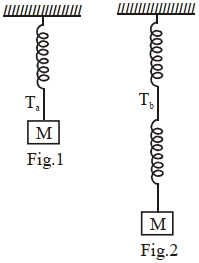
- 1Consider two identical springs each of spring constant $k$ and negligible mass compared to the mass $M$ as shown. Fig. $1$ shows one of them and Fig. $2$ shows their series combination. The ratios of time period of oscillation of the two $SHM$ is $\frac{ T _{ b }}{ T _{ a }}=\sqrt{ x },$ where value of $x$ isView Solution
(Round off to the Nearest Integer)
- 2Two particles are executing $SHM$ in a straight line. Amplitude $'A'$ and time period $'T'$ of both the particles are equal. At time $t = 0$ one particle is at displacement $x_1 = +A$ and other at ${x_2} = \frac{{ - A}}{2}$ and they are approaching towards each other. Time after which they will cross each other isView Solution
- 3A particle executes $S.H.M$ between $x =\, -A$ to $x =\, +A$ . The time taken for it in going from $0$ to $A/2$ is $T_1$ and from $A/2$ to $A$ is $T_2$. ThenView Solution
- 4The length of a seconds pendulum is .... $cm$View Solution
- 5$Assertion :$ In $SHM$, acceleration is always directed towards the mean position.View Solution
$Reason :$ In $SHM$, the body has to stop momentary at the extreme position and move back to mean position. - 6The phase of a particle executing simple harmonic motion is $\frac{\pi }{2}$ when it hasView Solution
- 7The equation of motion of a particle is $x = a\,cos (\alpha\, t)$ . The motion isView Solution
- 8The mass of a particle is $1\,\,kg$ and it is moving along $x-$ axis. The period of its small oscillation is $\frac {\pi }{2}$ . Its potential energy may beView Solution
- 9A pendulume clock loses $12\;s$ a day if the temperature is $40^oC$ and gains $4\;s$ a day if the temperature is $20^oC$. The temperature at which the clock will show correct time, and the coeffecient of linear expansion $(\alpha)$ of the metal of the pendulum shaft are respectivelyView Solution
- 10A particle moves such that its acceleration $a$ is given by $a = - bx$, where $x$ is the displacement from equilibrium position and b is a constant. The period of oscillation isView Solution