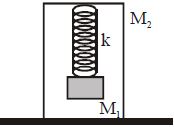
$A$ block of mass $M_1$ is hanged by a light spring of force constant $k$ to the top bar of a reverse Uframe of mass $M_2$ on the floor. The block is pooled down from its equilibrium position by $a$ distance $x$ and then released. Find the minimum value of $x$ such that the reverse $U$ -frame will leave the floor momentarily.
Medium


Download our appand get started for free
Experience the future of education. Simply download our apps or reach out to us for more information. Let's shape the future of learning together!No signup needed.*
Similar Questions
- 1Two simple harmonic motion, are represented by the equations ${y}_{1}=10 \sin \left(3 \pi {t}+\frac{\pi}{3}\right)$View Solution
$y_{2}=5(\sin 3 \pi t+\sqrt{3} \cos 3 \pi t)$
Ratio of amplitude of ${y}_{1}$ to ${y}_{2}={x}: 1$. The value of ${x}$ is ...... .
- 2A particle doing simple harmonic motion, amplitude $= 4\, cm$, time period $= 12\, sec$. The ratio between time taken by it in going from its mean position to $2 \,cm$ and from $2\, cm$ to extreme position isView Solution
- 3A particle is subjected to two mutually perpendicular simple harmonic motions such that its $x$ and $y$ coordinates are given by ?View Solution
$ x = 2 \sin \omega t \,;$ $ y = 2 \sin \left( {\omega t + \frac{\pi }{4}} \right)$
The path of the particle will be :
- 4The position, velocity and acceleration of a particle executing simple harmonic motion are found to have magnitudes of $4 \mathrm{~m}, 2 \mathrm{~ms}^{-1}$ and $16 \mathrm{~ms}^{-2}$ at a certain instant. The amplitude of the motion is $\sqrt{\mathrm{x}} \mathrm{m}$ where $\mathrm{x}$ is. . . . . . .View Solution
- 5A particle of unit mass is moving along the $x$-axis under the influence of a force and its total energy is conserved. Four possible forms of the potential energy of the particle are given in column $I$ (a and $U _0$ are constants). Match the potential energies in column $I$ to the corresponding statement$(s)$ in column $II.$View Solution
column $I$ column $II$ $(A)$ $U _1( x )=\frac{ U _0}{2}\left[1-\left(\frac{ x }{ a }\right)^2\right]^2$ $(P)$ The force acting on the particle is zero at $x = a$. $(B)$ $U _2( x )=\frac{ U _0}{2}\left(\frac{ x }{ a }\right)^2$ $(Q)$ The force acting on the particle is zero at $x=0$. $(C)$ $U _3( x )=\frac{ U _0}{2}\left(\frac{ x }{ a }\right)^2 \exp \left[-\left(\frac{ x }{ a }\right)^2\right]$ $(R)$ The force acting on the particle is zero at $x =- a$. $(D)$ $U _4( x )=\frac{ U _0}{2}\left[\frac{ x }{ a }-\frac{1}{3}\left(\frac{ x }{ a }\right)^3\right]$ $(S)$ The particle experiences an attractive force towards $x =0$ in the region $| x |< a$. $(T)$ The particle with total energy $\frac{ U _0}{4}$ can oscillate about the point $x=-a$. - 6The angular velocity and the amplitude of a simple pendulum is $\omega $ and $a$ respectively. At a displacement $X$ from the mean position if its kinetic energy is $T$ and potential energy is $V$, then the ratio of $T$ to $V$ isView Solution
- 7If $A$ is the area of cross-section of a spring $L$ is its length $E$ is the Young's modulus of the material of the spring then time period and force constant of the spring will be respectivelyView Solution
- 8A particle executes simple harmonic oscillation with an amplitude $a.$ The period of oscillation is $T.$ The minimum time taken by the particle to travel half of the amplitude from the equilibrium position isView Solution
- 9The maximum velocity of a particle, executing simple harmonic motion with an amplitude $7\ mm$, is $4.4\ m/s$. The period of oscillation is .... $sec$View Solution
- 10Two springs with spring constants ${K_1} = 1500\,N/m$ and ${K_2} = 3000\,N/m$ are stretched by the same force. The ratio of potential energy stored in spring will beView Solution