MCQ
A block slides down a smooth inclined plane when released from the top, while another falls freely from the same point
  • A
    sliding block will reach the ground first with greater speed
  • B
    freely falling block will reach the ground first with greater speed
  • C
    both the blocks will reach the ground at the same time but with different speeds
  • both the blocks will reach the ground with same speed but the freely falling block first

Answer

Correct option: D.
both the blocks will reach the ground with same speed but the freely falling block first
d
In case of sliding motion on an inclined plane,

${\mathrm{h}=\mathrm{s}=\frac{1}{2} \mathrm{g} \sin \theta \mathrm{t}^{2}}$

${\text { or } \mathrm{t}=\mathrm{t_s}=\frac{1}{\sin \theta} \sqrt{\frac{2 \mathrm{h}}{\mathrm{g}}}}$

${\text { and } \mathrm{u}_{\mathrm{s}}=\sqrt{2 \mathrm{gh}}=\sqrt{2(\mathrm{g} \sin \theta) \mathrm{s}}}$

while in case of free fall,

$\mathrm{t}_{\mathrm{F}}=\sqrt{\frac{2 \mathrm{h}}{\mathrm{g}}}$ and $\mathrm{u}_{\mathrm{F}}=\sqrt{2 \mathrm{gh}}$

$\frac{\mathrm{t}_{\mathrm{F}}}{\mathrm{t}_{\mathrm{s}}}=\sin \theta<1 \mathrm{i.e.}, \mathrm{t}_{\mathrm{F}}<\mathrm{t}_{\mathrm{s}}$

i.e., falling body reaches the ground first.

Also $\quad \frac{\mathrm{u}_{\mathrm{F}}}{\mathrm{u}_{\mathrm{s}}}=1,$ i.e., $\mathrm{u}_{\mathrm{F}}=\mathrm{u}_{\mathrm{s}}$

i.e., both reach the ground with same speed (not velocity as for falling body direction is vertical while for sliding body along the plane downwards).
Need a full question paper?

Generate a complete, print-ready paper with questions like this in minutes — across 16+ boards, with answer keys.

Start Generating Free

Similar questions

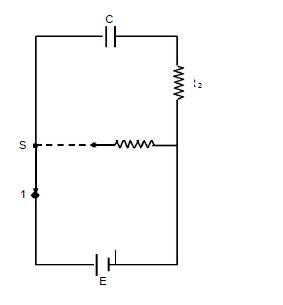
Switch $S$ of circuit shown in figure is in position $1$ for a long time. At instant $t = 0$ , it is thrown from position $1$ to $2$ . The thermal power $P_1(t)$ generated in resistance $R_1$
$3$ particles each of mass $m$ are kept at vertices of an equilateral triangle of side $L$. The gravitational field at centre due to these particles is
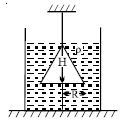
A cone of radius $R$ and height $H$, is hanging inside a liquid of density $\rho$ by means of a string as shown in the figure. The force, due to the liquid acting on the slant surface of the cone is
If $\vec{u}$ is instantaneous velocity of particle and $\vec{v}$ is velocity of wave, then
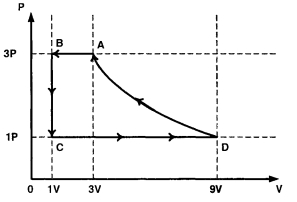
One mole of a monatomic ideal gas is taken through a cycle $ABCDA$ as shown in the $P-V$ diagram. Column $II$ gives the characteristics involved in the cycle. Match them with each of the processes qiven in Column $I$
Column $I$ Column $II$
$(A)$ Process $A \rightarrow B$ $(p)$ Internal energy decreases.
$(B)$ Process $B \rightarrow C$ $(q)$ Internal energy increases.
$(C)$ Process $C \rightarrow D$ $(r)$ Heat is lost.
$(D)$ Process $D \rightarrow A$ $(s)$ Heat is gained.
  $(t)$ Work is done on the gas.

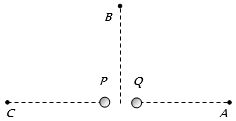
Figure here shows $P$ and $Q$ as two equally intense coherent sources emitting radiations of wavelength $20 \,m$. The separation $PQ$ is $5.0 \,m$ and phase of $P$ is ahead of the phase of $Q$ by $90^{0}$. $A, B $ and $ C$ are three distant points of observation equidistant from the mid-point of $PQ$. The intensity of radiations at $A, B, C$  will bear the ratio
Mercury violet light $(\lambda = 4558{Å})$ is falling on a photosensitive material $(\phi = 2.5eV)$. The speed of the ejected electrons is in $m{s^{ - 1}}$, about
A particle moves in the $x-y$ plane according to equation $\overrightarrow r  = (\widehat i + 2\widehat j)\, A \, \cos \omega t$. The  motion of the particle is 
A thief is running away on a straight road in jeep moving with a speed of $9$$m{s^{ - 1}}.$ A police man chases him on a motor cycle moving at a speed of $10$$m{s^{ - 1}}.$ If the instantaneous separation of the jeep from the motorcycle is $100\, m$, how long will it take for the police to catch the thief.......$s$
If $x$ longitudinal strain is produced in a wire of Young's modulus $y,$ then energy stored in the material of the wire per unit volume is