Questions · Page 1 of 16

SECTION - A [PHYSICS MCQ]

🎯

Test yourself on this topic

50 questions · timed · auto-graded

MCQ 14 Marks
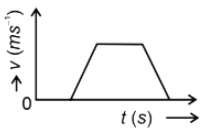
The velocity $(v)-$ time $(t)$ plot of the motion of a body is shown below:

(image)

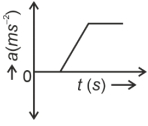
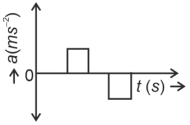
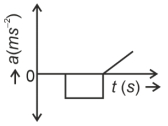
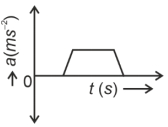
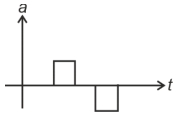
The acceleration $(a)-$ time $(t)$ graph that best suits this motion is :
  • A


  • C

  • D

Answer
Correct option: B.

b
Initially, the body has zero velocity and zero slope. Hence the acceleration would be zero initially. After that, the slope of v-t curve is constant and positive.

After some time, velocity becomes constant and acceleration is zero.

After that, the slope of v-t curve is constant and negative.
View full question & answer
MCQ 24 Marks
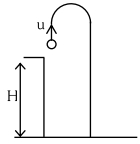
A horizontal bridge is built across a river. A student standing on the bridge throws a small ball vertically upwards with a velocity $4\,m s ^{-1}$. The ball strikes the water surface after $4\,s$. The height of bridge above water surface is $......\,m$ $\left(\right.$ Take $\left.g=10\,m s ^{-2}\right)$
  • A
    $68$
  • B
    $56$
  • C
    $60$
  • $64$
Answer
Correct option: D.
$64$
d
$S = ut +\frac{1}{2} a t^2$

$-H =4 \times 4-\frac{1}{2} \times 10 \times 4^2$

$-H =16-80$

$-H =-64$

$H =64\,m$

View full question & answer
MCQ 34 Marks
A bullet from a gun is fired on a rectangular wooden block with velocity $u$.When bullet travels $24\,cm$ through the block along its length horizontally, velocity of bullet becomes $\frac{u}{3}$. Then it further penetrates into the block in the same direction before coming to rest exactly at the other end of the block. The total length of the block is $........\,cm$
  • A
    $30$
  • $27$
  • C
    $24$
  • D
    $28$
Answer
Correct option: B.
$27$
b
By $v^2=u^2+2 a s$

$\left(\frac{u}{3}\right)^2=u^2-2 a x$

$2 a x=u^2-\frac{u^2}{9}$

$2 a x=\frac{8 u^2}{9}.........(1)$

Similarly from starting

$v^2=u^2+2 ax$

$0= u ^2-2 ax _2$

$2 ax _2= u ^2..........(2)$

$By (1) /(2)$

$\frac{ x }{ x _2}=\frac{8}{9}$

$\frac{24}{ x _2}=\frac{8}{9}$

$x _2=27\,cm$

View full question & answer
MCQ 44 Marks
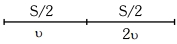
A vehicle travels half the distance with speed $v$ and the remaining distance with speed $2\,v$.Its average speed is :
  • A
    $\frac{3 v}{4}$
  • B
    $\frac{ v }{3}$
  • C
    $\frac{2 v}{3}$
  • $\frac{4 v}{3}$
Answer
Correct option: D.
$\frac{4 v}{3}$
d
$V_{a v g}=\frac{2 v_1 v_2}{v_1+v_2}=\frac{2(v)(2 v)}{v+2 v}=\frac{4 v^2}{3 v}=\frac{4 v}{3}$
View full question & answer
MCQ 54 Marks
The ratio of the distances travelled by a freely falling body in the $1^{\text {st }}, 2^{\text {nd }}, 3^{\text {rd }}$ and $4^{\text {th }}$ second :
  • A
    $1: 4: 9: 16$
  • $1: 3: 5: 7$
  • C
    $1: 1: 1: 1$
  • D
     $1: 2: 3: 4$
Answer
Correct option: B.
$1: 3: 5: 7$
b
$S _{ nth }= u +\frac{ a }{2}(2 n -1)$

$=0+\frac{ a }{2}(2 n -1)$

$S _{r th } \propto(2 n -1)$

$\Rightarrow S_{1 s }, S _{2 ed }, S _{3 ed }, S _{\text {4th }}$

$=[2(1)-1]:[2(2)-1]:[2(3)-1]:[2(4)-1]$

$=1: 3: 5: 7$

View full question & answer
MCQ 64 Marks
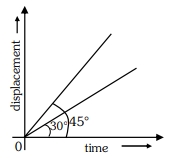
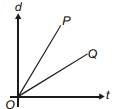
The displacement-time graphs of two moving particles make angles of $30^{\circ}$ and $45^{\circ}$ with the $x$-axis as shown in the figure. The ratio of their respective velocity is :
  • A
    $1: 1$
  • B
    $1: 2$
  • $1: \sqrt{3}$
  • D
    $\sqrt{3}: 1$
Answer
Correct option: C.
$1: \sqrt{3}$
c
Velocity is slope of $x$-t graph

$V =\frac{ dx }{ dt }=\tan \theta$

$\frac{ V _{1}}{ V _{2}}=\frac{\tan \theta_{1}}{\tan \theta_{2}}=\frac{\tan 30^{\circ}}{\tan 45^{\circ}}=\frac{1}{\sqrt{3}}$

View full question & answer
MCQ 74 Marks
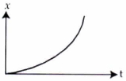
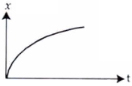
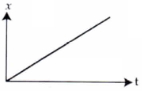
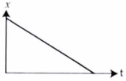
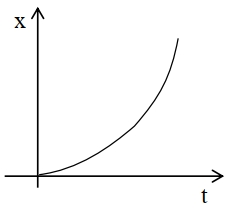
The position-time $(x-t)$ graph for positive acceleration is

  • B

  • C

  • D

Answer
Correct option: A.

a
$x=\frac{1}{2} a t^2 \quad$ (if coefficients of $t^2$ is positive $(a > 0)$ upward opening parabola)
View full question & answer
MCQ 84 Marks
A small block slides down on a smooth inclined plane, starting from rest at time $t=0 .$ Let $S_{n}$ be the distance travelled by the block in the interval $\mathrm{t}=\mathrm{n}-1$ to $\mathrm{t}=\mathrm{n} .$ Then, the ratio $\frac{\mathrm{S}_{\mathrm{n}}}{\mathrm{S}_{\mathrm{n}+1}}$ is
  • A
    $\frac{2 n-1}{2 n}$
  • $\frac{2 n-1}{2 n+1}$
  • C
    $\frac{2 n+1}{2 n-1}$
  • D
    $\frac{2 n}{2 n-1}$
Answer
Correct option: B.
$\frac{2 n-1}{2 n+1}$
b
$\frac{s_{n}}{S_{n+1}}=\frac{\frac{a}{2}(2 n-1)}{\frac{a}{2}(2(n+1)-1)}=\frac{2 n-1}{2 n+2-1}=\frac{2 n-1}{2 n+1}$
View full question & answer
MCQ 94 Marks
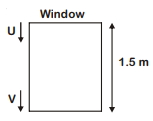
A person sitting in the ground floor of a building notices through the window, of height $1.5 \;m ,$ a ball dropped from the roof of the building crosses the window in $0.1 \;s$. What is the velocity (In $m/s$) of the ball when it is at the topmost point of the window $?\left( g =10\, m / s ^{2}\right)$
  • A
    $20$
  • B
    $15.5$
  • $14.5$
  • D
    $4.5$
Answer
Correct option: C.
$14.5$
c
From equation of motion

$S = ut +\frac{1}{2} at ^{2}$

$1.5= u (0.1)+\frac{1}{2} \times 10(0.1)^{2}$

$1.5=(0.1) u +0.05$

$u =15-0.5$

$\quad=14.5 m / s$

View full question & answer
MCQ 104 Marks
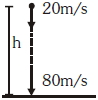
A ball is thrown vertically downward with a velocity of $20\; m / s$ from the top of a tower. It hits the ground after some time with a velocity of $80\, m / s$. The helght of the tower is $......m$ : $\left( g =10\, m / s ^{2}\right)$
  • $300$
  • B
    $360$
  • C
    $340$
  • D
    $320$
Answer
Correct option: A.
$300$
a
$v^{2}=u^{2}+2 g h$

$80^{2}=20^{2}+2 \times 10 h$

$h =300 m$

View full question & answer
MCQ 114 Marks
Preeti reached the metro station and found that the escalator was not working. She walked up the stationary escalator in time $t_1$ . On other days, if she remains stationary on the moving escalator, then the escalator takes her up in time $t_2$. The time taken by her to walk up on the moving escalator will be 
  • A
    $\frac{{{t_1}{t_2}}}{{{t_2} - {t_1}}}$
  • $\;\frac{{{t_1}{t_2}}}{{{t_2} + {t_1}}}$
  • C
    ${t_1} - {t_2}$
  • D
    $\frac{{{t_1} + {t_2}}}{2}$
Answer
Correct option: B.
$\;\frac{{{t_1}{t_2}}}{{{t_2} + {t_1}}}$
b
$\begin{array}{l}
Let\,{v_1}\,is\,the\,velocity\,of\,preeti\,on\,stationary\,escalator\,and\,\\
d\,is\,the\,{\rm{distance}}\,travelled\,bt\,her\\
\therefore \,{v_1} = \frac{d}{{{t_1}}}\\
Again\,let\,{v_2}\,is\,the\,velocity\,of\,escalator\,\\
\therefore \,{v_2} = \frac{d}{{{t_2}}}
\end{array}$

$\begin{array}{l}
\therefore \,Net\,velocity\,of\,preeti\,on\,moving\,escalator\,with\,respect\,\\
to\,the\,ground\,\\
\,\,\,\,\,\,\,\,\,\,\,v = {v_1} + {v_2} = \frac{d}{{{t_1}}} + \frac{d}{{{t_2}}} = d\left( {\frac{{{t_1} + {t_2}}}{{{t_t}{t_2}}}} \right)\\
The\,time taken by her to walk up on the moving escalatror will be\\
\,\,\,\,\,\,t = \frac{d}{v} = \frac{d}{{d\left( {\frac{{{t_1} + {t_2}}}{{{t_1}{t_2}}}} \right)}} = \frac{{{t_1}{t_2}}}{{{t_1} + {t_2}}}
\end{array}$

View full question & answer
MCQ 124 Marks
Two cars $P$ and $Q$ start from a point at the same time in a straight line and their positions are represented by $ x_p(t)=at+bt^2 $ and $x_Q(t)= ft- t^2$. At what time do the cars have the same velocity $?$ 
  • A
    $\frac{{a + f}}{{2\left( {1 + b} \right)}}$
  • $\;\frac{{f - a}}{{2\left( {1 + b} \right)}}$
  • C
    $\;\frac{{a + f}}{{\left( {1 + b} \right)}}$
  • D
    $\;\frac{{a + f}}{{2\left( {b - 1} \right)}}$
Answer
Correct option: B.
$\;\frac{{f - a}}{{2\left( {1 + b} \right)}}$
b
$\begin{array}{l}
\,\,\,Position\,of\,car\,P\,at\,any\,time\,t,\,is\\
\,\,{x_p}\left( t \right) = at + b{t^2}\\
\,\,{v_p}\left( t \right) = \frac{{d{x_p}\left( t \right)}}{{dt}} = a + 2bt\,\,\,\,\,\,\,\,\,\,\,\,\,\,\,\,\,\,\,\,\,\,\,\,\,\,\,...\left( i \right)\\
{\rm{Similarly}},\,for\,car\,Q,\\
\,\,\,\,\,\,\,\,\,\,\,\,\,{x_Q}\left( t \right) = ft - {t^2}\\
\,\,\,\,\,\,\,\,\,\,\,\,\,{v_Q}\left( t \right) = \frac{{d{x_q}\left( t \right)}}{{dt}} = f - 2t\,\,\,\,\,\,\,\,\,\,\,\,\,\,\,\,\,\,...\left( {ii} \right)\\
\,\,\,\,\,\,\,\,\,\,{v_p}\left( t \right) = {v_Q}\left( t \right)\,\,\,\,\,\,\,\,\,\,\,\,\,\,\,\,\,\,\,\,\,\,\,\,\,\,\,\,\,\,\,\,\,\,\,\,\left( {Given} \right)\\
\therefore \,\,\,\,\,\,\,\,\,\,\,a + 2bt = f - 2t\,or,\,2t\left( {b + 1} \right) = f - a\\
\therefore \,\,\,\,\,\,\,\,\,\,\,\,t = \frac{{f - a}}{{2\left( {1 + b} \right)}}\,
\end{array}$
View full question & answer
MCQ 134 Marks
If the velocity of a particle is $v =At+ Bt^2$ ,where $A$ and $B$ are constants, then the distance travelled by it between $1\, s$ and $2\, s$ is
  • A
    $3A+7B$
  • $\frac{3}{2}A + \frac{7}{3}B$
  • C
    $\frac{A}{2} + \frac{B}{3}$
  • D
    $\;\frac{3}{2}A + 4B$
Answer
Correct option: B.
$\frac{3}{2}A + \frac{7}{3}B$
b
$V=\alpha t+\beta t^{2}$

$\frac{ ds }{ dt }=\alpha t +\beta t ^{2}$

$\int_{s_{1}}^{s_{2}} d s=\int_{1}^{2}\left(\alpha t+\beta t^{2}\right) d t$

$S_{2}-S_{1}=\left[\frac{\alpha t^{2}}{2}+\frac{\beta t^{3}}{3}\right]_{1}^{2}$

As particle is not changing direction So distance $=$ displacement.

Distance $=\left[\frac{\alpha[4-1]}{2}+\frac{\beta[8-1]}{3}\right]$

$=\frac{3 \alpha}{2}+\frac{7 \beta}{3}$

View full question & answer
MCQ 144 Marks
Two bodies starts moving from same point along a straight line with velocities $v_1=6 \,m / s$ and $v_2=10 \,m / s$, simultaneously. After what time their separation becomes $40 \,m$ is ........ $s$
  • A
    $6$
  • B
    $8$
  • C
    $12$
  • $10$
Answer
Correct option: D.
$10$
d
(d)

$s_{ rel }=u_{ rel } t+\frac{1}{2} a_{ rel } t^2$

$a_{ rel }=0$

$\Rightarrow 40=(10-6) \times t$

$\Rightarrow \frac{40}{4}=t \Rightarrow t=10 \,s$

View full question & answer
MCQ 154 Marks
Two trains each of length $100 \,m$ moving parallel towards each other at speed $72 \,km / h$ and $36 \,km / h$ respectively. In how much time will they cross each other is ..........
  • A
    $4.5$
  • $6.67$
  • C
    $3.5$
  • D
    $7.25$
Answer
Correct option: B.
$6.67$
b
(b)

When two trains are moving in opposite direction then

$v_{\text {rel }}=(20+10)=30 \,ms ^{-1}$

$t=\frac{200}{30}=6.67 \,s$

View full question & answer
MCQ 164 Marks
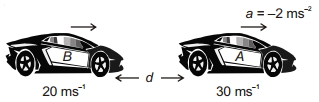
Two cars $A$ and $B$ are moving in same direction with velocities $30 \,m / s$ and $20 \,m / s$. When car $A$ is at a distance $d$ behind the car $B$, the driver of the car $A$ applies brakes producing uniform retardation of $2 \,m / s ^2$. There will be no collision when ......... $m$
  • A
    $d < 2.5$
  • B
    $d > 125$
  • $d > 25$
  • D
    $d < 125$
Answer
Correct option: C.
$d > 25$
c
(c)

$v^2=u^2+2 a d$

$\Rightarrow 0=(10)^2-2 \times 2 \times d_{ rel }$

$\Rightarrow \frac{100}{4} \leq d_{ rel }$

$\Rightarrow d_{ rel } \geq 25 \,m$

View full question & answer
MCQ 174 Marks
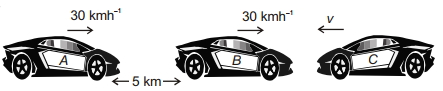
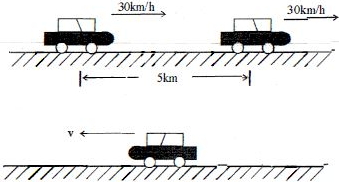
Two cars are moving in the same direction with a speed of $30 \,km / h$. They are separated from each other by $5 \,km$. Third car moving in the opposite direction meets the two cars after an interval of $4$ minutes. The speed of the third car is .......... $km / h$
  • A
    $30$
  • B
    $25$
  • C
    $40$
  • $45$
Answer
Correct option: D.
$45$
d
(d)

The distance of $5 km$ is in between $A$ and $B$ is covered by $C$ in 4 minute with relative velocity $(v+30)$.

So, $d_{\text {rel }}=v_{\text {rel }} \times t$

$\Rightarrow 5 \,km =(v+30) \times \frac{4}{60}$

$\Rightarrow 75 \,kmh ^{-1}=v+30$

$\Rightarrow v=45 \,kmh ^{-1}$

View full question & answer
MCQ 184 Marks
Two balls are projected upward simultaneously with speeds $40 \,m / s$ and $60 \,m / s$. Relative position $(x)$ of second ball w.r.t. first ball at time $t=5 s$ is .......... $m$ [Neglect air resistance].
  • A
    $20$
  • B
    $80$
  • $100$
  • D
    $120$
Answer
Correct option: C.
$100$
c
(c)

$S_{ rel }=U_{ rel } t+\frac{1}{2} a_{ rel } t^2$

$\Rightarrow S_{ rel }=(60-40) 5 \quad\left(a_{ rel }=0\right)$

$\Rightarrow S_{ rel }=100 \,m$

View full question & answer
MCQ 194 Marks
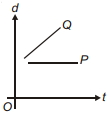
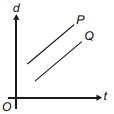
Which one of the following time-displacement graph represents two moving objects $P$ and $Q$ with zero relative velocity?
  • A


  • C

  • D

Answer
Correct option: B.

b
(b)

Zero relative velocity means that both of them have same slope.

View full question & answer
MCQ 204 Marks
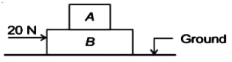
Blocks shown in figure moves with constant velocity $10 \,m / s$ towards right. All surfaces in contact are rough. The friction force applied by ground on block $B$ is ........ $N$
  • A
    $0$
  • $20$
  • C
    $10$
  • D
    Insufficient data
Answer
Correct option: B.
$20$
b
(b)

Given that:

velocity of blocks $=10\,ms ^{-1}$

Friction force between $B$ and $A=20\,N$.

As we know,

Force $=$ mass $\times$ acceloration

So, Friction force between the block $B$ and the ground is zero as acceleration of the blocks is zero as they are moving with constant velocity.

View full question & answer
MCQ 214 Marks
An elevator car whose floor to ceiling distance is $27\,m$ starts ascending with a constant acceleration of $1.2\,m / s ^2$. After $2\,s$ of the start, a bolt falls from the ceiling of the car. The free fall time of the bolt is $\left(g=9.8\,m / s ^2\right)$
  • A
    $\sqrt{\frac{2.7}{9.8}}\,s$
  • B
    $\sqrt{\frac{5.4}{9.8}}\,s$
  • C
    $\sqrt{\frac{5.4}{8.6}}\,s$
  • $\sqrt{\frac{5.4}{11}}\,s$
Answer
Correct option: D.
$\sqrt{\frac{5.4}{11}}\,s$
d
(d)

Relative to lift

$u_r =0$

$a_r =(9.8+1.2)=11\,m / s ^2$

$s_r =\frac{1}{2} a_r t^2$

$2.7 =\frac{1}{2} \times 11 \times t^2$

or $t=\sqrt{\frac{5.4}{11}}\,s$

View full question & answer
MCQ 224 Marks
A particle is dropped from rest and another particle is thrown downward simultaneously with initial speed $u$, then
  • A
    Time after which their separation becomes $h$, is $\frac{h}{u}$
  • B
    Their relative velocity is always $u$
  • C
    Their relative acceleration is always zero
  • All of these
Answer
Correct option: D.
All of these
d
View full question & answer
MCQ 234 Marks
On a foggy day, two drivers spot each other when $80\, m$ apart. They were travelling at $70\, km/h$ and $60\, km/h$. Both apply brakes simultaneously which retard the cars at the rate of $5\, ms^{-2}$. Which of the following statements is correct ?
  • The collision will be averted
  • B
    The collision will take place
  • C
    They will cross each other
  • D
    They will just collide
Answer
Correct option: A.
The collision will be averted
a
$70 \mathrm{km}$ to $\mathrm{m} / \mathrm{s} \rightarrow\left(70 \times \frac{5}{18}\right)$

$60 \mathrm{km}$ to $\mathrm{m} / \mathrm{s} \rightarrow\left(60 \times \frac{5}{18}\right)$

$V_{A B}=\left(V_{A}-V_{B}\right)=\frac{5}{18}[70+60]=\left(\frac{5}{18} \times 130\right)$

$a_{A B}=\left(a_{A}-a_{B}\right)=-(5+5)=-10 m / s^{2}$

$v^{2}=u^{2}+2 a s$

$o=u^{2}-2 \times 80 \times 10$

$u^{2} \leqslant 800 \times 2=1600$ (To revert collision)

$1304.0 \leqslant 1600$

View full question & answer
MCQ 244 Marks
A person walks up a stalled escalator in $90 s$. When just standing on the same moving escalator, he is carried in $60 s$. The time it would take him to walk up the moving escalator will be $.......\,s$
  • A
    $27$
  • B
    $50$
  • C
    $18$
  • $36$
Answer
Correct option: D.
$36$
d
(d)

$v_1=\frac{s}{90}, v_2=\frac{s}{60}$

Now,

$t=\frac{s}{v_1+v_2}=\frac{s}{\frac{s}{90}+\frac{s}{60}}$

$=\frac{90 \times 60}{90+60}=36\,s$

View full question & answer
MCQ 254 Marks
A $100\,m$ long train crosses a man travelling at $5\,km / h$, in opposite direction, in $7.2\,s$, then the velocity of train is $..........\,km/h$
  • A
    $40$
  • B
    $25$
  • C
    $20$
  • $45$
Answer
Correct option: D.
$45$
d
(d)

$7.2=\frac{100}{(v+5)(5 / 18)}$

or

$v=45\,km / h$

View full question & answer
MCQ 264 Marks
Two trains are moving with equal speed in opposite directions along two parallel railway tracks. If the wind is blowing with speed $u$ along the track so that the relative velocities of the trains with respect to the wind are in the ratio of $1:2$, then the speed of each train must be
  • $3u$
  • B
    $2u$
  • C
    $4u$
  • D
    $u$
Answer
Correct option: A.
$3u$
a
Let the speed of trains be $x$

$\therefore \frac{x-u}{x+u}=\frac{1}{2}$ or $2 x-2 u=x+u$

or $x=3 u$

View full question & answer
MCQ 274 Marks
Two cars get closer by $8\,m$ every second while travelling in the opposite directions. They get closer by $0.8\,m$ in every second while travelling in the same direction. What are the speeds of the two cars ?
  • A
    $4\,ms^{-1}$ and $4.4\,ms^{-1}$
  • $4.4\,ms^{-1}$ and $3.6\,ms^{-1}$
  • C
    $4\,ms^{-1}$ and $3.6\,ms^{-1}$
  • D
    $4\,ms^{-1}$ and $3\,ms^{-1}$
Answer
Correct option: B.
$4.4\,ms^{-1}$ and $3.6\,ms^{-1}$
b
In opposite direction speed will add

$v_1+v_2=8 / 1=8$

In same direction they subtract

$v_1-v_2=0.8 / 1=0.8$

From both eqn,

${v}_1=4.4$

${v}_2=3.6$

View full question & answer
MCQ 284 Marks
What are the speeds of two objects if, when they move uniformly towards each other, they get $4\,m$ closer in each second and when they move uniformly in the same direction with the original speeds, they get $4.0\,m$ closer each $10\,s$ ?
  • A
    $2.8\,m / s$ and $1.2\,m / s$
  • B
    $5.2\,m / s$ and $4.6\,m / s$
  • C
    $3.2\,m / s$ and $2.1\,m / s$
  • $2.2\,m / s$ and $2.8\,m / s$
Answer
Correct option: D.
$2.2\,m / s$ and $2.8\,m / s$
d
(d)

$v_A+v_B=4\,m / s$ and $v_A-v_B=\frac{4.0}{10}=0.4\,m / s$

View full question & answer
MCQ 294 Marks
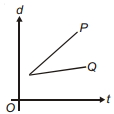
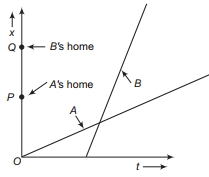
Figure shows the position-time $(x-t)$ graph of the motion of two boys $A$ and $B$ returning from school $O$ to their homes $P$ and $Q$ respectively. Which of the following statements is true?
  • A
    $A$ walks faster than $B$
  • B
    Both $A$ and $B$ reach home at the same time
  • C
    $B$ starts for home earlier than $A$
  • $B$ overtakes $A$ on his way to home
Answer
Correct option: D.
$B$ overtakes $A$ on his way to home
d
(d)

Slope of $B$ is more. Therefore, speed of $B$ will be more.

View full question & answer
MCQ 304 Marks
Two cars $A$ and $B$ are moving with same speed of $45\,km/h$ along same direction. If a third car $C$ coming from the opposite direction with a speed of $36\,km/h$ meets two cars in an interval of $5\,min,$ the distance of separation of two cars $A$ and $B$ should be.......$km$
  • $6.75$
  • B
    $7.25$
  • C
    $5.55$
  • D
    $8.35$
Answer
Correct option: A.
$6.75$
a
${V_{rel.}}\, = \,45\, + \,36\, = \,81\,\,km/h$

$S\, = \,{V_{rel.}}\, \times \,t\,\, = \,81\,\, \times \,\frac{5}{{60}}\, = \frac{{81}}{{12}} = 6.75\,\,\,km$

View full question & answer
MCQ 314 Marks
A body is moving with uniform velocity of $8\,ms ^{-1}$. When the body just crossed another body, the second one starts and moves with uniform acceleration of $4\,m / s ^2$. The time after which two bodies meet, will be $...........\,s$
  • A
    $2$
  • $4$
  • C
    $6$
  • D
    $8$
Answer
Correct option: B.
$4$
b
(b)

Displacements of both should be equal. Or,

$8 t=\frac{1}{2} \times 4 \times t^2$ or $t=4\,s$

View full question & answer
MCQ 324 Marks
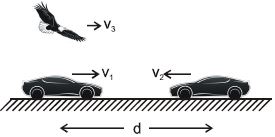
A bird flies to and fro between two cars which move with velocity $v_1 = 20\, m/s$ and $v_2 = 30\, m/s$. If the speed of the bird is $v_3 = 10\, m/s$ and the initial distance of  separation between them is $d = 2\, km$, find the total distance covered by the bird till  the cars meet.........$m$
  • A
    $2000$
  • B
    $1000$
  • $400$
  • D
    $200$
Answer
Correct option: C.
$400$
c
Time to meet the cars $: t=\frac{d}{v_{1}+v_{2}}$

Distance travelled by bird in this time

$s=v_{3} t=\frac{v_{3} d}{v_{1}+v_{2}}=\frac{10 \times 2000}{(20+30)}=400 m$

View full question & answer
MCQ 334 Marks
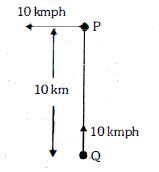
There are two particles $P$ and $Q$ separated by distance $10\ km$ and moving with velocities $10\ kmph$ as shown on a smooth horizontal surface. The time elapsed before they come at minimum separation is.........$hr$
  • A
    $1$
  • $0.5$
  • C
    $0.25$
  • D
    $2$
Answer
Correct option: B.
$0.5$
b
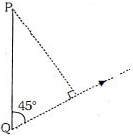
Diagram shows relative path of $\mathrm{Q}$ w.r.t. $\mathrm{P}$

$t=\frac{10 \cos 45}{10 \sqrt{2}}$

View full question & answer
MCQ 344 Marks
Two cars are moving in the same direction with a speed of $30\ kph$ . They are separated from each other by $5\ km$ . Third car moving in the opposite direction meets the two cars after an interval of $4\ minutes$ . What is the speed of the third car ?..........$km/h$
  • A
    $30$
  • B
    $35$
  • C
    $40$
  • $45$
Answer
Correct option: D.
$45$
d
Using relative speed of third car, we have

$v+30=\frac{5}{\left(\frac{4}{60}\right)}$

$\Rightarrow v+30=\frac{5 \times 60}{4}=75$

$\Rightarrow v=75-30=45 \mathrm{km} / \mathrm{h}$

View full question & answer
MCQ 354 Marks
A block is thrown with a velocity of $2 ms^{^{-1}}$ (relative to ground) on a belt, which is moving with velocity $4 ms^{^{-1}}$ in opposite direction of the initial velocity of block. If the block stops slipping on the belt after $4 \,\,sec$ of the throwing then choose the correct statements (s)
  • A
    Displacement with respect to ground is zero in $8/3 \,\,sec$.
  • B
    Magnitude of displacement with respect to ground in $4\,\, sec$ is $4 \,\,m$.
  • C
    Magnitude of displacement with respect to belt in $4\,\, sec$ is $12\,\, m$.
  • All of the above
Answer
Correct option: D.
All of the above
d
Let belt is moving towards left $(4 \mathrm{m} / \mathrm{s})$ and initial velocity of block is towards right $(2\;m/s)$. Now let us assume everthing wrt belt velocity of block will be $6\; \mathrm{m} / \mathrm{s}$ towards right and final velocity will be zero. So acceleration is

$1.5 m / s^{2}$

because time taken to stop wrt belt is $4\; sec$. Distance travelled wrt belt is

$S=6 \times 4-\frac{1}{2} \times 1.5 \times 4^{2}=12$

Distance travelled by belt in that time is

$4 \times 4=16$

Now taking direction of movement of belt as positive . Displacement wrt to belt is - $12 \mathrm{m}$. Displacement wrt ground is $(-12+16=4)=4 \mathrm{m}$

Also displacement wrt ground will be zero when

$S=6 \times t-\frac{1}{2} \times 1.5 \times t^{2}-4 \times t=0$

$\Rightarrow t=\frac{8}{3}$

View full question & answer
MCQ 364 Marks
A body is thrown up in a lift with a velocity $u$ relative to the lift and the time of flight is found to be $ t.$ The acceleration with which the lift is moving up is
  • A
    $\frac{{u - gt}}{t}$
  • $\frac{{2u - gt}}{t}$
  • C
    $\frac{{u + gt}}{t}$
  • D
    $\frac{{2u + gt}}{t}$
Answer
Correct option: B.
$\frac{{2u - gt}}{t}$
b
velocity of lift $v_{r e l}=u$

acceleration due to gravity $a_{g}=-g$ relative acceleration

$a_{r e l}=-g-a$ $t_{r e l}=\frac{2 u}{g+a}$

$a=\frac{2 u-g t}{t}$

View full question & answer
MCQ 374 Marks
Two trains one of length $100 \,m$ and another of length $125\, m$, are moving in mutually opposite directions along parallel lines, meet each other, each with speed $10$$m/s$. If their acceleration are $0.3$$m/{s^2}$ and $0.2$$m/{s^2}$ respectively, then the time they take to pass each other will be.........$s$
  • A
    $5$
  • $10$
  • C
    $15$
  • D
    $20$
Answer
Correct option: B.
$10$
b
(b) Relative velocity of one train w.r.t. other

$=10+10=20m/s.$

Relative acceleration $=0.3+0.2=0.5 m/s^2$

If trains cross each other then from $s = ut + \frac{1}{2}a{t^2}$

$As,\;s = {s_1} + {s_2}$$ = 100 + 125 = 225$

==> $225 = 20t + \frac{1}{2} \times 0.5 \times {t^2}$ ==> $0.5{t^2} + 40t - 450 = 0$

==> $t = - \frac{{40 \pm \sqrt {1600 + 4.(005) \times 450} }}{1}$$ = - 40 \pm 50$

$\therefore t = 10\sec $ (Taking +ve value).

View full question & answer
MCQ 384 Marks
An express train is moving with a velocity $v_1$. Its driver finds another train is moving on the same track in the same direction with velocity $v_2$. To escape collision, driver applies a retardation a on the train. the minimum time of escaping collision will be
  • $t = \frac{{{v_1} - {v_2}}}{a}$
  • B
    ${t_1} = \frac{{v_1^2 - v_2^2}}{2}$
  • C
    None
  • D
    Both
Answer
Correct option: A.
$t = \frac{{{v_1} - {v_2}}}{a}$
a
(a) As the trains are moving in the same direction. So the initial relative speed $({v_1} - {v_2})$ and by applying retardation final relative speed becomes zero.

From $v = u - at$ $⇒$ $0 = ({v_1} - {v_2}) - at$ $⇒$ $t = \frac{{{v_1} - {v_2}}}{a}$

View full question & answer
MCQ 394 Marks
A boat moves with a speed of $5 \,km/h $ relative to water in a river flowing with a speed of $3 \,km/h$ and having a width of $1 \,km$. The minimum time taken around a round trip is.........$min$
  • A
    $5$
  • B
    $60 $
  • C
    $20$
  • $30 $
Answer
Correct option: D.
$30 $
d
(d) For the round trip he should cross perpendicular to the river

$\therefore $Time for trip to that side $ = \frac{{1km}}{{4km/hr}} = 0.25\,hr$

To come back, again he take $0.25$ hr to cross the river.
Total time is $30\, min$, he goes to the other bank and come back at the same point.

View full question & answer
MCQ 404 Marks
The distance between two particles is decreasing at the rate of $6 \,m/sec$. If these particles travel with same speeds and in the same direction, then the separation increase at the rate of $4 \,m/sec$. The particles have speeds as
  • $5\, m/sec ; 1\, m/sec$
  • B
    $4 \,m/sec ; 1\, m/sec$
  • C
    $4\, m/sec ; 2 \,m/sec$
  • D
    $5 \,m/sec ; 2\, m/sec$
Answer
Correct option: A.
$5\, m/sec ; 1\, m/sec$
a
(a)  When two particles moves towards each other then ${v_1} + {v_2} = 6$...(i)

When these particles moves in the same direction then ${v_1} - {v_2} = 4$...(ii)

By solving ${v_1} = 5$ and ${v_2} = 1\;m/s$

View full question & answer
MCQ 414 Marks
A train of $150 $ meter length is going towards north direction at a speed of $10m/\sec $. A parrot flies at the speed of $5\,\,m/\sec $ towards south direction parallel to the railway track. The time taken by the parrot to cross the train is........$sec$
  • A
    $12$
  • B
    $8$
  • C
    $15 $
  • $10 $
Answer
Correct option: D.
$10 $
d
(d) Relative velocity $ = 10 + 5 = 15\;m/sec$

$\therefore  t = \frac{{150}}{{15}} = 10\;sec$

View full question & answer
MCQ 424 Marks
A police jeep is chasing with, velocity of $45\, km/h$ a thief in another jeep moving with velocity $153\, km/h$. Police fires a bullet with muzzle velocity of $180 \,m/s$. The velocity it will strike the car of the thief is........$m/s$
  • $150 $
  • B
    $27$
  • C
    $450$
  • D
    $250 $
Answer
Correct option: A.
$150 $
a
(a) Effective speed of the bullet = speed of bullet + speed of police jeep

$ = 180\;m/s + 45\;km/h = (180 + 12.5)\;m/s = 192.5\;m/s$

Speed of thief ’s jeep $ = 153\,km/h = 42.5m/s$

Velocity of bullet w.r.t thief ’s car $ = 192.5 - 42.5$

$=150\,m/s$

View full question & answer
MCQ 434 Marks
A $120\, m$ long train is moving in a direction with speed $20 \,m/s$. $A$ train $B$ moving with $30\, m/s$ in the opposite direction and $130\, m$ long crosses the first train in a time
  • A
    $6\,s$
  • B
    $36 \,s$
  • C
    $38 \,s$
  • None of these
Answer
Correct option: D.
None of these
d
(d) Total distance $ = 130 + 120 = 250\;m$

Relative velocity $ = 30 - ( - 20) = 50\;m/s$

Hence $t = 250/50 = 5s$

View full question & answer
MCQ 444 Marks
Ball $A$ is thrown up vertically with speed $10 \,m / s$. At the same instant another ball $B$ is released from rest at height h. At time $t$, the speed of $A$ relative to $B$ is ...........
  • $10 \,m / s$
  • B
    $10-2 g t$
  • C
    $\sqrt{10^2-2 g h}$
  • D
    $10-g t$
Answer
Correct option: A.
$10 \,m / s$
a
(a)

$v_A=10 \,ms ^{-1}-10 t$

$v_B=0-10 t$

$v_{A B}=v_A-v_B=10-(10 t)-(-10 t)=10-10 t+10 t=0$

$\Rightarrow v_{A B}=10 \,ms ^{-1}$

View full question & answer
MCQ 454 Marks
A body is dropped from a certain height $h$ ( $h$ is very large) and second body is thrown downward with velocity of $5 \,m / s$ simultaneouly. What will be difference in heights of the two bodies after $3 \,s$ is ....... $m$
  • A
    $5$
  • B
    $10$
  • $15$
  • D
    $20$
Answer
Correct option: C.
$15$
c
(c)

$u_{\text {rel }}=u_1-u_2=0-(-5)=5 ms ^{-1}$

$t=3 \,s$

$a_{ rel }=a_1-a_2=-g-(-g)=0 \,ms ^{-2}$

$s_{ rel }=u_{ rel } t+\frac{1}{2} a_{ rel } t^2$

$\Rightarrow s_{ rel }=5 \times 3=15 \,m \quad\left(\because a_{ rel }=0\right)$

So, $s_{\text {rel }}=15 \,m$

View full question & answer
MCQ 464 Marks
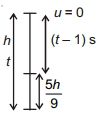
A stone dropped from the top of a tower is found to travel $\left(\frac{5}{9}\right)$ of the height of the tower during the last second of its fall. The time of fall is ....... $s$
  • A
    $2$
  • $3$
  • C
    $4$
  • D
    $5$
Answer
Correct option: B.
$3$
b
(b)

Let the total height of tower $=H$

Total time of journey $=t$

Time taken to cover the $\frac{5 h}{9}$ is = last second

So, $s_t-s_{t-1}=\frac{5 h}{9}$

$\Rightarrow \frac{1}{2} g t^2-\frac{1}{2} g(t-1)^2=\frac{5}{9} \times \frac{1}{2} g t^2$ $\left[\because h=\frac{1}{2} g t^2\right]$

$\Rightarrow \frac{1}{2} g\left(t^2-t^2-1+2 t\right)=\frac{1}{2} g t^2 \times \frac{5}{9}$

$\Rightarrow (2 t-1)=\frac{5}{9} t^2$

$\Rightarrow 18 t-9=5 t^2$

$\Rightarrow 5 t^2-18 t+9=0$

$\Rightarrow 5 t^2-15 t-3 t+9=0$

$\Rightarrow 5 t(t-3)-3(t-3)=0$

$\Rightarrow(5 t-3)(t-3)=0$

$t=\frac{3}{5}, t=3 s \quad\left(t=\frac{3}{5}\right.$, doesn't satisfy the given criterion, so we neglect it)

View full question & answer
MCQ 474 Marks
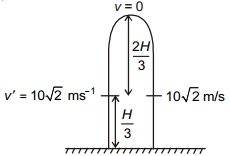
When a particle is thrown vertically upwards, its velocity at one third of its maximum height is $10 \sqrt{2}\,m / s$. The maximum height attained by it is .......... $m$
  • A
    $20 \sqrt{2}$
  • B
    $30$
  • $15$
  • D
    $12.8$
Answer
Correct option: C.
$15$
c
(c)

$v^2-u^2=-2 g \times \frac{2 H}{3}$

$\Rightarrow-100 \times 2=-2 \times 10 \times \frac{2 H}{3}$

$\Rightarrow H=15 \,m$

View full question & answer
MCQ 484 Marks
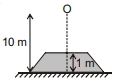
A body falling from a vertical height of $10 \,m$ pierces through a distance of $1 \,m$ in sand. It faces an average retardation in sand equal to ( $g$ = acceleration due to gravity)
  • A
    $g$
  • $9 g$
  • C
    $100 g$
  • D
    $1000 g$
Answer
Correct option: B.
$9 g$
b
(b)

If the ball is dropped then $x=0$, the velocity with which it will hit the sand will be given by

$v^2-u^2=2(-g)(-9)$

$v^2-0=18 g$

$v^2=18 g$

Now on striking sand, the body penetrates into sand for $1 m$ and comes to rest. So, $v \rightarrow$ initial for sand and final velocity $=0$

$v^{\prime 2}-v^2=2(a) \times(-1)$

$\Rightarrow -18 g=-2 a$

$\Rightarrow a=9 g$

View full question & answer
MCQ 494 Marks
A ball dropped from the top of tower falls first half height of tower in $10 \,s$. The total time spend by ball in air is ......... $s$ [Take $g=10 \,m / s ^2$ ]
  • $14.14$
  • B
    $15.25$
  • C
    $12.36$
  • D
    $17.36$
Answer
Correct option: A.
$14.14$
a
(a)

$\frac{-H}{2}=u t-\frac{1}{2} g \times 10^2$

$\Rightarrow H=g \times 10^2$

$\Rightarrow -H=-\frac{1}{2} g t^2 \quad$ (Full joumey)

$g \times 10^2=\frac{1}{2} g t^2$

$\Rightarrow t^2=200$

$\Rightarrow t=10 \sqrt{2} s$

$\Rightarrow t=10 \times 1.414 s$

$=14.14 s =t$

View full question & answer
MCQ 504 Marks
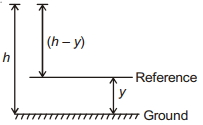
A ball is dropped from a height $h$ above ground. Neglect the air resistance, its velocity $(v)$ varies with its height above the ground as
  • $\sqrt{2 g(h-y)}$
  • B
    $\sqrt{2 g h}$
  • C
    $\sqrt{2 g y}$
  • D
    $\sqrt{2 g(h+y)}$
Answer
Correct option: A.
$\sqrt{2 g(h-y)}$
a
(a)

$v=\sqrt{2 g(h-y)}$

View full question & answer
SECTION - A [PHYSICS MCQ] - JEE STD 11 Science Questions - Vidyadip