Question
A body is moved along a closed loop. Is the work done in moving the body necessarily zero? If not, state the condition under which work done over a closed path is always zero.

Answer

Work done by a body moving along closed loop can be zero if only conservative force acting on the body during motion. Work done by a body moving along a loop is not zero if any non-conservative force, i.e., frictional, electrostatic, magnetic force are acting on body.

Need a full question paper?

Generate a complete, print-ready paper with questions like this in minutes — across 16+ boards, with answer keys.
Start Generating Free

Similar questions

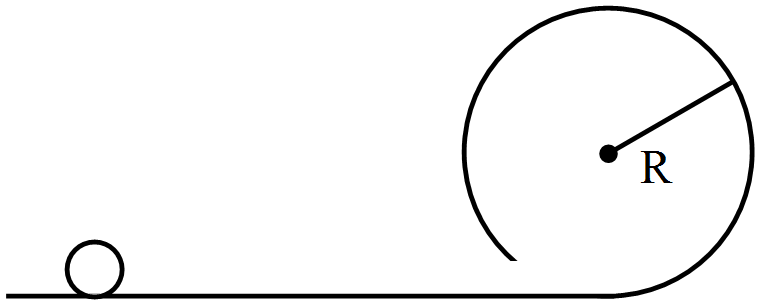
Figure shows a rough track, a portion of which is in the form of a cylinder of radius R. With what minimum linear speed should a sphere of radius r be set rolling on the horizontal part so that it completely goes round the circle on the cylindrical part.
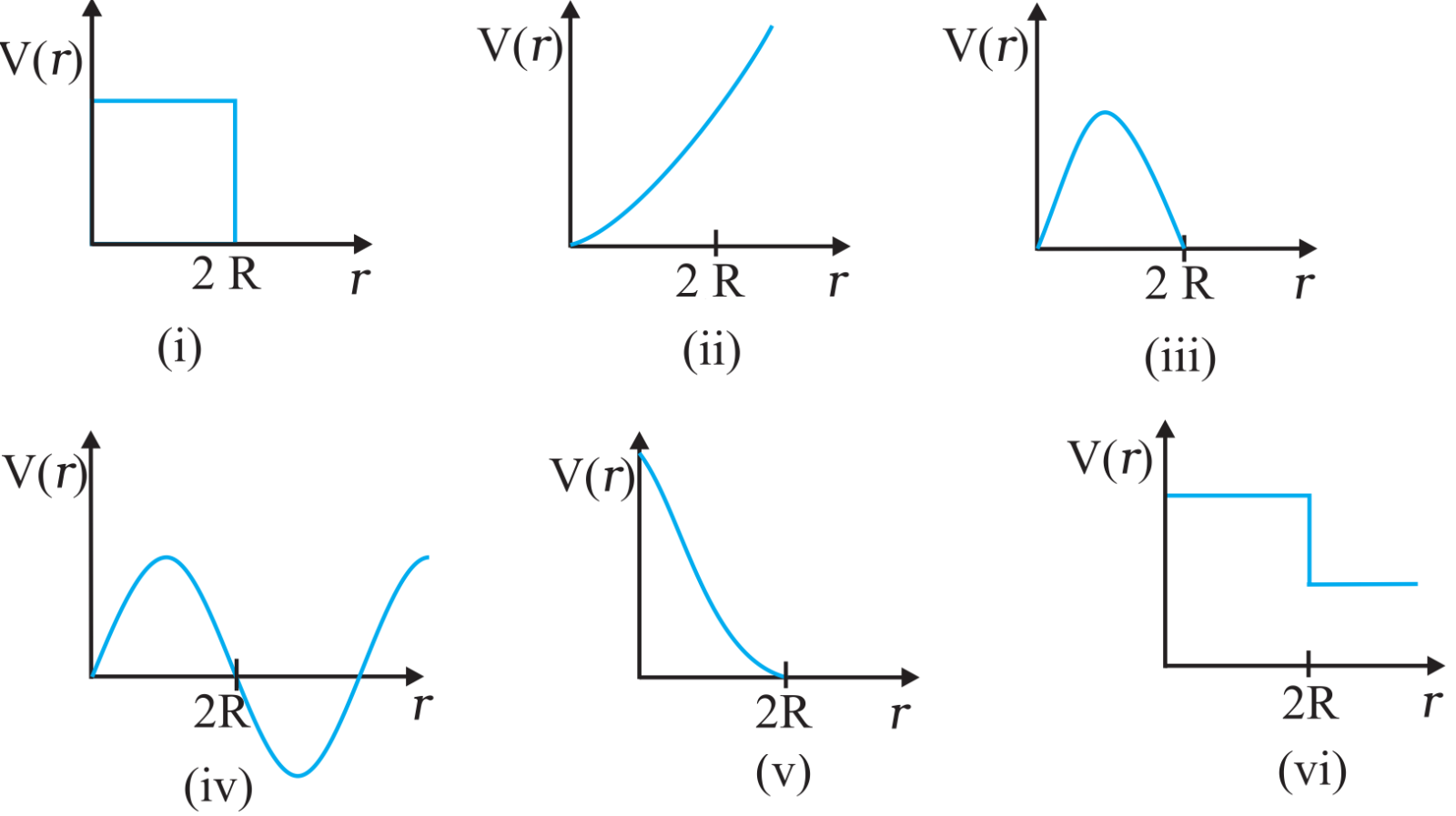
Which of the following potential energy curves in cannot possibly describe the elastic collision of two billiard balls? Here r is the distance between centres of the balls.
When an apple falls from a tree what happens to its gravitational potential energy just as it reaches the ground? After it strikes the ground?
A liquid drop of diameter 4mm breaks into 1000 droplets of equal size. Calculate the resultant change in surface energy, the surface tension of the liquid is 0.07Nm".
In the relation $\text{p}=\Big(\frac{\text{a}}{\text{b}}\Big)^{\text{e}^{-\Big(\frac{\text{az}}{\theta}\Big)}},\text{p}$ is the pressure, Z is the distance, and is the temperature. What is the dimensional formula of p?
If the velocity of light (c), the constant of gravitation (G) and Planck's constant (h) be chosen as the fundamental units, find the dimensions of mass, length and time in the new system.
Suppose we have 12 protons and 12 neutrons. We can assemble them to form either a :uMg nucleus or two 12C nuclei. In which of the two cases more energy will be liberated?
A progressive and a stationary wave have frequency $300Hz$ and the same wave velocity $360m/s.$ Calculate.
  1. The phase difference between two points on the progressive wave which are $0.4m$ apart,
  2. The equation of motion of progressive wave if its amplitude is $0.02m$,
  3. The eugation of the stationary wave if its amplitude is $0.01m$ and
  4. The distance between consecutive nodes in the stationary wave.
In a test experiment on a model aeroplane in a wind tunnel, the flow speeds on the upper and lower surfaces of the wing are $70 \mathrm{~m} \mathrm{~s}^{-1}$ and $63 \mathrm{~m} \mathrm{~s}^{-1}$ respectively. What is the lift on the wing if its area is $2.5 \mathrm{~m}^2$ ? Take the density of air to be $1.3 \mathrm{~kg} \mathrm{~m}^{-3}$.
Find the ratio of the linear momenta of two particles of masses 1.0kg and 4.0kg if their kinetic energies are equal.